-
Glass Fused To Steel Tanks (719)
-
Stainless Steel Tanks (434)
-
Fusion Bonded Epoxy Tanks (592)
-
Galvanized Steel Tanks (321)
-
Aluminum Dome Roofs (1336)
-
Wastewater Storage Tanks (237)
-
Welded Steel Tanks (457)
-
Pressure Vessels (295)
-
Anaerobic Digester (202)
-
Industrial Water Tanks (349)
-
Glass Lined Steel Tanks (180)
-
Bolted Steel Tanks (389)
-
Sludge Storage Tank (115)
-
Biogas Storage Tank (173)
-
Leachate Storage Tanks (133)
-
Agricultural Water Storage Tanks (179)
-
Fire Water Tank (166)
-
Grain Storage Silos (146)
-
Biogas Projects (424)
-
Wastewater Treatment Projects (1420)
-
Double Membrane Roof (223)


|
Customized Biogas Storage Tanks Exporter: Engineering to the Plant, Not to a Catalogue
| Place of Origin: | China |
| Brand Name: | CEC TANKS |
| Certification: | ISO 9001:2008, AWWA D103 , OSHA , BSCI |
| Model Number: | W201609013 |
| Minimum Order Quantity: | 1set |
| Price: | $5000~$20000 one set |
| Packaging Details: | PE poly-foam between each two steel plates ; wooden pallet and wooden box |
| Delivery Time: | 0-60 days after deposit received |
| Payment Terms: | L/C,T/T |
| Supply Ability: | 60 sets per month |
|
Detail Information |
|||
| Place of Origin | China | Brand Name | CEC TANKS |
|---|---|---|---|
| Certification | ISO 9001:2008, AWWA D103 , OSHA , BSCI | Model Number | W201609013 |
| Coating Thickness: | 0.25mm~0.40mm & Double Coating | Adhesion: | 3,450N/cm |
| Service Life: | ≥30 Years | Holiday Test: | >1500v |
| Elastic: | Same As Steel Sheet ,around 500KN /mm | Capacity: | 20 M3 To 18,000 M3 |
| Highlight: | customized biogas storage tanks exporter,glass fused steel biogas tanks,engineered biogas storage plant tanks |
||
Product Description
Customized Biogas Storage Tanks Exporter: Engineering to the Plant, Not to a Catalogue
Biogas plants are built around a feedstock that exists locally, a consumption pattern set by a local heat or grid contract, and a climate that is specific to the site. Those three inputs mean that two plants of nominally identical output rarely want the same storage vessel. A catalogue approach resolves this by offering standard sizes and letting the project adapt, and the adaptation usually shows up later as flaring, engine trips or a holder that cannot be maintained without shutting the whole plant down. Customisation in this context is not a luxury finish; it is the difference between a vessel that fits the process and one the process has to work around.
Shijiazhuang Zhengzhong Technology Co., Ltd. (Center Enamel) exports bolted glass-fused-to-steel biogas vessels to more than one hundred countries and has delivered single-tank capacities up to 32,000 cubic metres. Because the vessels are bolted, customisation happens at the engineering stage rather than at a premium - the plates are the same, and what changes is the geometry, the penetration layout and the safety and gas handling provisions.
1. What Actually Drives a Biogas Storage Design?
Six parameters determine the vessel, and only one of them is volume. A quotation prepared from volume alone will be wrong in ways that only appear during commissioning.
- Production and Consumption Profiles: Hourly gas production against hourly consumption is the primary input. The buffer must absorb the largest sustained mismatch, not the average one.
- Operating Pressure Envelope: Low-pressure membrane storage and higher-pressure rigid storage use very different fractions of geometric volume, so the pressure range changes the required tank size materially.
- Feedstock and Gas Composition: Hydrogen sulphide content, moisture and temperature affect material selection, condensate provisions and whether desulphurisation is upstream of storage.
- Climate and Regulatory Conditions: Ambient temperature range, wind, seismic and snow loading change the structural design and insulation, while local pressure equipment rules, hazardous area classification and the site safety philosophy determine the safety devices and the certification route.
- Expansion Strategy: If a second phase is planned, the vessel and the gas manifold should be arranged so that capacity can be added without taking the plant offline.
2. What Can Be Customised, Practically?
On a bolted vessel, almost everything outside the plate itself is configurable. The constraint is lead time for specialist bought-in items, not the tank, so early decisions on those items protect the schedule.
- Geometry: Diameter and height are set independently within structural limits, so the vessel can be proportioned to the available footprint or to a preferred aspect ratio for mixing.
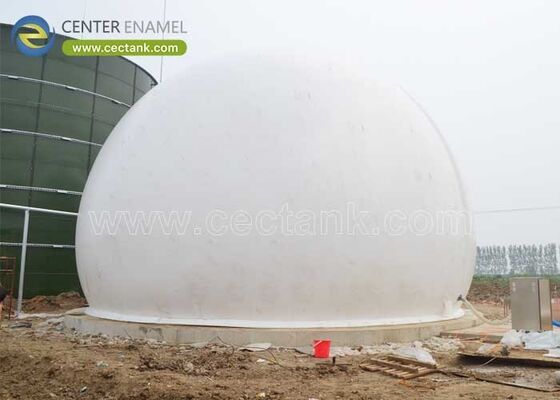
- Storage Type: Double-membrane roof on the digester, a separate membrane holder, or a rigid vessel with a geodesic aluminum dome, each with its own pressure and maintenance characteristics.
- Penetration Layout: Gas inlet and outlet, condensate drain, pressure and level instrumentation, sample points, inspection openings and relief device connections, all positioned to the plant layout.
- Safety and Gas Handling: Pressure-vacuum relief, flame arrestors, condensate traps, gas analyser connections and, where required, desulphurisation integration.
- Finish and Accessories: External colour, insulation and cladding, ladders, platforms, handrails, walkways and lighting provisions to match site standards.
3. What Should an Exporter Confirm Before Production Starts?
Customisation shifts risk toward the interface between what the buyer assumed and what the exporter assumed. A short confirmation list agreed before production removes most of that risk, and it costs nothing compared with a change after the plates are rolled.
- Design Basis in Writing: Feedstock analysis, gas composition, production and consumption profiles, target pressure range and site conditions, all documented and signed off.
- Applicable Code and Certification: AWWA D103-09 or EN 1090 and the Eurocodes, plus any local pressure equipment or hazardous area requirement, confirmed before engineering begins.
- Battery Limits: A clear statement of where the exporter's supply ends - typically at the tank flange - so that gas piping, electrical work and civil works are unambiguously allocated.
- Documentation Language and Format: Drawings, manuals and certificates in the agreed language, with the format the buyer's engineering team needs for their own approvals.
- Verification Hold Points: Agreed inspection stages, whether the buyer or a third party attends, and which certificates are issued at each hold point.
| Customisation Area | What Is Configured | Why It Matters |
|---|---|---|
| Geometry | Diameter and height set independently | Fits the footprint and the preferred mixing aspect ratio |
| Storage type | Membrane roof, separate holder or rigid dome | Sets pressure envelope and maintenance strategy |
| Penetrations | Gas, condensate, instrument and relief connections | Must match the plant layout and be formed in the factory |
| Safety provisions | Pressure-vacuum relief, flame arrestors, condensate traps | Determines whether the system fails safe in both directions |
| Documentation | Language, format and inspection hold points | Decides how smoothly the package clears site approvals |
Engineering Assurance and Project Support
Every tank delivered by Shijiazhuang Zhengzhong Technology Co., Ltd. (Center Enamel) is engineered against AWWA D103-09 and EN 1090 with finite element verification of shell, roof and nozzle loads, fused at 820-930°C under ISO 9001 and ISO 45001 control, holiday tested at 1500 V across one hundred percent of the surface, and assembled with Grade 8.8 bolts and manufacturer-certified sealant. Biogas vessels are engineered against AWWA D103-09 and EN 1090 with finite element verification for site-specific wind and seismic cases, fused at 820-930 degrees Celsius and holiday tested at 1500 V, and delivered with gas handling provisions, pressure-vacuum relief, condensate drainage, insulation where specified and a documentation set in the agreed language.
Frequently Asked Questions (FAQ)
How long does a customised biogas tank take to deliver?
Standard manufacturing lead time is around thirty days for the vessel itself, with additional time for specialist bought-in items such as membranes, relief devices or instrumentation, and for sea freight. The schedule is usually governed by when the design basis is frozen, so early confirmation protects the delivery date more than anything else.
Does customisation increase the cost significantly?
Usually less than buyers expect, because a bolted vessel is built from standard plates and the customisation is in the engineering rather than in special tooling. The items that do carry a real premium are specialist membranes, high-specification safety devices and non-standard instrumentation.
Can a customised vessel still be expanded later?
Yes, and the expansion route should be decided at design stage. Additional courses increase height within the design envelope, additional vessels tie into the existing manifold, and bolt-on penetrations can be accommodated if the layout has been planned for them.
What information do we need to provide for a quotation?
Feedstock type and analysis, expected gas production and consumption profiles, target storage volume and pressure range, gas composition including hydrogen sulphide, site location with wind and seismic data, and the applicable code and certification requirements.