-
Glass Fused To Steel Tanks (734)
-
Stainless Steel Tanks (434)
-
Fusion Bonded Epoxy Tanks (592)
-
Galvanized Steel Tanks (321)
-
Aluminum Dome Roofs (1336)
-
Wastewater Storage Tanks (237)
-
Welded Steel Tanks (457)
-
Pressure Vessels (295)
-
Anaerobic Digester (202)
-
Industrial Water Tanks (349)
-
Glass Lined Steel Tanks (180)
-
Bolted Steel Tanks (389)
-
Sludge Storage Tank (115)
-
Biogas Storage Tank (173)
-
Leachate Storage Tanks (133)
-
Agricultural Water Storage Tanks (179)
-
Fire Water Tank (166)
-
Grain Storage Silos (146)
-
Biogas Projects (424)
-
Wastewater Treatment Projects (1430)
-
Double Membrane Roof (223)
|
Biogas Storage Tank: Roof Storage or a Separate Holder?
| Place of Origin: | China |
| Brand Name: | CEC TANKS |
| Certification: | ISO 9001:2008, AWWA D103 , OSHA , BSCI |
| Model Number: | W20161227006 |
| Minimum Order Quantity: | 1set |
| Price: | $5000~$20000 one set |
| Packaging Details: | PE poly-foam between each two steel plates ; wooden pallet and wooden box |
| Delivery Time: | 0-60 days after deposit received |
| Payment Terms: | L/C,T/T |
| Supply Ability: | 60 sets per month |
|
Detail Information |
|||
Product Description
Biogas Storage Tank: Roof Storage or a Separate Holder?
Biogas plants generate continuously and consume in steps. A digester does not stop producing because the engine is being serviced, and a boiler does not wait for a lull in production. Somewhere between the two, the plant needs a place to put gas. That place is the single decision that most affects how forgiving the plant is to operate, and it is usually settled late in the design, after the digester size has already been fixed.
There are two families of answer, and they behave very differently. Shijiazhuang Zhengzhong Technology Co., Ltd. (Center Enamel) supplies both configurations, and the choice depends less on the gas volume than on how the plant intends to run: whether it wants the buffer attached to the reactor or independent of it.
1. What Are the Options for Storing Biogas?
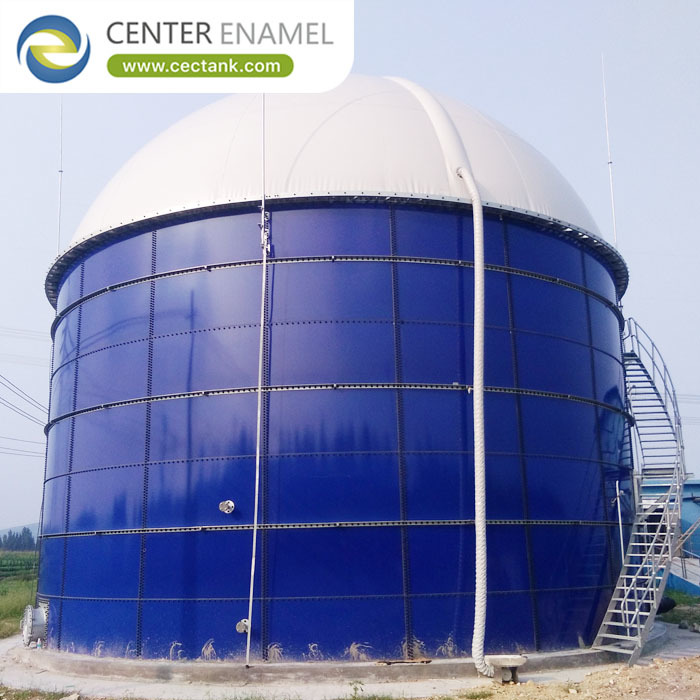
Gas can be stored in a membrane fitted on top of the digester itself, in a separate purpose-built holder, or as an integrated double-membrane roof on a storage tank. Each gives the plant different operational freedom.
- Roof-Mounted Storage: A double-membrane roof on the digester provides an integral gas space. It is compact and economical, but the buffer is tied to the vessel that produces the gas.
- Separate Gas Holder: A dedicated holder decouples storage from production. The digester can operate at a steady level while the holder absorbs the mismatch, and the holder can be maintained independently.
- Rigid versus Membrane: Rigid holders are robust and weather-tolerant; membrane holders are lighter, lower cost for a given volume, and have no sliding seal to maintain.
- Multiple Smaller Units: Several units give redundancy. Losing one holder to maintenance does not remove all of the plant's buffer, which is often worth the extra pipework.
- Pressurised Storage: Where the downstream process accepts higher pressure, storage volume can be reduced - but every increase in pressure raises the classification and the safety requirements.
2. What Pressure Does the System Actually Work At?
Biogas storage is low pressure by design, typically in the low millibar range. That constraint shapes everything else: because pressure cannot be raised at will, volume is the only way to increase stored energy, and small pressure differences matter.
- Operating Envelope: Membrane holders commonly work between roughly 5 and 30 mbar. The usable buffer is the gas that sits between the low and high set points, not the geometric volume.
- Usable versus Geometric Volume: A holder that cannot be emptied below its low set point stores less than its nameplate. Ask for the usable figure at the operating pressure range.
- Pressure Control: Gas pressure is managed by the membrane's outer air support or by a rigid holder's moving seal, with a control range set to protect both the holder and the upstream seals.
- Upstream Protection: Digester roof seals and water traps are sensitive to back pressure. The holder's pressure range must sit below the limits of everything connected to it.
- Downstream Requirements: Engines, boilers and upgrading plant each have their own inlet pressure requirement and tolerance, and the storage pressure has to sit within all of them.
3. What Safety and Control Provision Is Required?
Storing combustible gas at low pressure is safe when the arrangement is right and unforgiving when it is not. The safety devices are not optional accessories; they are what makes a low-pressure gas system workable.
- Flame Arrestment: Flame arresters on vents and on the gas line to consuming equipment prevent a flashback from reaching the stored volume.
- Over and Under Pressure Protection: A water seal or relief device protects against overpressure; a vacuum breaker protects against collapse when gas is drawn faster than it is produced.
- Venting and Stack Arrangement: Emergency and maintenance venting must discharge to a safe location, with the routing considered as part of the site's hazardous area layout.
- Gas Monitoring: Methane and hydrogen sulphide detection, plus level and pressure indication, give the operator the information needed to act before a limit is reached.
- Hazardous Area Classification: The installation is classified and equipment specified accordingly. This should be settled during design, because it affects every electrical item on the package.
| Selection Factor | Roof-Mounted Storage | Separate Gas Holder |
|---|---|---|
| Footprint | No additional plot area required | Needs dedicated space and its own foundation |
| Operational coupling | Buffer tied to the digester's operating level | Storage independent of the reactor |
| Maintainability | Maintenance means working on the digester | Can be isolated and serviced while the plant runs |
| Redundancy | Single point of storage | Multiple units can provide partial cover during maintenance |
| Cost profile | Lower capital, less flexibility | Higher capital, more operational freedom |
Engineering Assurance and Project Support
Every tank delivered by Shijiazhuang Zhengzhong Technology Co., Ltd. (Center Enamel) is engineered against AWWA D103-09 and EN 1090 with finite element verification of shell, roof and nozzle loads, fused at 820-930°C under ISO 9001 and ISO 45001 control, holiday tested at 1500 V across one hundred percent of the surface, and assembled with Grade 8.8 bolts and manufacturer-certified sealant. Biogas storage is supplied as a complete package: glass-fused-to-steel shell with an integrated double-membrane roof or a dedicated holder vessel, gas-tight construction holiday tested at 1500 V, pressure control and safety devices sized to the system, flame arresters and vacuum protection, gas monitoring and instrumentation, and documentation covering the hazardous area classification and commissioning procedure.
Frequently Asked Questions (FAQ)
Should biogas be stored on the digester roof or in a separate holder?
Roof-mounted storage is compact and economical and works well where the production and consumption profiles are closely matched. A separate holder is the better choice where the plant needs operational freedom - steady digester level, maintenance without shutdown, or redundancy through multiple units.
How much usable storage does the nameplate volume actually give?
Less than the geometric figure, because the holder cannot be drawn below its low pressure set point. Ask the supplier for the usable volume at the specified operating pressure range rather than comparing nameplate volumes, which are measured differently between designs.
What safety devices are needed on a biogas storage tank?
Flame arrestment on vents and gas lines, overpressure protection through a water seal or relief device, vacuum protection against collapse during rapid draw-off, safe vent routing, gas detection, and pressure and level indication - all specified within a hazardous area classification agreed during design.
Can a biogas storage tank be configured to our plant?
Yes. Configuration, usable volume, operating pressure range, number of units, coating grade, safety devices, instrumentation and control philosophy are all set from the plant's production and consumption profile, the downstream equipment requirements and the site's safety classification.