-
Glass Fused To Steel Tanks (734)
-
Stainless Steel Tanks (434)
-
Fusion Bonded Epoxy Tanks (592)
-
Galvanized Steel Tanks (321)
-
Aluminum Dome Roofs (1336)
-
Wastewater Storage Tanks (237)
-
Welded Steel Tanks (457)
-
Pressure Vessels (295)
-
Anaerobic Digester (202)
-
Industrial Water Tanks (349)
-
Glass Lined Steel Tanks (180)
-
Bolted Steel Tanks (389)
-
Sludge Storage Tank (115)
-
Biogas Storage Tank (173)
-
Leachate Storage Tanks (133)
-
Agricultural Water Storage Tanks (179)
-
Fire Water Tank (166)
-
Grain Storage Silos (146)
-
Biogas Projects (424)
-
Wastewater Treatment Projects (1430)
-
Double Membrane Roof (223)
|
GFS Leachate Tanks: Why Landfill Leachate Defeats Most Coatings
| Place of Origin: | China |
| Brand Name: | CEC TANKS |
| Certification: | ISO 9001:2008, AWWA D103 , OSHA , BSCI |
| Model Number: | W20160705009 |
| Minimum Order Quantity: | 1set |
| Price: | $5000~$20000 one set |
| Packaging Details: | PE poly-foam between each two steel plates ; wooden pallet and wooden box |
| Delivery Time: | 0-60 days after deposit received |
| Payment Terms: | L/C,T/T |
| Supply Ability: | 60 sets per month |
|
Detail Information |
|||
Product Description
GFS Leachate Tanks: Why Landfill Leachate Defeats Most Coatings
Landfill leachate is not one liquid, and that is the core of the problem. It is a variable, concentrated mixture whose composition shifts with the age of the landfill, the weather and the waste stream that produced it. A coating chosen against a single analysis of a young leachate can be badly wrong five years later, and by then the tank is full, the site is operating, and replacing the vessel is an emergency project rather than a purchase.
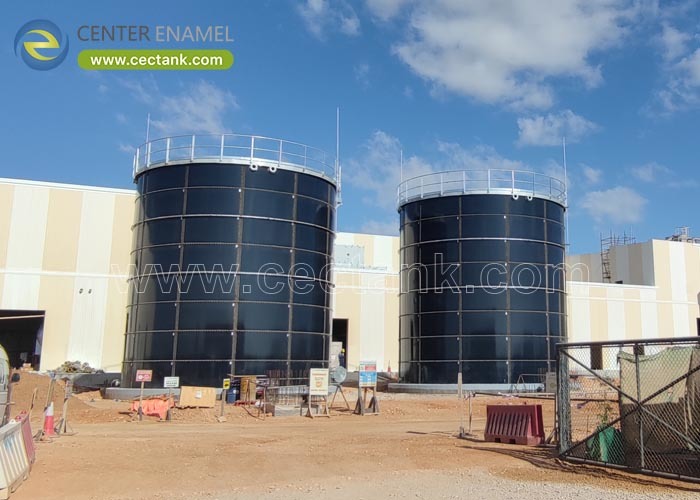
This is why leachate storage rewards a coating whose resistance does not depend on the specific chemistry of the month. Shijiazhuang Zhengzhong Technology Co., Ltd. (Center Enamel) supplies glass-fused-to-steel leachate tanks, including a 10,392 m3 installation for a Beijing leachate project delivered in 2023, engineered against the full range of conditions the site will see.
1. Why Is Leachate So Aggressive?
Leachate combines high chloride with high ammonia, a wide and shifting pH, dissolved organics and elevated temperature. Each of those attacks coatings and steel differently, and their combined effect is worse than any single factor tested alone.
- Chlorides: High chloride concentrations drive pitting and stress corrosion in stainless steel and break down many organic coatings through osmotic blistering.
- Ammonia: Free ammonia is present at concentrations that are toxic to the biology in a treatment plant and aggressive to copper and brass components in instruments and fittings.
- Variable pH: Young leachate is typically acidic; mature leachate trends neutral to slightly alkaline. A coating tolerant of only one end of that range will fail at the other.
- Dissolved Organics: High COD supports biological activity, which generates gas and sulphide and makes the vapour space corrosive in the same way a sludge tank's is.
- Temperature: Leachate from an active, degrading landfill can be warm, and elevated temperature accelerates every chemical attack mechanism operating in the tank.
2. How Does Glass-Fused-to-Steel Resist It?
A vitreous enamel layer fused to steel at 820-930 degrees Celsius is chemically inert glass, not an organic film. Its resistance does not depend on the coating being impermeable to a particular ion - it is impermeable and inert across the whole range leachate presents.
- Chemical Inertia: The fired glass surface is inert across a wide pH range, so a shift from acidic young leachate to alkaline mature leachate does not change the coating's resistance.
- Impermeability: Because the layer is glass rather than a polymer film, chloride and ammonia cannot diffuse through it to reach the steel, which removes osmotic blistering as a mechanism.
- Bond Strength: Adhesion in the region of 3450 N per square centimetre means the coating stays bonded through thermal cycling and shell movement, rather than lifting as a film would.
- Hardness and Abrasion: At around 6.0 Mohs the surface resists the grit and scale that leachate carries, and it can be cleaned without damage.
- Smoothness: A smooth surface resists scale deposition, which matters because leachate precipitates scale readily and scale underneath a coating is a failure waiting to happen.
3. What Should a Leachate Tank Specification Include?
The specification has to cover the vapour space and the seams as carefully as the immersed wall, because in leachate service those are the locations that fail first. It also has to acknowledge that the liquid will change over the life of the site.
- Coating Grade by Zone: Roof and upper courses should carry two-coat-two-fire or three-coat-three-fire, because the vapour space sees sulphide and acid. Immersed lower courses may need less.
- Seam Sealant Compatibility: Specify a sealant rated for chloride, ammonia and sulphide exposure. The coating protects the plate; the sealant protects the joint, and the joint is where leaks start.
- Gas Handling and Odour Control: Leachate generates gas and odour. Roof design, vent routing and any carbon treatment should be part of the tank scope, not a later addition.
- Mixing and Aeration Provision: Equalisation tanks need mixing to keep solids in suspension; treatment tanks may need aeration. Penetrations and supports must be designed into the shell.
- External and Splash Zone Protection: Leachate splashes, and washdown water runs down the outside of the tank. External protection should match the internal standard at the splash zone and foundation level.
| Leachate Challenge | Effect on an Ordinary Coating or Steel | GFS Response |
|---|---|---|
| High chlorides | Pitting in stainless steel, osmotic blistering under organic films | Glass layer is impermeable, so chlorides cannot reach the steel |
| High ammonia | Aggressive to metals, instruments and many organic coatings | Inert vitreous surface is unaffected across the concentration range |
| Shifting pH with landfill age | Coatings tolerant of one pH range fail at the other | Inertia holds across acidic young leachate and alkaline mature leachate |
| Sulphide in the vapour space | Acid attack concentrated at the roof and upper courses | Higher coating grade applied by zone where attack occurs |
| Grit, scale and elevated temperature | Abrasion and accelerated chemical attack | Around 6.0 Mohs hardness and a smooth surface that resists scale adhesion |
Engineering Assurance and Project Support
Every tank delivered by Shijiazhuang Zhengzhong Technology Co., Ltd. (Center Enamel) is engineered against AWWA D103-09 and EN 1090 with finite element verification of shell, roof and nozzle loads, fused at 820-930°C under ISO 9001 and ISO 45001 control, holiday tested at 1500 V across one hundred percent of the surface, and assembled with Grade 8.8 bolts and manufacturer-certified sealant. Leachate tanks are engineered with coating grade selected by zone, holiday tested at 1500 V across the full surface, fused at 820-930 degrees Celsius, supplied with chloride, ammonia and sulphide compatible sealants, gas-tight roof and odour control provisions, mixing or aeration penetrations designed into the shell, external splash zone protection, and full coating and test documentation.
"Leachate is not a liquid with a specification - it is a moving target. Choose a coating whose resistance does not depend on hitting the target."
Frequently Asked Questions (FAQ)
What pH range can a glass-fused-to-steel leachate tank handle?
The fired vitreous surface is inert across a wide pH range, which is the point: leachate moves from acidic in a young landfill toward neutral or slightly alkaline as the site matures. Rather than specify a pH window, the useful specification is the coating grade by zone and the holiday test coverage, both of which can be verified on delivery.
Is there a chloride limit for a GFS leachate tank?
The coating has no chloride limit in the way stainless steel does, because chloride cannot pass through a glass layer to reach the steel. The components that do need attention are the sealant, the flange gaskets and any metallic fittings in contact with the liquid, and those should be specified against the site's actual chloride concentration.
How is odour controlled on a leachate tank?
Odour comes from the vapour space, so control starts with a gas-tight roof and sealed penetrations, continues with a properly routed vent, and where the site is close to neighbours ends with carbon treatment or connection to the site's odour control system.
Can a leachate tank be customized to our site's analysis?
Yes. Volume, coating grade by zone, sealant selection, roof and gas handling, mixing or aeration provisions, penetrations, external protection and instrumentation are all configured to the leachate analysis, the landfill's stage and the regulatory requirements, and documented before manufacture.
Key Takeaways
- Leachate composition shifts with landfill age, so specify coating inertia rather than a pH window.
- Chlorides cannot pass through glass - the vulnerable parts are the sealant, gaskets and metallic fittings.
- The vapour space and seams fail before the immersed wall: put the higher coating grade and the compatible sealant there.
- Odour control, mixing and external splash protection are tank scope items, not later additions.