-
Glass Fused To Steel Tanks (777)
-
Stainless Steel Tanks (434)
-
Fusion Bonded Epoxy Tanks (592)
-
Galvanized Steel Tanks (321)
-
Aluminum Dome Roofs (1336)
-
Wastewater Storage Tanks (237)
-
Welded Steel Tanks (457)
-
Pressure Vessels (295)
-
Anaerobic Digester (202)
-
Industrial Water Tanks (349)
-
Glass Lined Steel Tanks (180)
-
Bolted Steel Tanks (389)
-
Sludge Storage Tank (115)
-
Biogas Storage Tank (173)
-
Leachate Storage Tanks (133)
-
Agricultural Water Storage Tanks (179)
-
Fire Water Tank (166)
-
Grain Storage Silos (146)
-
Biogas Projects (424)
-
Wastewater Treatment Projects (1470)
-
Double Membrane Roof (223)


|
20000 m3 Steel Water Storage Tanks: Engineering a Large Bolted or Welded Tank
| Place of Origin: | China |
| Brand Name: | CEC TANKS |
| Certification: | ISO 9001:2008, AWWA D103 , OSHA , BSCI |
| Model Number: | W201609013 |
| Minimum Order Quantity: | 1set |
| Price: | $5000~$20000 one set |
| Packaging Details: | PE poly-foam between each two steel plates ; wooden pallet and wooden box |
| Delivery Time: | 0-60 days after deposit received |
| Payment Terms: | L/C,T/T |
| Supply Ability: | 60 sets per month |
|
Detail Information |
|||
| Place of Origin | China | Brand Name | CEC TANKS |
|---|---|---|---|
| Certification | ISO 9001:2008, AWWA D103 , OSHA , BSCI | Model Number | W201609013 |
| Coating Thickness: | 0.25mm~0.40mm & Double Coating | Adhesion: | 3,450N/cm |
| Service Life: | ≥30 Years | Holiday Test: | >1500v |
| Elastic: | Same As Steel Sheet ,around 500KN /mm | Capacity: | 20 M3 To 18,000 M3 |
| Highlight: | 20000 m3 steel water storage tank,large bolted welded water tank,glass fused steel storage tank |
||
Product Description
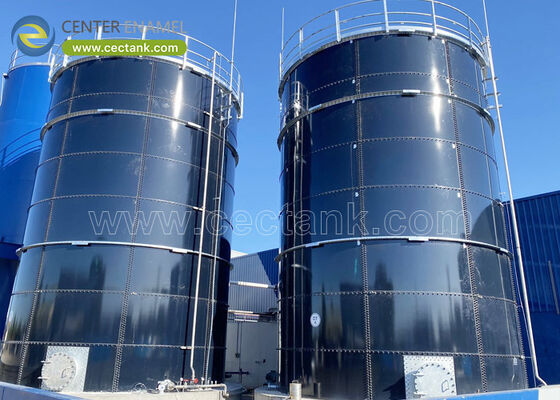
A 20000 m3 steel water storage tank is a major municipal or industrial reserve that must stay watertight for decades while cycled daily. At this volume both bolted Glass-Fused-to-Steel (GFS) and welded steel are valid, and the choice turns on site logistics and coating need. Engineered by Shijiazhuang Zhengzhong Technology Co., Ltd. (Center Enamel), a 20,000 m3 GFS tank is built from bolted panels with an inert enamel surface.
A 20,000 m3 steel water tank holds twenty million liters, enough for a mid-size municipality's buffer or an industrial process reserve. At this scale the shell height, diameter, and foundation load are the dominant design drivers, and the tank must absorb daily fill-draw cycles without fatigue at the joints or the coating.
- Volume: 20,000 m3 = 20 million liters.
- Role: Municipal buffer or process reserve.
- Cycle: Daily fill-draw, thermal change.
- Driver: Shell, foundation, and coating.
A 20,000 m3 tank is built as a large bolted GFS vessel (panels, 8.8-grade bolts, gasketed seams) or as a welded shell to API 650. Both use a fixed or geodesic-dome roof and a ring-wall or slab foundation. GFS brings an inert enamel; welded brings the familiar single-shell look with field coating.
- Bolted GFS: Panels, inert enamel, fast build.
- Welded: API 650 shell, field-applied coating.
- Roof: Cone or aluminum geodesic dome.
- Foundation: Ring wall or slab by soil.
Twenty-thousand-cubic-meter steel tanks serve city water systems, industrial complexes, and irrigation districts. They operate at ambient to 60°C, cycle through the day, and must protect water quality under cover, which is why the roof seal and the interior surface are specified together with the structure.
- Municipal: City buffer and pressure reserve.
- Industrial: Process and fire reserve.
- Irrigation: District storage.
- Quality: Covered, inert interior.
At 20,000 m3 the shell is calculated by the one-foot method to AWWA D103-09 (bolted) or API 650 (welded), with plate thickness growing toward the base to 6-40 mm. The foundation carries the full water weight plus the shell, so soil bearing sets the diameter versus height trade. The coating is chosen for the water and the climate.
- Shell: One-foot method, 6-40 mm plate.
- Foundation: Soil bearing sets D/H trade.
- Standards: D103-09 or API 650.
- Coating: GFS enamel or certified paint.
A bolted GFS 20,000 m3 tank resists corrosion and erects without heavy welding plant, which shortens the build. A limitation is that very large diameters need wide, prepared foundations and careful crane access; this boundary must be checked against the site, because a 20,000 m3 footprint is significant even when the shell is bolted.
- Advantage: Inert enamel, fast bolted build.
- Advantage: No heavy welding plant on site.
- Limitation: Large footprint needs prepared ground.
- Limitation: Crane and panel access must be planned.
The values below are the engineering checkpoints for a 20,000 m3 steel water tank. They let the designer confirm the shell, the foundation load, and the coating before steel is ordered, and they feed the hydrostatic test and the inspection record.
| Design parameter | Typical value or range | Why it matters |
|---|---|---|
| Capacity range | 500-40,000 m3 | Single-tank throughput |
| Shell plate | 6-40 mm | Hydrostatic head by elevation |
| Enamel DFT | 0.25-0.40 mm | Verified before shipment |
| Fusion temperature | 820-930 °C | Enamel bond to steel |
| Holiday test | 1500 V | Every square meter checked |
| Bolt grade | 8.8 | Field joint integrity |
| Design life | 30-50 years | With inspection plan |
| Operating temperature | 20-60 °C | Product and climate |
| Code basis | AWWA D103-09 / ISO 28765 | Design authority |
| Limitation to check | Feed pH and abrasives | Confirm in specification |
For a 20,000 m3 tank both bolted GFS and welded are in range; the table contrasts them on build, coating, and logistics so the owner can match the tank to the site and the maintenance philosophy.
| Criterion | Bolted GFS (20,000 m3) | Welded steel (20,000 m3) | Concrete (20,000 m3) | FRP (20,000 m3) |
|---|---|---|---|---|
| Build | Bolted, fast | Welded, slower | Cast in place | Not practical |
| Coating | Inert enamel | Field paint | Inherent | Resin |
| Site plant | Light crane | Welding + NDE | Heavy civil | Shop |
| Life | 30-50 years | 30-50 years | 40-60 years | N/A at scale |
| Best fit | Corrosive, modular | Generic large | Permanent civil | Small only |
Confirm soil bearing first, then set diameter versus height, choose bolted GFS or welded, and require the coating proof for your water. Shijiazhuang Zhengzhong Technology Co., Ltd. (Center Enamel) provides the shell calculation, the coating certificate, and the inspection file so a 20,000 m3 tank is engineered, not estimated.
- Step 1: Confirm soil bearing and footprint.
- Step 2: Set diameter vs height from the load.
- Step 3: Choose bolted GFS or welded API 650.
- Step 4: Require coating proof and inspection file.
A 20,000 m3 steel water tank is an engineering object, not a catalogue item. Start from the foundation, choose bolted Glass-Fused-to-Steel (GFS) or welded by site and coating need, and prove the shell and the surface before steel is cut, and the reserve will serve for its 30-50 year design life.
Yes. A 20,000 m3 Glass-Fused-to-Steel (GFS) tank is built from bolted panels and is well within the 500-40,000 m3 single-shell range, avoiding heavy welding plant on site.
AWWA D103-09 for the bolted shell, with ISO 28765 for the enamel system and, for potable use, NSF/ANSI 61 or WRAS contact approval.
Plate ranges from about 6 mm at the top courses to 40 mm near the base, sized by the one-foot method for the hydrostatic head.
A ring-wall or slab foundation sized to the soil bearing and the full water-plus-shell load; the soil condition sets the diameter versus height trade.
A GFS vitreous enamel fused at 820-930°C is inert and needs no repainting; welded tanks use a certified field coating instead.
A properly specified 20,000 m3 steel water tank is designed for a 30-50 year life with a documented inspection and maintenance plan.