-
Glass Fused To Steel Tanks (777)
-
Stainless Steel Tanks (434)
-
Fusion Bonded Epoxy Tanks (592)
-
Galvanized Steel Tanks (321)
-
Aluminum Dome Roofs (1336)
-
Wastewater Storage Tanks (237)
-
Welded Steel Tanks (457)
-
Pressure Vessels (295)
-
Anaerobic Digester (202)
-
Industrial Water Tanks (349)
-
Glass Lined Steel Tanks (180)
-
Bolted Steel Tanks (389)
-
Sludge Storage Tank (115)
-
Biogas Storage Tank (173)
-
Leachate Storage Tanks (133)
-
Agricultural Water Storage Tanks (179)
-
Fire Water Tank (166)
-
Grain Storage Silos (146)
-
Biogas Projects (424)
-
Wastewater Treatment Projects (1470)
-
Double Membrane Roof (223)

|
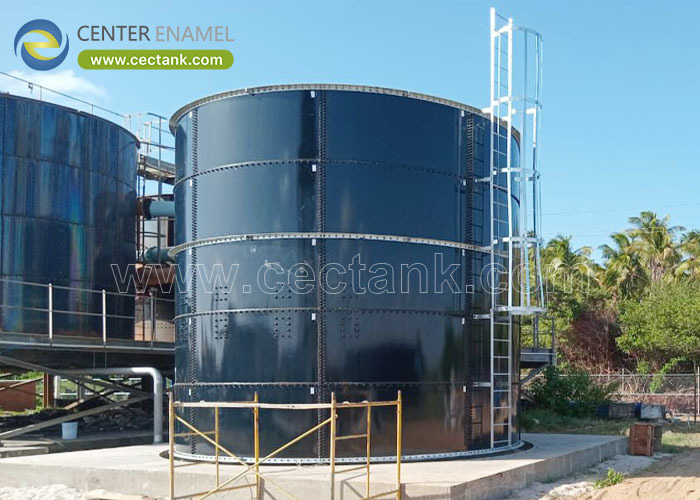
Glass-Lined Sludge Digester Tanks: GFS for Municipal Biosolids
| Place of Origin: | China |
| Brand Name: | CEC TANKS |
| Certification: | ISO 9001:2008, AWWA D103 , OSHA , BSCI |
| Model Number: | W |
| Minimum Order Quantity: | 1set |
| Price: | $5000~$20000 one set |
| Packaging Details: | PE poly-foam between each two steel plates ; wooden pallet and wooden |
| Delivery Time: | 10-30 days after deposit received |
| Payment Terms: | L/C,T/T |
| Supply Ability: | 60 sets per month |
|
Detail Information |
|||
| Place of Origin | China | Brand Name | CEC TANKS |
|---|---|---|---|
| Certification | ISO 9001:2008, AWWA D103 , OSHA , BSCI | Model Number | W |
| Tank Material: | Glass Fused To Steel | Foundation: | Concrete Or Glass Fused Steel |
| Steel Plates Thickness: | 3mm To 12mm , Depends On The Tank Structure | Size Of Panel: | 2.4M * 1.2M |
| Easy To Clean: | Smooth, Glossy, Inert, Anti-adhesion | Permeability: | Gas / Liquid Impermeable |
| Highlight: | Glass-lined sludge digester tanks,GFS municipal biosolids tanks,Glass fused to steel digester tanks |
||
Product Description
Glass-Lined Sludge Digester Tanks: GFS for Municipal Biosolids
A glass lined sludge digester tank stabilizes municipal biosolids while capturing biogas, using a vitreous enamel surface that resists the acidic, abrasive digestate. The glass lining is the Glass-Fused-to-Steel (GFS) coating fused at 820-930°C. Engineered by Shijiazhuang Zhengzhong Technology Co., Ltd. (Center Enamel), these bolted digesters give plants a corrosion-proof shell that outlasts painted steel by decades.
What a Glass-Lined Sludge Digester Tank Is
A glass lined sludge digester tank is an anaerobic reactor whose internal surface is a Glass-Fused-to-Steel (GFS) vitreous enamel fused onto steel plate. That inert lining lets the tank hold thickened sludge at 35-38°C and 20-40 day retention without the coating blistering, which is the failure mode that ends the life of a painted digester.
- Lining: Vitreous enamel, inert to digestate.
- Process: Anaerobic stabilization of biosolids.
- Temperature: Mesophilic 35-38°C is standard.
- Retention: 20-40 days for stable digestion.
Key Characteristics, Components, and Types
Municipal digesters combine a coated shell, a sealed roof, a mixing system, and a gas path. Glass lined tanks use bolted GFS panels with 8.8-grade fasteners, a fixed or domed roof, and side or submersible mixers. Capacities run from a few hundred to 40,000 m3 in a single shell.
- Shell: GFS panels, holiday-tested at 1500 V.
- Roof: Cone, geodesic dome, or double-membrane holder.
- Mixing: Side-entry or submersible at 5-15 W/m3.
- Gas: Collected at 5-30 mbar under the roof or holder.
Applications and Operating Conditions
Glass lined sludge digester tanks serve water resource recovery facilities treating municipal wastewater, and co-digestion plants adding food waste. They operate continuously, tolerate feed swings, and cut both odor and sludge volume while producing 55-65% methane biogas for plant heat and power.
- Municipal: Primary and secondary sludge digestion.
- Co-digestion: Food waste blended with sludge.
- Energy: Biogas to CHP or boiler.
- Odor: Sealed tank cuts fugitive emissions.
Technical Considerations
Sizing follows sludge volume and volatile solids, with hydraulic retention of 20-40 days and operating temperature of 35-38°C. Gas of 55-65% methane sets holder volume and 5-30 mbar pressure drives the seal. The shell is calculated to AWWA D103-09 and ISO 28765, with the enamel verified before shipment.
- Retention: 20-40 days HRT for stable gas yield.
- Temperature: Mesophilic 35-38°C default.
- Gas: 55-65% methane, trace H2S managed.
- Standards: AWWA D103-09 and ISO 28765 shell.
Advantages and Limitations
The glass lining resists acid and abrasion far better than paint, giving a 30-50 year life with little recoating. A limitation is that GFS is not the right choice where the feed pH stays below 5.5 without correction; this boundary must be checked in process design, because the lining protects the steel but cannot fix an out-of-range feed.
- Advantage: Inert lining resists digestate corrosion.
- Advantage: Bolted build is fast and modular.
- Limitation: Low pH feed needs correction first.
- Limitation: Single shell ceiling near 40,000 m3.
Design Parameters
The figures below define a sludge digester spec. They let the plant confirm the shell, the lining, and the joints before construction, and they are the evidence an insurer and a regulator expect for a digester that must run for decades.
| Design parameter | Typical value or range | Why it matters |
| Capacity range | 500-40,000 m3 | Single-tank throughput |
| Shell plate | 6-40 mm | Hydrostatic head by elevation |
| Enamel DFT | 0.25-0.40 mm | Verified before shipment |
| Fusion temperature | 820-930 °C | Enamel bond to steel |
| Holiday test | 1500 V | Every square meter checked |
| Bolt grade | 8.8 | Field joint integrity |
| Design life | 30-50 years | With inspection plan |
| Operating temperature | 20-60 °C | Product and climate |
| Code basis | AWWA D103-09 / ISO 28765 | Design authority |
| Limitation to check | Feed pH and abrasives | Confirm in specification |
Comparison and Selection Guide
Against welded steel with field coating and concrete, a glass lined GFS digester wins on corrosion resistance and build speed for the 500-40,000 m3 range. The table helps match the digester to feed corrosivity and site logistics.
| Criterion | GFS bolted tank | Welded steel tank | Concrete tank | FRP tank |
| Corrosion defense | Vitreous enamel, inert | Coating-dependent | Good but porous | Liner-dependent |
| Construction | Bolted, fast on site | Welded, slower | Cast in place | Molded / shop |
| Capacity ceiling | Up to 40,000 m3 | Up to 150,000 m3 | Very large | Limited (<5,000 m3) |
| Design life | 30-50 years | 30-50 years | 40-60 years | 20-30 years |
| Best fit | Corrosive, modular | Very large, generic | Heavy civil works | Small, neat chemical |
Best Practices: How to Specify
Require ISO 28765 calculation, a 1500 V holiday-test report, and a DFT log per tank, plus references from digesters of similar sludge and size. Shijiazhuang Zhengzhong Technology Co., Ltd. (Center Enamel) delivers drawings, NDE records, and an inspection package per tank so the digester passes both audit and decades of operation.
- Ask for: ISO 28765 shell calculation and AWWA D103-09 letter.
- Verify: Holiday test 1500 V, DFT 0.25-0.40 mm.
- Confirm: Mixer, roof, and gas holder in one scope.
- Reference: A digester of comparable sludge, still running.
A glass lined sludge digester tank is a structural calculation, a Glass-Fused-to-Steel (GFS) lining, and an inspection record that must hold for 30 years. Specify the lining proof and the code calculation, and the digester will stabilize biosolids and make gas long after a painted tank would have been rehabbed.
Frequently Asked Questions (FAQ)
What is a glass lined sludge digester tank?
An anaerobic digester whose internal surface is a Glass-Fused-to-Steel (GFS) vitreous enamel, giving an inert lining that resists acidic, abrasive municipal sludge.
Why use glass lining instead of paint?
The enamel fused at 820-930°C is non-porous and inert, so it resists digestate corrosion and abrasion far longer than field-applied paint, extending life to 30-50 years.
What temperature does a sludge digester run at?
Typically mesophilic 35-38°C, with a hydraulic retention of 20-40 days and biogas of 55-65% methane collected at 5-30 mbar.
What standard governs the GFS shell?
AWWA D103-09 for the bolted shell and ISO 28765 for the enamel system, with materials controlled under ISO 9001 and ISO 45001.
What capacity can one digester reach?
A single glass lined GFS digester spans about 500-40,000 m3; larger duty uses multiple tanks.
Can the digester be customized?
Yes. Roof, mixers, nozzles, and gas holder are matched to sludge volume and climate, with drawings and an inspection package issued per tank.