-
Glass Fused To Steel Tanks (777)
-
Stainless Steel Tanks (434)
-
Fusion Bonded Epoxy Tanks (592)
-
Galvanized Steel Tanks (321)
-
Aluminum Dome Roofs (1336)
-
Wastewater Storage Tanks (237)
-
Welded Steel Tanks (457)
-
Pressure Vessels (295)
-
Anaerobic Digester (202)
-
Industrial Water Tanks (349)
-
Glass Lined Steel Tanks (180)
-
Bolted Steel Tanks (389)
-
Sludge Storage Tank (115)
-
Biogas Storage Tank (173)
-
Leachate Storage Tanks (133)
-
Agricultural Water Storage Tanks (179)
-
Fire Water Tank (166)
-
Grain Storage Silos (146)
-
Biogas Projects (424)
-
Wastewater Treatment Projects (1470)
-
Double Membrane Roof (223)
|
FDA Compliant GFS Tanks: Food-Contact Enamel and 21 CFR 175.300
| Place of Origin: | China |
| Brand Name: | CEC TANKS |
| Certification: | ISO 9001:2008, AWWA D103 , OSHA , BSCI |
| Model Number: | W20160705009 |
| Minimum Order Quantity: | 1set |
| Price: | $5000~$20000 one set |
| Packaging Details: | PE poly-foam between each two steel plates ; wooden pallet and wooden box |
| Delivery Time: | 0-60 days after deposit received |
| Payment Terms: | L/C,T/T |
| Supply Ability: | 60 sets per month |
|
Detail Information |
|||
Product Description
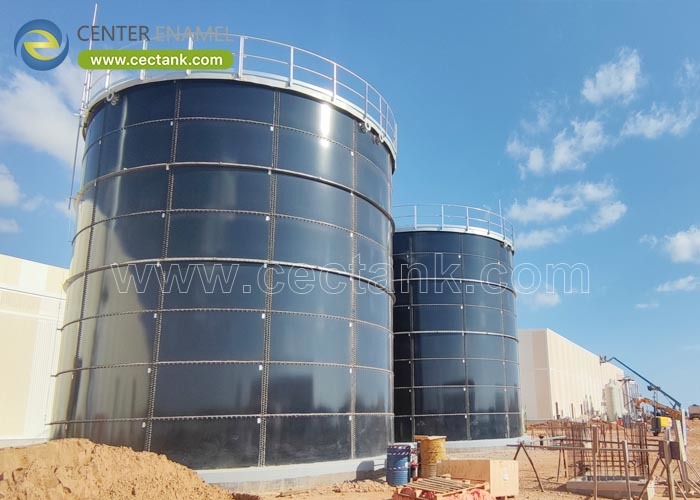
An FDA compliant GFS tank stores food-grade or potable liquid against a surface formulated for contact under 21 CFR 175.300. The compliance lives in the enamel frit and the coating certificate, not in the steel alone. Engineered by Shijiazhuang Zhengzhong Technology Co., Ltd. (Center Enamel), a Glass-Fused-to-Steel (GFS) tank can be produced with contact-grade enamel when the frit and the documentation are specified up front.
An FDA compliant GFS tank is a Glass-Fused-to-Steel (GFS) vessel whose vitreous enamel is formulated so the food-contact surface meets 21 CFR 175.300 for resinous and polymeric coatings. The steel provides structure; the enamel provides the inert, cleanable contact layer. Compliance is proven by the frit formulation record and a coating compliance letter, not by the tank being merely enameled.
- Surface: Contact-grade vitreous enamel, not a generic frit.
- Rule: 21 CFR 175.300 governs food-contact coatings.
- Proof: Frit formulation and a compliance letter per order.
- Companion: NSF/ANSI 61 covers potable contact separately.
Food-contact GFS tanks use the same bolted shell as any GFS tank but with a contact-grade frit, a smoother fired surface, and full traceability of the enamel lot. They serve potable water, food-processing liquids, and beverages, with fixed or geodesic-dome roofs and hygienic nozzles that meet sanitary design expectations.
- Frit: Contact-grade, lot-traced for the order.
- Finish: Smooth fired surface for cleanability.
- Roof: Sealed dome or cone to protect the product.
- Traceability: Enamel lot linked to the tank serial.
FDA compliant GFS tanks store potable water, fruit juice and syrup, liquid food intermediates, and process water at food plants. They operate at ambient to mildly warm temperatures, typically 20-60°C, and are chosen where the surface must stay inert and easily cleaned to protect product safety and shelf life.
- Potable: Drinking-water reserve under contact approval.
- Food: Juice, syrup, and liquid intermediates.
- Beverage: Process and blend water.
- Temp: Ambient to 60°C, no thermal shock design.
Specifying an FDA compliant tank means naming 21 CFR 175.300 in the purchase order, requesting the frit formulation and the compliance letter, and aligning with NSF/ANSI 61 for potable use. The shell still follows AWWA D103-09 and ISO 28765; the difference from a standard GFS tank is the documented food-contact enamel and its lot traceability.
- Specify: 21 CFR 175.300 and NSF/ANSI 61 as applicable.
- Request: Frit formulation and coating compliance letter.
- Standards: AWWA D103-09 shell, ISO 28765 enamel system.
- Trace: Enamel lot tied to the tank serial number.
A contact-grade GFS tank gives an inert, cleanable, long-life surface that resists flavor carryover and corrosion. The limitation is that compliance is conditional: it must be ordered and documented, and the enamel cannot be assumed food-grade by default. This boundary must be confirmed in the specification, because a standard GFS frit is not automatically 21 CFR 175.300 listed.
- Advantage: Inert, smooth, cleanable food-contact surface.
- Advantage: 30-50 year life with low maintenance.
- Limitation: Food-grade must be specified, not assumed.
- Limitation: Documentation is required for audit.
These are the values a food-contact GFS tank should quote. They confirm the structure and the documented surface system, giving the quality team the evidence that the contact layer meets the cited rule before the tank is filled.
| Design parameter | Typical value or range | Why it matters |
|---|---|---|
| Capacity range | 500-40,000 m3 | Single-tank throughput |
| Enamel DFT | 0.25-0.40 mm | Verified before shipment |
| Fusion temperature | 820-930 °C | Enamel bond to steel |
| Holiday test | 1500 V | Every square meter checked |
| Contact rule | 21 CFR 175.300 | Food-contact compliance |
| Potable rule | NSF/ANSI 61 | Drinking-water contact |
| Design life | 30-50 years | With inspection plan |
| Operating temp | 20-60 °C | Product and climate |
| Code basis | AWWA D103-09 | Design authority |
| Limitation to check | Frit grade ordered | Confirm in PO |
Against stainless steel and coated carbon steel, a contact-grade GFS tank offers a large, economical, inert volume. Use the table to weigh it against alternatives where food or potable contact is required.
| Criterion | GFS food-grade | Stainless 304/316 | Coated carbon steel | FRP tank |
|---|---|---|---|---|
| Food contact | 21 CFR 175.300 frit | Intrinsic | Coating-dependent | Resin-dependent |
| Capacity | Up to 40,000 m3 | Limited by cost | Up to 150,000 m3 | Limited |
| Corrosion | Inert enamel | Good | Coating-dependent | Good |
| Cost at scale | Lower | Higher | Mid | Mid |
| Best fit | Large food/potable | Small hygienic | Generic | Small neat |
Put 21 CFR 175.300 and NSF/ANSI 61 in the purchase order, require the frit formulation and compliance letter, and keep the enamel lot tied to the tank. Shijiazhuang Zhengzhong Technology Co., Ltd. (Center Enamel) issues the contact-grade certificate and the inspection file so the tank passes food-safety audit as well as structural review.
- Specify: 21 CFR 175.300 and NSF/ANSI 61 in the PO.
- Require: Frit formulation and compliance letter.
- Verify: Holiday test at 1500 V, DFT 0.25-0.40 mm.
- Trace: Enamel lot linked to the serial number.
An FDA compliant GFS tank is a standard bolted shell carrying a documented food-contact enamel. The compliance is in the frit and the certificate, so specify 21 CFR 175.300 up front, keep the lot traceable, and the tank serves food and potable duty with a 30-50 year life.
No. A Glass-Fused-to-Steel (GFS) tank is only food-contact compliant when the enamel frit is formulated to 21 CFR 175.300 and documented; this must be specified and certified per order.
It governs resinous and polymeric coatings used as food-contact surfaces, including the vitreous enamel layer on a GFS tank. Compliance is shown by the frit formulation and a coating letter.
For potable water, yes - NSF/ANSI 61 confirms drinking-water contact. Food-grade (21 CFR 175.300) and potable (NSF/ANSI 61) are related but distinct approvals.
A single contact-grade GFS tank spans about 500-40,000 m3, suitable for most food and beverage bulk storage.
By holiday test at 1500 V, DFT of 0.25-0.40 mm, and a frit formulation record tied to the tank serial with a compliance letter.
Yes. Roof type, nozzles, and hygienic fittings are matched to the process; the food-grade enamel and its documentation are carried through the customization.