-
Glass Fused To Steel Tanks (777)
-
Stainless Steel Tanks (434)
-
Fusion Bonded Epoxy Tanks (592)
-
Galvanized Steel Tanks (321)
-
Aluminum Dome Roofs (1336)
-
Wastewater Storage Tanks (237)
-
Welded Steel Tanks (457)
-
Pressure Vessels (295)
-
Anaerobic Digester (202)
-
Industrial Water Tanks (349)
-
Glass Lined Steel Tanks (180)
-
Bolted Steel Tanks (389)
-
Sludge Storage Tank (115)
-
Biogas Storage Tank (173)
-
Leachate Storage Tanks (133)
-
Agricultural Water Storage Tanks (179)
-
Fire Water Tank (166)
-
Grain Storage Silos (146)
-
Biogas Projects (424)
-
Wastewater Treatment Projects (1470)
-
Double Membrane Roof (223)

|
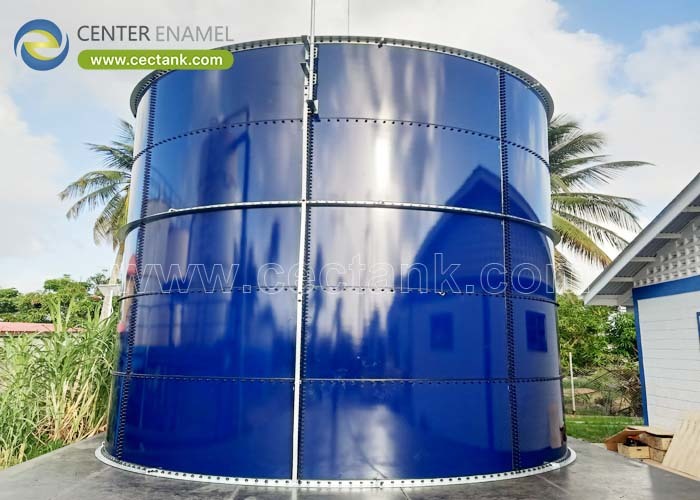
Steel Tanks: Bolted GFS, Welded, and Shop-Built Options Compared
| Place of Origin: | China |
| Brand Name: | CEC TANKS |
| Certification: | ISO 9001:2008, AWWA D103 , OSHA , BSCI |
| Model Number: | J2016012315 |
| Minimum Order Quantity: | 1set |
| Price: | $5000~$20000 one set |
| Packaging Details: | PE poly-foam between each two steel plates ; wooden pallet and wooden box |
| Delivery Time: | 0-60 days after deposit received |
| Payment Terms: | L/C,T/T |
| Supply Ability: | 60 sets per month |
|
Detail Information |
|||
| Place of Origin | China | Brand Name | CEC TANKS |
|---|---|---|---|
| Certification | ISO 9001:2008, AWWA D103 , OSHA , BSCI | Model Number | J2016012315 |
| Acid And Alkalinity Proof: | Standard Coating Suits For PH3 - PH11, Special Coating Suits For PH1 - PH14 | Elastic: | Same As Steel Sheet , Around 500KN/mm |
| Serive Life: | More Than 30 Years | PH Range: | PH 1 - PH 14 |
| Coating Color: | Dark Blue, Dark Green , White, And Customized | Steel Plates Thickness: | 3mm - 12mm , Depends On The Diameter & Height |
| Easy Yo Clean: | Smooth, Glossy, Inert, Anti-adhesion | Coating Thickness: | 4.0.25mm - 0.4mm, Two Coating Internal And External |
| Highlight: | bolted GFS steel tanks,welded glass fused steel tanks,shop-built steel tank options |
||
Product Description
Steel Tanks: Bolted GFS, Welded, and Shop-Built Options Compared
Steel tanks store water, wastewater, fuel, and process liquids across every industry, but the word 'steel' hides three very different builds. The choice drives capacity, corrosion defense, and how long the site is a construction site. Engineered by Shijiazhuang Zhengzhong Technology Co., Ltd. (Center Enamel), a Glass-Fused-to-Steel (GFS) bolted tank is one of the three families and the one most often specified for corrosive duty.
What a Steel Tank Is
A steel tank is a liquid container built from steel plate, distinguished by how the plates are joined. Bolted tanks use gasketed, fastened panels; welded tanks use continuous welds; shop-built tanks are fabricated and tested off site then delivered. The join method sets the achievable diameter, the coating system, and the on-site labor.
- Bolted: Panels shipped flat, erected with 8.8-grade bolts and gaskets.
- Welded: Continuous weld on site, rated to API 650 or EN 14015.
- Shop-built: Made and tested in a factory, then transported.
- Common: All three serve water, waste, fuel, and process duty.
Key Characteristics, Components, and Types
Beyond the join, steel tanks differ by coating and lining. A Glass-Fused-to-Steel (GFS) bolted tank fuses vitreous enamel at 820-930°C for an inert surface; welded tanks rely on field-applied coatings; shop-built units carry a factory finish. Roofs range from fixed cone to aluminum geodesic dome and, for fuel, to internal floating roofs.
- Coating: GFS enamel, epoxy, or galvanizing by duty.
- Roof: Cone, dome, or floating by product and code.
- Foundation: Ring wall or slab sized to the shell load.
- Linings: Cathodic protection where soil or product demands.
Applications and Operating Conditions
Steel tanks hold potable water, equalized wastewater, crude and product oil, fire-protection reserves, and industrial process liquids. Bolted GFS leads for corrosive or modular duty; welded leads for very large volumes above 40,000 m3; shop-built suits small, standardized tanks where transport allows it.
- Water: Potable and process storage under cover.
- Waste: Equalization and digestion where chemistry is harsh.
- Fuel: API 650 welded with floating roofs.
- Fire: NFPA 22 reserve, often welded or bolted GFS.
Technical Considerations
Selection starts from volume and chemistry. Bolted GFS covers 500-40,000 m3 with fast erection; welded covers up to 150,000 m3 but needs more site plant and NDE. The coating is chosen from pH, chlorides, and temperature, and the shell is calculated to AWWA D103-09, API 650, or EN 14015 as applicable.
- Volume: Bolted to 60,000 m3, welded to 150,000 m3.
- Chemistry: pH and chlorides set the lining.
- Standards: AWWA D103-09, API 650, EN 14015 per build.
- Build time: Bolted is fastest; welded needs welding and NDE.
Advantages and Limitations
Bolted Glass-Fused-to-Steel (GFS) tanks resist corrosion and relocate easily, but cap near 40,000 m3 per shell. Welded tanks reach the largest volumes yet need heavy site work and recoating later. The limitation to check is simply the single-shell ceiling versus your required volume, which decides the family before any coating is discussed.
- Bolted GFS: Corrosion-resistant, modular, fast.
- Welded: Largest volumes, slower, more site plant.
- Shop-built: Quality finish, limited by transport size.
- Boundary: Above ~40,000 m3 single shell, prefer welded or multiple.
Design Parameters
These values frame a steel tank spec regardless of build. They let the engineer confirm the shell, the surface system, and the joints, and they are the numbers carried into the hydrostatic test and the inspection record.
| Design parameter | Typical value or range | Why it matters |
|---|---|---|
| Capacity range | 500-40,000 m3 | Single-tank throughput |
| Shell plate | 6-40 mm | Hydrostatic head by elevation |
| Enamel DFT | 0.25-0.40 mm | Verified before shipment |
| Fusion temperature | 820-930 °C | Enamel bond to steel |
| Holiday test | 1500 V | Every square meter checked |
| Bolt grade | 8.8 | Field joint integrity |
| Design life | 30-50 years | With inspection plan |
| Operating temperature | 20-60 °C | Product and climate |
| Code basis | AWWA D103-09 / ISO 28765 | Design authority |
| Limitation to check | Feed pH and abrasives | Confirm in specification |
Comparison and Selection Guide
The three builds trade capacity, corrosion defense, and build method. Glass-Fused-to-Steel (GFS) bolted leads for corrosive modular duty; welded leads for very large volumes; shop-built fits small standardized tanks. The table maps each to its best fit.
| Criterion | GFS bolted tank | Welded steel tank | Concrete tank | FRP tank |
|---|---|---|---|---|
| Corrosion defense | Vitreous enamel, inert | Coating-dependent | Good but porous | Liner-dependent |
| Construction | Bolted, fast on site | Welded, slower | Cast in place | Molded / shop |
| Capacity ceiling | Up to 40,000 m3 | Up to 150,000 m3 | Very large | Limited (<5,000 m3) |
| Design life | 30-50 years | 30-50 years | 40-60 years | 20-30 years |
| Best fit | Corrosive, modular | Very large, generic | Heavy civil works | Small, neat chemical |
Best Practices: How to Choose
Lead with volume and chemistry, then pick the build that meets both without over-specifying. Require the coating proof for the build you choose, and for GFS demand a 1500 V holiday test. Shijiazhuang Zhengzhong Technology Co., Ltd. (Center Enamel) issues the calculation and inspection file so the chosen build is verifiable, not assumed.
- Step 1: Set volume and the corrosive load of the liquid.
- Step 2: Pick bolted GFS, welded, or shop-built to fit both.
- Step 3: Require the coating and NDE proof for that build.
- Step 4: Confirm the inspection package and a reference.
'Steel tank' is a family, not a product. Match the build to volume and chemistry: bolted Glass-Fused-to-Steel (GFS) for corrosive modular duty, welded for the largest shells, shop-built for small standard tanks, and the asset will perform for its 30-50 year design life.
Frequently Asked Questions (FAQ)
What are the main types of steel tanks?
Bolted (panels fastened on site), welded (continuous field weld), and shop-built (made and tested in a factory). They differ in capacity, coating, and on-site labor.
Which steel tank resists corrosion best?
A Glass-Fused-to-Steel (GFS) bolted tank, where vitreous enamel fused at 820-930°C gives an inert surface that outperforms painted steel in acidic or abrasive service.
What capacity can a bolted steel tank reach?
A single GFS bolted tank spans about 20-60,000 m3; welded construction extends to roughly 150,000 m3 for very large duty.
Which standard applies to welded vs bolted?
Bolted shells follow AWWA D103-09 (and ISO 28765 for GFS); welded shells follow API 650 or EN 14015.
Are bolted tanks as strong as welded?
For their rated volume they are, because the shell is calculated the same way and the joints are gasketed and torqued to spec; they are simply built differently.
Can a bolted tank be moved later?
Yes, bolted GFS tanks are modular and can be dismantled and re-erected, which welded and shop-built tanks cannot do economically.