-
Glass Fused To Steel Tanks (777)
-
Stainless Steel Tanks (434)
-
Fusion Bonded Epoxy Tanks (592)
-
Galvanized Steel Tanks (321)
-
Aluminum Dome Roofs (1336)
-
Wastewater Storage Tanks (237)
-
Welded Steel Tanks (457)
-
Pressure Vessels (295)
-
Anaerobic Digester (202)
-
Industrial Water Tanks (349)
-
Glass Lined Steel Tanks (180)
-
Bolted Steel Tanks (389)
-
Sludge Storage Tank (115)
-
Biogas Storage Tank (173)
-
Leachate Storage Tanks (133)
-
Agricultural Water Storage Tanks (179)
-
Fire Water Tank (166)
-
Grain Storage Silos (146)
-
Biogas Projects (424)
-
Wastewater Treatment Projects (1470)
-
Double Membrane Roof (223)
|
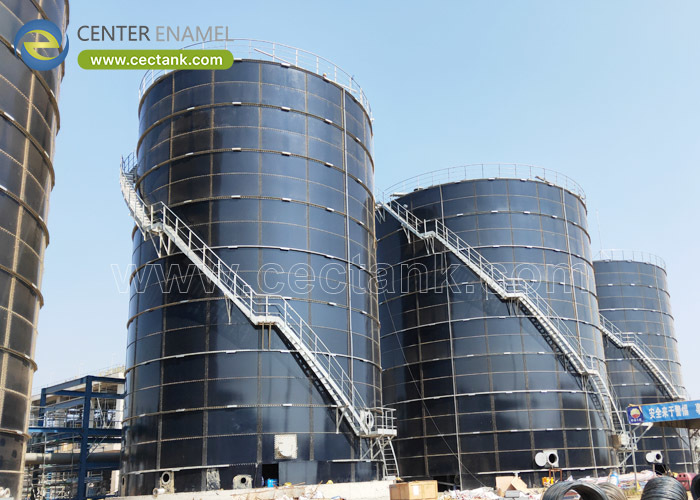
Glass-Lined Steel Tanks: What the Vitreous Enamel Coating Delivers
| Place of Origin: | CHINA |
| Brand Name: | CEC TANKS |
| Certification: | ISO 9001:2008, AWWA D103 , OSHA , BSCI |
| Model Number: | W20180508003 |
| Minimum Order Quantity: | 1 SET |
| Price: | $5000~$20000 one set |
| Packaging Details: | PE poly-foam between each two steel plates;wooden pallets and wooden box |
| Delivery Time: | 10-30 days after deposit received |
| Payment Terms: | L/C,T/T |
| Supply Ability: | 60 sets per month |
|
Detail Information |
|||
Product Description
Glass-Lined Steel Tanks: What the Vitreous Enamel Coating Delivers
A glass lined steel tank is a steel vessel whose interior is protected by a vitreous enamel fused directly to the plate, a system the industry calls Glass-Fused-to-Steel (GFS). The enamel is glass, so it is inert to most chemicals that destroy paint. Engineered by Shijiazhuang Zhengzhong Technology Co., Ltd. (Center Enamel), these bolted tanks pair that coating with a calculated shell for a 30-50 year service life.
What a Glass-Lined Steel Tank Is
A glass lined steel tank is built from steel plates clad on the wetted side with a vitreous enamel - literally glass fused to steel at 820-930°C. The result is a single material that carries load like steel yet presents a non-porous glass surface to the liquid. The term Glass-Fused-to-Steel (GFS) is the formal name for this coated-steel system.
- Core: Steel plate for structure.
- Surface: Vitreous enamel for the wetted face.
- Bond: Fused at 820-930°C, not glued.
- Name: Glass-Fused-to-Steel (GFS) is the system.
Key Characteristics, Components, and Types
Glass lined steel tanks are usually bolted from enamel-coated panels with gasketed, 8.8-grade joints, though welded versions exist for special duty. They carry fixed cone or geodesic-dome roofs and range from small process tanks to 40,000 m3 storage. The coating DFT is 0.25-0.40 mm, verified by holiday test at 1500 V.
- Build: Bolted panels, gasketed joints.
- Coating: 0.25-0.40 mm DFT, holiday-tested.
- Roof: Cone or aluminum geodesic dome.
- Volume: 500-40,000 m3 per shell.
Applications and Operating Conditions
Glass lined steel tanks store potable water, wastewater, leachate, sludge, and mild process chemicals. They operate at 20-60°C and suit any duty where the liquid would attack paint or where product purity matters, which is why they appear from municipal plants to food and beverage sites.
- Water: Potable and process storage.
- Waste: Equalization and digestion.
- Leachate: Landfill and industrial streams.
- Food: Where contact grade is specified.
Technical Considerations
The steel carries the load while the enamel sets the chemical resistance, so specification starts from the liquid chemistry. The shell is calculated to AWWA D103-09 and the enamel system to ISO 28765; plate is blasted to Sa 2.5 before firing so the glass bonds instead of sitting on mill scale, then holiday-tested at 1500 V.
- Chemistry: pH and abrasives choose the enamel.
- Standards: AWWA D103-09 shell, ISO 28765 enamel.
- Prep: Sa 2.5 blast before firing.
- Test: 1500 V holiday test, every m2.
Advantages and Limitations
The enamel is inert, smooth, and long-lived, needing little maintenance versus painted steel. A limitation is impact: a hard local blow can chip the glass, so handling and bolt torque are controlled during erection, and the boundary to watch is mechanical abuse rather than chemical attack, which the lining shrugs off.
- Advantage: Inert, smooth, low-maintenance surface.
- Advantage: 30-50 year life with inspection.
- Limitation: Hard impact can chip the glass.
- Limitation: Erection torque must be controlled.
Design Parameters
These values define a glass lined steel tank spec. They confirm the structure and the coating system before fabrication and are the basis for the hydrostatic test and the inspection record that follows.
| Design parameter | Typical value or range | Why it matters |
|---|---|---|
| Capacity range | 500-40,000 m3 | Single-tank throughput |
| Shell plate | 6-40 mm | Hydrostatic head by elevation |
| Enamel DFT | 0.25-0.40 mm | Verified before shipment |
| Fusion temperature | 820-930 °C | Enamel bond to steel |
| Holiday test | 1500 V | Every square meter checked |
| Bolt grade | 8.8 | Field joint integrity |
| Design life | 30-50 years | With inspection plan |
| Operating temperature | 20-60 °C | Product and climate |
| Code basis | AWWA D103-09 / ISO 28765 | Design authority |
| Limitation to check | Feed pH and abrasives | Confirm in specification |
Comparison and Selection Guide
Against painted steel, concrete, and FRP, a glass lined (GFS) tank leads on inertness and life for corrosive or pure duty. The table maps the four materials to their best fit so the specifier can match the tank to the liquid.
| Criterion | GFS bolted tank | Welded steel tank | Concrete tank | FRP tank |
|---|---|---|---|---|
| Corrosion defense | Vitreous enamel, inert | Coating-dependent | Good but porous | Liner-dependent |
| Construction | Bolted, fast on site | Welded, slower | Cast in place | Molded / shop |
| Capacity ceiling | Up to 40,000 m3 | Up to 150,000 m3 | Very large | Limited (<5,000 m3) |
| Design life | 30-50 years | 30-50 years | 40-60 years | 20-30 years |
| Best fit | Corrosive, modular | Very large, generic | Heavy civil works | Small, neat chemical |
Best Practices: How to Specify
Require the ISO 28765 enamel system, a 1500 V holiday test, and a DFT log, and confirm the enamel grade for your chemistry. Shijiazhuang Zhengzhong Technology Co., Ltd. (Center Enamel) provides the calculation, the coating certificate, and the inspection file so the glass lined tank is proven, not assumed.
- Require: ISO 28765 enamel system.
- Verify: Holiday test 1500 V, DFT 0.25-0.40 mm.
- Confirm: Enamel grade matches the chemistry.
- Check: Erection torque and handling plan.
A glass lined steel tank is steel for strength and glass for the surface, fused at 820-930°C into one corrosion-proof material. Specify the enamel system and prove it with a holiday test, and the tank will protect the liquid and the structure for its 30-50 year design life.
Frequently Asked Questions (FAQ)
What is a glass lined steel tank?
A steel tank whose wetted surface is a vitreous enamel fused to the plate - the Glass-Fused-to-Steel (GFS) system - giving a load-carrying shell with an inert glass interior.
How is the enamel bonded to steel?
Steel plate is blasted to Sa 2.5 and fired at 820-930°C so the vitreous enamel fuses into the surface, forming a bond stronger than any adhesive.
Is glass lining better than paint?
For corrosive or pure duty, yes - the enamel is non-porous and inert, resisting acids and abrasion far longer and needing little recoating over a 30-50 year life.
What standard covers the coating?
The enamel system follows ISO 28765 and the bolted shell follows AWWA D103-09, with the finished surface holiday-tested at 1500 V.
What capacity can a glass lined tank reach?
A single Glass-Fused-to-Steel (GFS) tank spans about 500-40,000 m3; larger duty uses multiple tanks.
Can the coating be damaged?
A hard local impact can chip the glass, so handling and bolt torque are controlled during erection; chemical attack is not the usual failure mode.