-
Glass Fused To Steel Tanks (896)
-
Stainless Steel Tanks (434)
-
Fusion Bonded Epoxy Tanks (652)
-
Galvanized Steel Tanks (321)
-
Aluminum Dome Roofs (1336)
-
Wastewater Storage Tanks (280)
-
Welded Steel Tanks (457)
-
Pressure Vessels (426)
-
Anaerobic Digester (202)
-
Industrial Water Tanks (349)
-
Glass Lined Steel Tanks (180)
-
Bolted Steel Tanks (389)
-
Sludge Storage Tank (115)
-
Biogas Storage Tank (173)
-
Leachate Storage Tanks (133)
-
Agricultural Water Storage Tanks (179)
-
Fire Water Tank (166)
-
Grain Storage Silos (146)
-
Biogas Projects (424)
-
Wastewater Treatment Projects (1712)
-
Double Membrane Roof (223)
|
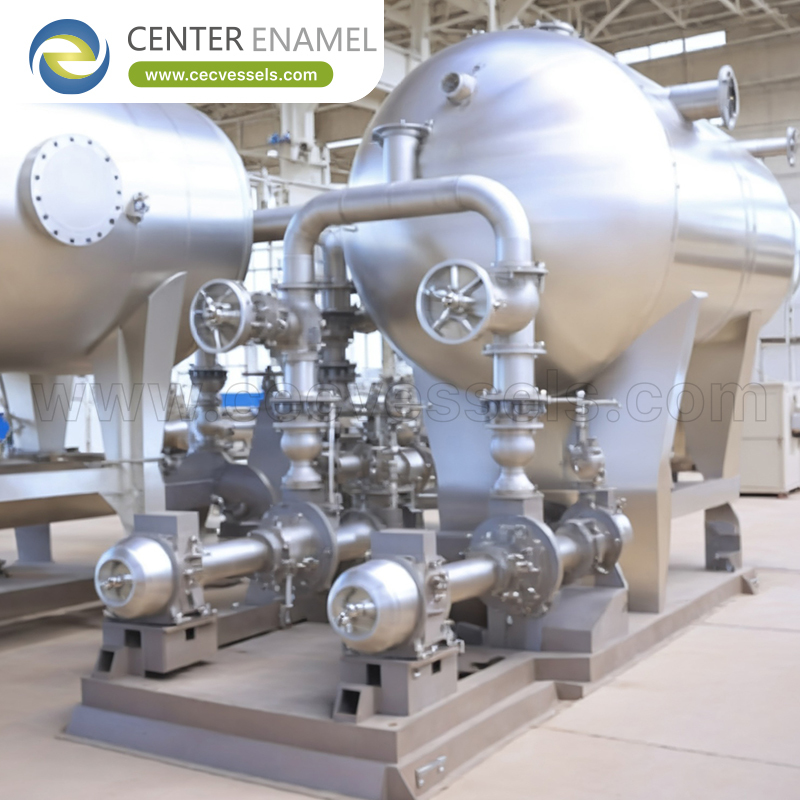
What Is an Alloy Reactor? Grades, Design & Applications
| Place of Origin: | China |
| Brand Name: | Center Enamel |
| Certification: | ISO 9001,CE, NSF/ANSI 61, WRAS, ISO 28765, LFGB, BSCI, ISO 45001 |
| Minimum Order Quantity: | 1 Sets |
| Price: | 2000 |
| Delivery Time: | 2 months |
| Payment Terms: | L/C,T/T |
| Supply Ability: | 200 sets / days |
|
Detail Information |
|||
Product Description
Answering the core question: What is an alloy reactor, and why are specialty alloys chosen over 304 or 316 stainless? An alloy reactor is fabricated from engineered nickel, duplex, or super-austenitic grades whose chromium, molybdenum, and nitrogen content deliver PREN values from 25 (316L) up to 65 (Hastelloy C-276). This resists chloride stress-corrosion cracking, high-temperature sulfidation, and reducing acids that destroy commodity stainless. Operating from minus 50 degree C (duplex) to 400 degree C (nickel-base) at 0.1-10 MPa, alloy reactors serve sour-gas, flue-gas desulfurization, and specialty-chemical plants where a single leak can cost millions.
Core Operating Principles of Alloy Reactors- **Alloying for Resistance:** Molybdenum (2-16 percent) and nitrogen raise chloride pitting (PREN); nickel base stabilizes structure in reducing and high-temperature service.
- **Phase Stability:** Controlled ferrite-austenite balance in duplex avoids sigma-phase embrittlement during long holds at 300-500 degree C.
- **Strength at Temperature:** Nickel alloys keep 200-400 MPa yield at 400 degree C, allowing thinner walls than carbon steel at the same pressure.
- **Duplex 2205 Reactors:** PREN about 38, 22 percent Cr / 5 percent Ni / 3 percent Mo; cost-effective for seawater and chloride process at minus 50 to 300 degree C.
- **Super-Austenitic 904L or 6Mo:** PREN 35-45, high nickel; resists sulfuric and phosphoric acid in fertilizer service.
- **Nickel-Base (Hastelloy C / Inconel):** PREN 50-65 at 300-400 degree C; handles hot HCl, HF (Inconel), and oxidizing chlorides.
Alloy Grade |
PREN |
Temp Range |
Best Service |
Duplex 2205 |
~38 |
-50 to 300 degree C |
Seawater, chlorides |
904L / 6Mo |
35-45 |
-20 to 200 degree C |
H2SO4, H3PO4 |
Hastelloy C-276 |
>65 |
20-260 degree C |
Mixed acids |
Inconel 625 |
~48 |
-50 to 400 degree C |
High temp, HF |
A: When chloride stress-corrosion, hot acids, or temperatures above 300 degree C exceed 316L limits; alloy PREN 38-65 provides the needed margin.
Q: What is PREN and why does it matter?A: Pitting Resistance Equivalent Number sums Cr, Mo, and N contributions; higher PREN means stronger resistance to chloride pitting in process streams.
Q: What is sigma-phase embrittlement?A: Prolonged exposure of duplex steels at 300-500 degree C precipitates brittle sigma phase; controlled chemistry and post-weld heat treatment avoid it.
Q: Which alloy resists the hottest service?A: Nickel-base Inconel or Hastelloy retain strength and corrosion resistance to 400 degree C, far above duplex or austenitic stainless limits.