-
Glass Fused To Steel Tanks (896)
-
Stainless Steel Tanks (434)
-
Fusion Bonded Epoxy Tanks (652)
-
Galvanized Steel Tanks (321)
-
Aluminum Dome Roofs (1336)
-
Wastewater Storage Tanks (280)
-
Welded Steel Tanks (457)
-
Pressure Vessels (426)
-
Anaerobic Digester (202)
-
Industrial Water Tanks (349)
-
Glass Lined Steel Tanks (180)
-
Bolted Steel Tanks (389)
-
Sludge Storage Tank (115)
-
Biogas Storage Tank (173)
-
Leachate Storage Tanks (133)
-
Agricultural Water Storage Tanks (179)
-
Fire Water Tank (166)
-
Grain Storage Silos (146)
-
Biogas Projects (424)
-
Wastewater Treatment Projects (1712)
-
Double Membrane Roof (223)
|
What Is a Pressure Reactor? Design, Safety & Applications
| Place of Origin: | China |
| Brand Name: | Center Enamel |
| Certification: | ISO 9001,CE, NSF/ANSI 61, WRAS, ISO 28765, LFGB, BSCI, ISO 45001 |
| Minimum Order Quantity: | 1 Sets |
| Price: | 2000 |
| Delivery Time: | 2 months |
| Payment Terms: | L/C,T/T |
| Supply Ability: | 200 sets / days |
|
Detail Information |
|||
Product Description
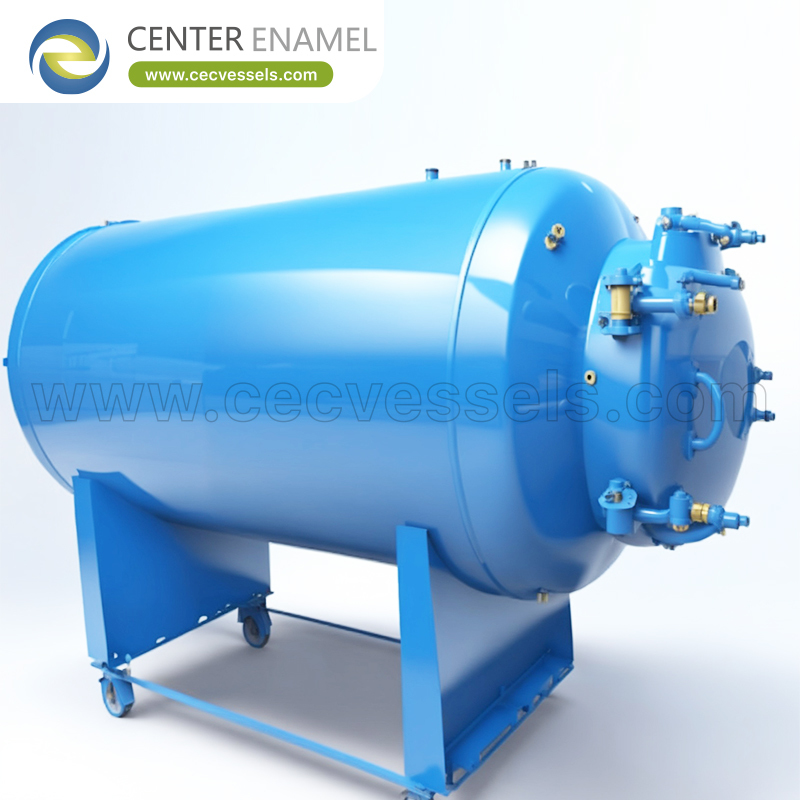
Answering the core question: What is a pressure reactor, and how is it designed to contain reactions safely at elevated pressure? A pressure reactor is a closed vessel engineered to run chemical or biochemical reactions above atmospheric pressure, from mild 0.1 MPa to extreme 100 MPa (e.g., hydrothermal, high-pressure hydrogenation). It is built to ASME Section VIII Division 1/2 (US) or PED 2014/68/EU (Europe), with a maximum allowable working pressure (MAWP) set 10-25% above operating pressure and a wall thickness of 6-200 mm. Pressurized rotating shafts use magnetic drives or double mechanical seals (API Plan 53 barrier fluid) to prevent leak of flammable/toxic gases. Over-pressure protection combines a rupture disc and pressure safety valve (PSV) sized per API 520/521 with DIERS two-phase relief, ensuring the vessel never exceeds MAWP even on runaway.
1. Core Design and Safety Principles of Pressure ReactorsPressure containment is governed by code, sealing, and relief. Three principles are non-negotiable:
- **Code Design and MAWP:** The vessel is designed so the MAWP (maximum allowable working pressure) exceeds the operating pressure by 10-25%, with wall thickness from the thin-shell formula t = P·R/(S·E - 0.6·P) (P = pressure, R = radius, S = allowable stress, E = joint efficiency). ASME Section VIII Div 1 covers most; Div 2 allows lower safety factors for detailed analysis at higher consequence. Hydrotest at 1.3x MAWP and pneumatic at 1.1x verify integrity before service. PED 2014/68/EU categorizes by pressure x volume and fluid hazard.
- **Shaft Sealing: Magnetic Drive vs Double Seal:** Pressurized agitation needs a leak-tight shaft. Magnetic drives (up to ~30 MPa) transmit torque through a static barrier with no penetration—eliminating seal leakage entirely, ideal for H2, toxic, or explosive gases. Double mechanical seals with pressurized barrier fluid (API Plan 53) are used above mag-drive torque limits; barrier pressure is held above process so any leak is inward (clean fluid out, not process gas). Both protect personnel and atmosphere.
- **Over-Pressure Protection (API 520/521 + DIERS):** A rupture disc (set 100-110% MAWP) bursts on over-pressure; a PSV (per API 520 sizing, API 521 location) relieves to a safe header/flare. For runaway exotherms that boil the liquid, DIERS methodology sizes relief for two-phase (vapor-liquid) discharge, not just vapor, preventing under-sizing that caused historical accidents. SIL-rated trips (high-T, high-P, loss-of-cooling) add layers below the mechanical relief.
Pressure reactors are classed by pressure regime and application. Three classes cover the field:
- **Low/Medium Pressure Reactor (0.1-5 MPa):** Jacketed or coil-heated STRs (5-50 m3) for hydrogenation, polymerization, and carbonation. Wall 6-40 mm, magnetic drive or double seal, PSV + rupture disc. The bulk of fine-chemical and polymer pressure reactors; temperature -20 to 250°C, often with Hastelloy/zirconium cladding for corrosion.
- **High-Pressure Autoclave (5-30 MPa):** Thick-wall (40-120 mm) agitated autoclaves for high-pressure hydrogenation (edible oil, fine pharma) and supercritical extraction. Magnetic drive standard; heating via external jacket or internal coil; cooling by liquid CO2 or heat-transfer oil. Runaway protection via DIERS relief and quench. Vessels are forged or multi-layer for integrity.
- **Ultra-High-Pressure Reactor (30-100 MPa):** Used for hydrothermal synthesis, high-pressure polymerization, and some catalytic studies. Wall 100-200 mm, often multi-layer or monoblock, with exotic internals. Instrumentation and sampling at pressure require special fittings (coned-and-threaded). Safety layers and remote operation dominate; these are niche but essential for specific chemistries.
Class |
Pressure Range |
Shaft Seal |
Relief Basis |
Low/Med (0.1-5 MPa) |
Jacketed STR |
Mag-drive / dbl seal |
API 520/521 |
High (5-30 MPa) |
Autoclave, forged |
Magnetic drive |
DIERS 2-phase |
Ultra (30-100 MPa) |
Monoblock/multi-layer |
Static (no shaft) |
DIERS + remote |
A: Use a magnetic drive whenever the process gas is flammable (H2), toxic, or valuable and any shaft leakage is unacceptable. Mag-drive has no penetrating shaft, so it cannot leak process to atmosphere—ideal up to ~30 MPa and moderate torque. Above mag-drive torque limits or very large agitators, a double mechanical seal with pressurized barrier fluid (API Plan 53) is used, with barrier pressure above process so leaks are inward.
Q: How is a pressure reactor protected from runaway over-pressure?A: Layered protection: BPCS holds setpoints; SIL-rated trips (high-T, high-P, loss-of-cooling, high-level) act first; then a rupture disc (set 100-110% MAWP) and a PSV sized per API 520 (located per API 521) relieve to flare/scrubber. For exotherms that vapor-liquid boil, DIERS two-phase relief sizing prevents under-design. The vessel never exceeds MAWP even on worst-case runaway.
Q: What is the difference between ASME Section VIII Div 1 and Div 2 for a pressure reactor?A: Div 1 uses standard formulas with conservative safety factors (design margin ~3.5 on tensile) and is simpler/cheaper for most reactors. Div 2 allows detailed stress analysis (FEA) with lower margins (~2.4) for high-consequence or heavy-wall vessels, reducing wall thickness and weight where justified by analysis and QA. Div 2 needs more engineering and documentation but enables more efficient high-pressure designs.
Q: What is PED and when does it apply to a pressure reactor?A: PED 2014/68/EU is the European Pressure Equipment Directive covering vessels above 0.5 bar (0.05 MPa) by pressure x volume and fluid hazard (group 1 dangerous, group 2 others), assigning categories I-IV and conformity routes. Any pressure reactor sold or operated in the EU must be PED-compliant (CE marked) with notified-body involvement for higher categories. ASME U-stamp is accepted in many markets but not a PED substitute within the EU.