-
Glass Fused To Steel Tanks (896)
-
Stainless Steel Tanks (434)
-
Fusion Bonded Epoxy Tanks (652)
-
Galvanized Steel Tanks (321)
-
Aluminum Dome Roofs (1336)
-
Wastewater Storage Tanks (280)
-
Welded Steel Tanks (457)
-
Pressure Vessels (426)
-
Anaerobic Digester (202)
-
Industrial Water Tanks (349)
-
Glass Lined Steel Tanks (180)
-
Bolted Steel Tanks (389)
-
Sludge Storage Tank (115)
-
Biogas Storage Tank (173)
-
Leachate Storage Tanks (133)
-
Agricultural Water Storage Tanks (179)
-
Fire Water Tank (166)
-
Grain Storage Silos (146)
-
Biogas Projects (424)
-
Wastewater Treatment Projects (1712)
-
Double Membrane Roof (223)
|
What Is a Stainless Steel Reactor? Grades, Design & Applications
| Place of Origin: | China |
| Brand Name: | Center Enamel |
| Certification: | ISO 9001,CE, NSF/ANSI 61, WRAS, ISO 28765, LFGB, BSCI, ISO 45001 |
| Minimum Order Quantity: | 1 Sets |
| Price: | 2000 |
| Delivery Time: | 2 months |
| Payment Terms: | L/C,T/T |
| Supply Ability: | 200 sets / days |
|
Detail Information |
|||
Product Description
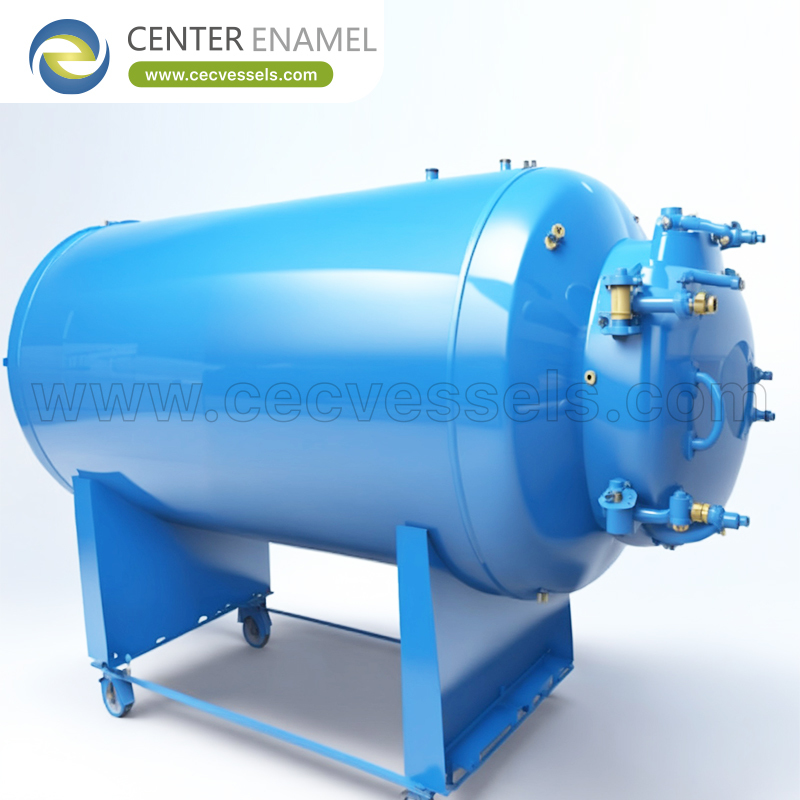
What Is a Stainless Steel Reactor? Grades, Design & Applications
Answering the core question: What is a stainless steel reactor, and how is the grade chosen for the service? A stainless steel reactor is a pressure vessel built from corrosion-resistant stainless alloys, most often 304L or 316L austenitic or duplex 2205/2507, fabricated to ASME SA-240 and Section VIII. Grade selection is driven by the pitting resistance equivalent number PREN = %Cr + 3.3·%Mo + 16·%N: 316L has PREN ~25 (good to ~20-30°C CPT, chloride < ~1000 ppm at 60°C), duplex 2205 PREN ~34, and super-duplex 2507 PREN ~40 for aggressive brines. The chromium oxide passive film gives general corrosion resistance, while molybdenum and nitrogen raise pitting/crevice resistance; for pharma the wetted surface is electropolished to Ra <= 0.5 µm. Stainless reactors serve 0.1-10 MPa, 3-40 mm wall, across chemical, pharmaceutical, and food duties.
1. Core Material Principles of Stainless Steel Reactors
Stainless selection balances corrosion resistance, fabricability, and cost. Three principles guide the choice:
- **PREN and Pitting Resistance:** PREN = %Cr + 3.3·%Mo + 16·%N quantifies resistance to pitting/crevice corrosion. 304L (PREN ~18) suits non-chloride service; 316L (2-3% Mo, PREN ~25) handles mild chloride; duplex 2205 (22% Cr, 3% Mo, 0.15% N, PREN ~34) resists higher chloride and has 2x the strength of 316L; super-duplex 2507 (25/4/0.27, PREN ~40) serves seawater-class brines. Higher PREN raises the critical pitting temperature (CPT) so the alloy survives hotter, saltier streams.
- **Passivation and Surface Finish:** The chromium oxide film passivates the surface; fabrication welds are pickled/passivated per ASTM A967 (nitric or citric) to restore it. For hygienic and high-purity service, wetted surfaces are electropolished to Ra <= 0.5 µm (pharma 0.25-0.38 µm), eliminating crevices and biofilm sites. Roughness, not just grade, controls cleanability and corrosion initiation in CIP/SIP duty.
- **Chloride Stress Corrosion Cracking (SCC):** Austenitic 304/316L are vulnerable to SCC above ~60°C in the presence of chlorides (even ppm in steam) and tensile stress. Mitigations: lower temperature, choose duplex (better SCC resistance) or higher nickel alloys, control chloride and oxygen, and relieve weld stress (PWHT). Duplex 2205 tolerates higher chloride/temperature than 316L but is still bounded; for severe service, 904L or nickel alloys are specified.
2. Major Stainless Reactor Grades and Uses
Four grade families cover the reactor market by severity. Selection matches duty to alloy:
- **304L / 316L Austenitic (general):** 304L (PREN ~18) for water, organics, mild acids; 316L (PREN ~25) for food, pharma, and moderate chloride (clean-in-place, < 1000 ppm Cl-, < 60°C). Easy to weld and electropolish, low cost. Wall 3-40 mm, ASME SA-240. The default for multiproduct and hygienic reactors where severe corrosion is absent.
- **Duplex 2205 (chloride/erosion):** PREN ~34, ~2x yield strength of 316L (allowing thinner walls, lower weight). Resists chloride pitting and SCC better and handles erosion/cavitation in slurries. Used in seawater-cooled, brine, and pulp/paper reactors at 0.5-5 MPa. Fabrication needs controlled heat input to preserve the ferrite/austenite balance (35-65% ferrite).
- **Super-Duplex 2507 / 904L (severe):** 2507 (PREN ~40) for seawater and aggressive acids; 904L (high Ni, Cr, Mo, Cu) for sulfuric/phosphoric acids and chloride at higher temperature. These extend stainless into duties that would otherwise need Hastelloy or zirconium, at lower cost than nickel alloys. Selected when 316L/2205 are at their chloride or temperature limit.
Stainless Steel Reactor Grade Comparison Matrix
Grade |
PREN |
Chloride Service |
Typical Use |
304L |
~18 |
Non-chloride only |
Water, organics, mild acid |
316L |
~25 |
< ~1000 ppm Cl- (<60°C) |
Food, pharma, CIP |
Duplex 2205 |
~34 |
Moderate-high chloride |
Brine, slurry, seawater |
Super-Duplex 2507 |
~40 |
Seawater-class |
Severe acid/brine |
Frequently Asked Questions (FAQ)
Q: What does PREN tell me when choosing a reactor grade?
A: PREN = %Cr + 3.3·%Mo + 16·%N is a quick index of pitting/crevice resistance. Higher PREN means the alloy survives hotter, saltier, more acidic service before pitting. It lets you compare 316L (PREN ~25) vs duplex 2205 (~34) vs super-duplex 2507 (~40) at a glance, but the exact chloride/temperature limit still needs the alloy's CPT data and the service environment (pH, oxidants, deposits).
Q: Why electropolish a stainless reactor for pharma?
A: Electropolishing to Ra <= 0.5 µm (often 0.25-0.38 µm) removes the rough, oxidized weld/heat-affected layer, closes surface pores, and creates a passive, smooth, non-adherent surface. This prevents bacterial biofilm, eases validated CIP, and reduces corrosion initiation at crevices. It is a GMP/ASME-BPE requirement for product-contact surfaces in biopharma.
Q: How is chloride stress corrosion cracking avoided in 316L reactors?
A: SCC needs three conditions: susceptible alloy (austenitic), chloride, and tensile stress above ~60°C. Avoid by keeping metal temperature below the chloride-SCC threshold, controlling chloride (especially in steam/CIP water) and oxygen, post-weld heat treating to relieve stress, or switching to duplex/super-austenitic/nickel alloys for hot chloride service. Design reviews check each junction for crevice + chloride + T.
Q: When would I pay for duplex instead of 316L?
A: Choose duplex 2205 when chloride/temperature exceeds 316L's CPT (~20-30°C) or when erosion/slurry or higher pressure lets its 2x strength thin the wall and cut weight/cost. It also resists SCC better. The trade-off is more careful welding (ferrite balance) and higher material cost; for benign service 316L remains cheaper and simpler.