-
Glass Fused To Steel Tanks (896)
-
Stainless Steel Tanks (434)
-
Fusion Bonded Epoxy Tanks (652)
-
Galvanized Steel Tanks (321)
-
Aluminum Dome Roofs (1336)
-
Wastewater Storage Tanks (280)
-
Welded Steel Tanks (457)
-
Pressure Vessels (426)
-
Anaerobic Digester (202)
-
Industrial Water Tanks (349)
-
Glass Lined Steel Tanks (180)
-
Bolted Steel Tanks (389)
-
Sludge Storage Tank (115)
-
Biogas Storage Tank (173)
-
Leachate Storage Tanks (133)
-
Agricultural Water Storage Tanks (179)
-
Fire Water Tank (166)
-
Grain Storage Silos (146)
-
Biogas Projects (424)
-
Wastewater Treatment Projects (1712)
-
Double Membrane Roof (223)
|
What Is a Titanium Reactor? Materials, Design & Applications
| Place of Origin: | China |
| Brand Name: | Center Enamel |
| Certification: | ISO 9001,CE, NSF/ANSI 61, WRAS, ISO 28765, LFGB, BSCI, ISO 45001 |
| Minimum Order Quantity: | 1 Sets |
| Price: | 2000 |
| Delivery Time: | 2 months |
| Payment Terms: | L/C,T/T |
| Supply Ability: | 200 sets / days |
|
Detail Information |
|||
Product Description
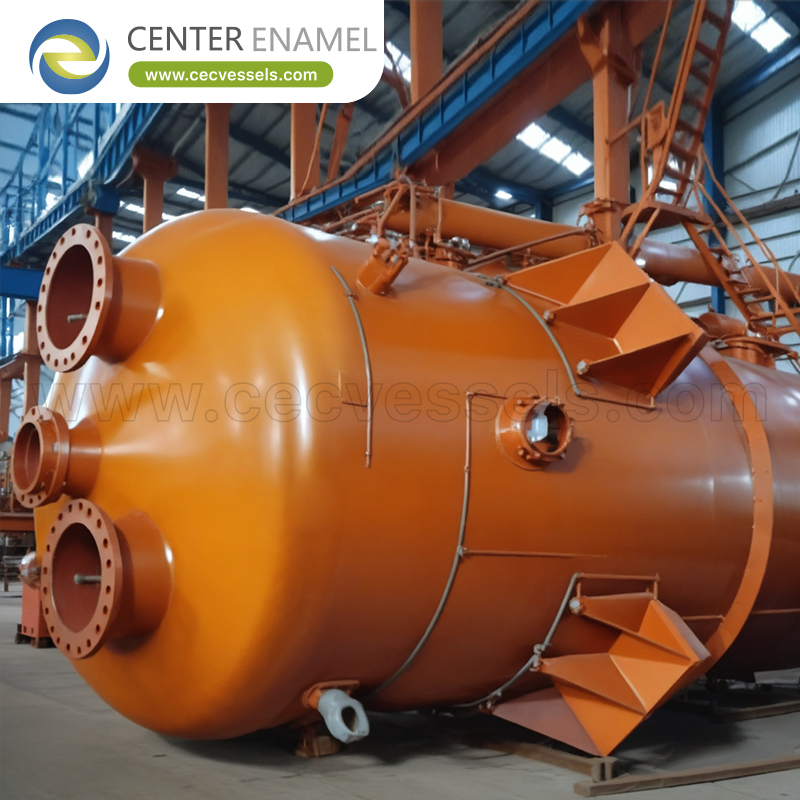
What Is a Titanium Reactor? Materials, Design & Applications
Answering the core question: What is a titanium reactor, and why does it survive chloride and acid environments that destroy stainless steel? A titanium reactor is a vessel built from commercially pure (Grade 2) or alloyed (Grade 5, Ti-6Al-4V) titanium whose surface forms a self-healing TiO2 passive film just 1-10 nm thick. That film resists pitting in chloride concentrations above 20,000 ppm and in oxidizing acids (nitric, wet chlorine) where 316L fails within months. Titanium serves at 0.1-10 MPa and up to 300 degree C in seawater desalination, chlor-alkali, and TiCl4 production, with a corrosion rate below 0.01 mm/year even under vapor-phase attack.
Core Operating Principles of Titanium Reactors
- **Self-Healing Passive Film:** The TiO2 layer reforms instantly when scratched, maintaining below 0.01 mm/year corrosion in oxidizing and chloride media.
- **Chloride Immunity:** Unlike 316L (pitting above 1,000 ppm Cl minus), titanium tolerates above 20,000 ppm chloride without crevice attack when properly designed.
- **Low Thermal Expansion / High Strength:** Ti-6Al-4V gives 900 MPa yield at half the weight of steel, allowing thin-wall, large-diameter reactors.
Major Types of Titanium Reactors
- **Solid Titanium Vessels:** Grade 2 or 5 construction for aggressive acid or chloride duty; used in chlor-alkali and spent-acid recovery.
- **Titanium-Clad (Explosion-Bonded) Reactors:** Carbon-steel shell with 3-6 mm Ti layer; 30-50 percent cheaper than solid Ti for large 20-200 m3 towers.
- **Titanium-Lined Agitated Reactors:** Glass-like inert lining for pharma and pigment synthesis requiring zero iron contamination.
Titanium Reactor Grades Comparison Matrix
Titanium Grade |
Composition |
Key Resistance |
Typical Service |
Grade 2 (CP-Ti) |
>99% Ti, low O |
Chlorides, nitric, wet Cl2 |
Seawater, chlor-alkali |
Grade 5 (Ti-6Al-4V) |
6%Al, 4%V |
High strength + corrosion |
High-pressure vessels |
Grade 7 (Ti-Pd) |
0.15% Pd |
Reducing acids (HCl) |
Acid recovery |
Grade 12 |
0.3% Mo, 0.8% Ni |
Hot brine, sour gas |
Geothermal, oilfield |
Frequently Asked Questions (FAQ)
Q: Why does titanium resist chloride corrosion better than stainless steel?
A: Its nanometer TiO2 film stays stable in oxidizing chloride solutions, whereas 316L depends on chromium oxide that breaks down above about 1,000 ppm Cl minus, causing pitting.
Q: When is titanium-clad construction used instead of solid titanium?
A: For large 20-200 m3 towers where solid Ti is costly, a 3-6 mm explosion-bonded Ti layer on carbon steel cuts cost 30-50 percent while keeping corrosion resistance.
Q: Does titanium have weaknesses?
A: It is vulnerable in non-oxidizing reducing acids (hydrofluoric, concentrated HCl) unless palladium-alloyed (Grade 7), and it can gall or hydrogen-embrittle above 0.06 percent H2 pickup.
Q: What temperature limit applies to titanium reactors?
A: Continuous service to about 300 degree C for Grade 2; above this the oxide film weakens and hydrogen pickup accelerates, so design stays below 300 degree C.