-
Glass Fused To Steel Tanks (896)
-
Stainless Steel Tanks (434)
-
Fusion Bonded Epoxy Tanks (652)
-
Galvanized Steel Tanks (321)
-
Aluminum Dome Roofs (1336)
-
Wastewater Storage Tanks (280)
-
Welded Steel Tanks (457)
-
Pressure Vessels (426)
-
Anaerobic Digester (202)
-
Industrial Water Tanks (349)
-
Glass Lined Steel Tanks (180)
-
Bolted Steel Tanks (389)
-
Sludge Storage Tank (115)
-
Biogas Storage Tank (173)
-
Leachate Storage Tanks (133)
-
Agricultural Water Storage Tanks (179)
-
Fire Water Tank (166)
-
Grain Storage Silos (146)
-
Biogas Projects (424)
-
Wastewater Treatment Projects (1712)
-
Double Membrane Roof (223)
|
What Is a Sterile Reactor? Validation, Design & Applications
| Place of Origin: | China |
| Brand Name: | Center Enamel |
| Certification: | ISO 9001,CE, NSF/ANSI 61, WRAS, ISO 28765, LFGB, BSCI, ISO 45001 |
| Minimum Order Quantity: | 1 Sets |
| Price: | 2000 |
| Delivery Time: | 2 months |
| Payment Terms: | L/C,T/T |
| Supply Ability: | 200 sets / days |
|
Detail Information |
|||
Product Description
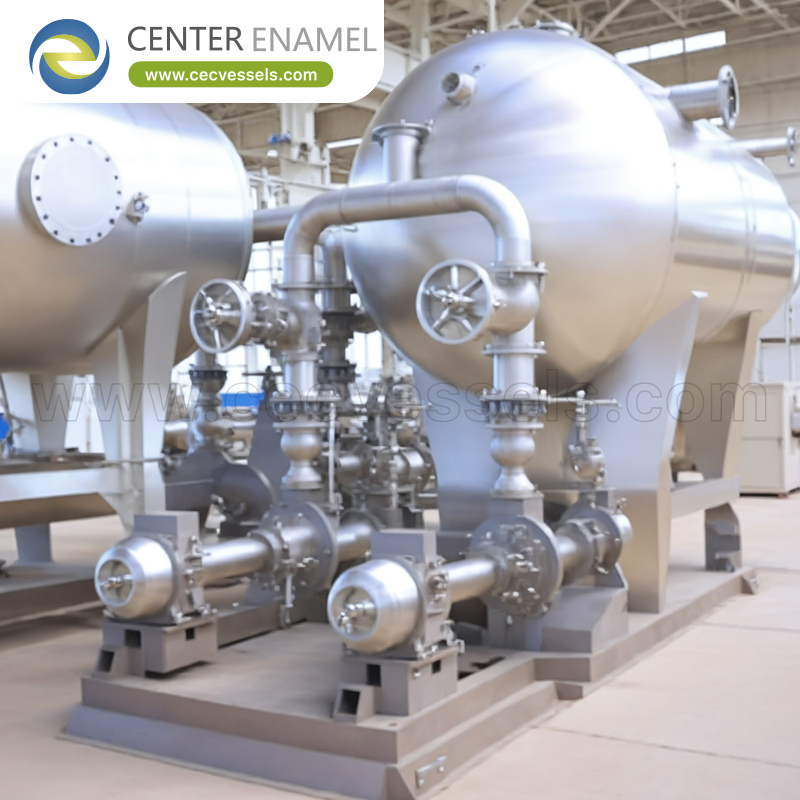
Answering the core question: What is a sterile reactor, and how does it maintain a contamination-free environment for aseptic production? A sterile reactor is a vessel validated to keep bioburden below 1 CFU/100 mL through sterilize-in-place (SIP) at 121-134 degree C for 15-30 min and clean-in-place (CIP) cycles. Aseptic mechanical seals, sterile 0.2 micrometer vent and feed filters, and an inert barrier prevent microbial ingress during batch transfer. Used in vaccine, monoclonal-antibody, and ophthalmic lines, sterile reactors of 0.1-20 m3 meet SAL 10 to the minus 6 (probability of a non-sterile unit below 10 to the minus 6) and pass media-fill challenges before commercial use.
Core Operating Principles of Sterile Reactors- **SIP Sterilization:** Saturated steam at 121-134 degree C for 15-30 min achieves SAL 10 to the minus 6 across all wetted surfaces, validated by thermocouple mapping.
- **Aseptic Transfer and Seals:** Double mechanical seals with sterile barrier fluid and aseptic diaphragm valves stop contamination at every inlet or outlet.
- **Bioburden Monitoring:** In-process sampling and 0.2 micrometer vent filtration keep the headspace and product at below 1 CFU/100 mL throughout the run.
- **SIP/CIP Stainless Bioreactor:** 316L electropolished (Ra below 0.8 micrometer) vessel for mammalian and microbial aseptic culture.
- **Single-Use Sterile Reactor:** Pre-sterilized bag or rig system eliminating SIP, used for multi-product pharma flexibility.
- **Aseptic Pilot Reactor:** 10-200 L glass or steel for process development under GMP aseptic conditions.
Sterile Reactor Type |
Sterilization |
Surface Finish |
Scale |
SIP/CIP SS |
Steam 121-134 degree C |
Ra <0.8 micrometer |
0.1-20 m3 |
Single-Use |
Gamma pre-sterile |
Bag film |
50-2,000 L |
Aseptic Pilot |
SIP + aseptic |
Ra <0.5 micrometer |
10-200 L |
Glass (dev) |
Autoclave |
Borosilicate |
1-50 L |