-
Glass Fused To Steel Tanks (896)
-
Stainless Steel Tanks (434)
-
Fusion Bonded Epoxy Tanks (652)
-
Galvanized Steel Tanks (321)
-
Aluminum Dome Roofs (1336)
-
Wastewater Storage Tanks (280)
-
Welded Steel Tanks (457)
-
Pressure Vessels (426)
-
Anaerobic Digester (202)
-
Industrial Water Tanks (349)
-
Glass Lined Steel Tanks (180)
-
Bolted Steel Tanks (389)
-
Sludge Storage Tank (115)
-
Biogas Storage Tank (173)
-
Leachate Storage Tanks (133)
-
Agricultural Water Storage Tanks (179)
-
Fire Water Tank (166)
-
Grain Storage Silos (146)
-
Biogas Projects (424)
-
Wastewater Treatment Projects (1712)
-
Double Membrane Roof (223)
|
What Is a Nitrogen Reactor? Principles, Design & Applications
| Place of Origin: | China |
| Brand Name: | Center Enamel |
| Certification: | ISO 9001,CE, NSF/ANSI 61, WRAS, ISO 28765, LFGB, BSCI, ISO 45001 |
| Minimum Order Quantity: | 1 Sets |
| Price: | 2000 |
| Delivery Time: | 2 months |
| Payment Terms: | L/C,T/T |
| Supply Ability: | 200 sets / days |
|
Detail Information |
|||
Product Description
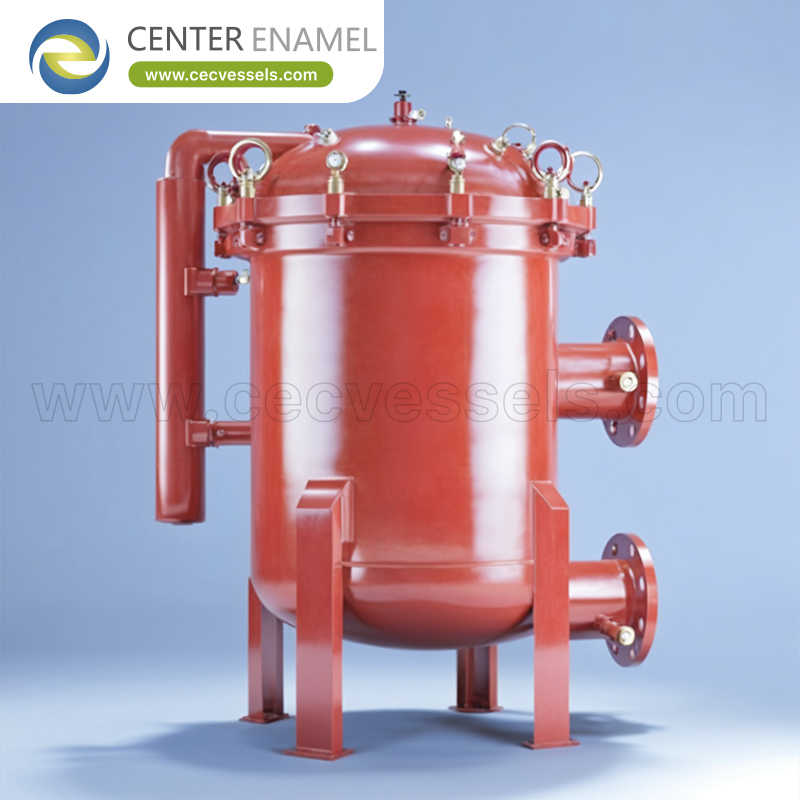
Answering the core question: What is a nitrogen reactor, and how does an inert nitrogen atmosphere protect sensitive and hazardous reactions? A nitrogen reactor is a vessel operated under a continuous or batch nitrogen blanket that displaces oxygen to below 50 ppm, eliminating combustion and oxidation risk. By holding the vapor-space oxygen concentration under 5 percent of the lower explosive limit (LEL), it permits handling of flammable solvents, pyrophoric catalysts, and oxygen-sensitive actives. Nitrogen is supplied at 0.1-10 MPa from cryogenic or PSA generators delivering 95-99.999 percent purity, while a purge-and-pressurize sequence reduces residual O2 to below 100 ppm before the batch starts.
Core Operating Principles of Nitrogen Reactors- **Inert Blanketing:** A steady N2 flow keeps vapor-space O2 below 5 percent LEL; pressure-vacuum vents (PVRV) maintain slight positive pressure to exclude air ingress.
- **Purge-and-Pressurize (P and P):** Three-volume nitrogen sweeps cut residual O2 from 21 percent to below 100 ppm before heating, preventing explosive mixtures.
- **O2 Monitoring and Interlock:** In-line paramagnetic O2 analyzers trip feed or heat if concentration exceeds setpoint, integrating with explosion-isolation valves.
- **Nitrogen-Blanketed Stirred Reactor:** Standard agitated vessel with N2 pad for solvent-based and pyrophoric-catalyst batches.
- **Glovebox-Integrated Reactor:** Sealed reactor inside an N2 glovebox (below 1 ppm O2) for air-free organometallic synthesis.
- **Cryogenic or PSA Fed System:** On-site generator delivering 95-99.999 percent N2 to a battery of reactors, removing cylinder logistics.
N2 Reactor Mode |
O2 Target |
Purity Needed |
Primary Purpose |
Blanketed |
<5% LEL (~1% v) |
95-99 percent |
Fire/oxidation prevention |
Purge-Pressurize |
<100 ppm |
99.5-99.9 percent |
Safe start-up |
Glovebox |
<1 ppm |
99.999 percent |
Air-free synthesis |
Sparge (liq) |
dissolved O2 <10 ppb |
99.9 percent |
O2-free product |
Q: Why use nitrogen instead of just closing the vessel?
A: Air leaks and thermal breathing draw oxygen in; a nitrogen blanket holds O2 below the 5 percent LEL threshold, preventing flammable or oxidative incidents.
Q: How low must oxygen go for explosive solvents?
A: Below 5 percent of the solvent LEL (often below 1 percent v) is the safe blanketing target; start-up purge reduces residual O2 to under 100 ppm.
Q: Where does the nitrogen come from?
A: On-site PSA or cryogenic generators supply 95-99.999 percent N2; high-purity glovebox work needs 99.999 percent to hold below 1 ppm O2.
Q: What failsafe protects a nitrogen reactor?
A: Paramagnetic O2 analyzers interlock with feed and heat; if O2 rises above setpoint, the system isolates and inerts the vessel.