-
Glass Fused To Steel Tanks (896)
-
Stainless Steel Tanks (434)
-
Fusion Bonded Epoxy Tanks (652)
-
Galvanized Steel Tanks (321)
-
Aluminum Dome Roofs (1336)
-
Wastewater Storage Tanks (280)
-
Welded Steel Tanks (457)
-
Pressure Vessels (426)
-
Anaerobic Digester (202)
-
Industrial Water Tanks (349)
-
Glass Lined Steel Tanks (180)
-
Bolted Steel Tanks (389)
-
Sludge Storage Tank (115)
-
Biogas Storage Tank (173)
-
Leachate Storage Tanks (133)
-
Agricultural Water Storage Tanks (179)
-
Fire Water Tank (166)
-
Grain Storage Silos (146)
-
Biogas Projects (424)
-
Wastewater Treatment Projects (1712)
-
Double Membrane Roof (223)
|
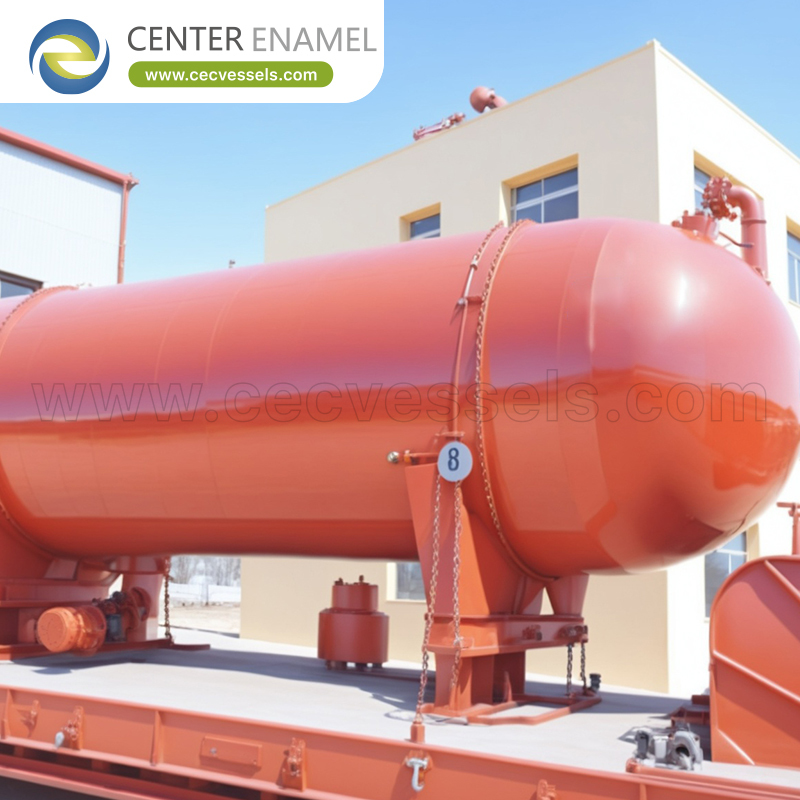
What Is a Jacketed Reactor? Principles, Design & Applications
| Place of Origin: | China |
| Brand Name: | Center Enamel |
| Certification: | ISO 9001,CE, NSF/ANSI 61, WRAS, ISO 28765, LFGB, BSCI, ISO 45001 |
| Minimum Order Quantity: | 1 Sets |
| Price: | 2000 |
| Delivery Time: | 2 months |
| Payment Terms: | L/C,T/T |
| Supply Ability: | 200 sets / days |
|
Detail Information |
|||
Product Description
What Is a Jacketed Reactor? Principles, Design & Applications
Answering the core question: What is a jacketed reactor, and how does its surrounding jacket deliver precise heating and cooling? A jacketed reactor is a vessel wrapped by an outer shell - the jacket - through which heat-transfer fluid circulates to control the reaction temperature within plus or minus 0.5-2 degree C. Jackets raise the effective heat-transfer area by 2-4 times versus internal coils alone, supporting duties from minus 40 degree C cryogenic cooling to 350 degree C thermal-oil heating at design pressures of 0.1-10 MPa. Dimple and half-pipe coil geometries raise the overall coefficient (U) to 150-500 W/m2K, allowing exothermic loads of 50-200 kW to be removed per cubic meter of batch.
Core Operating Principles of Jacketed Reactors
- **Jacket Heat-Transfer Geometry:** Dimple jackets (0.3-1.0 MPa coolant) and half-pipe coils (up to 6 MPa) raise turbulence, lifting U from 50 W/m2K (plain) to 500 W/m2K.
- **Thermal Fluid Selection:** Water-glycol (minus 40 to 120 degree C), steam (up to 200 degree C at 1.5 MPa), or thermal oil (to 350 degree C) is chosen by duty; flow velocity above 1.5 m/s avoids stratification.
- **Temperature Control Loop:** PID with jacket inlet/outlet sensors and cascade to reactor thermowell holds setpoint within plus or minus 0.5 degree C for pharma and specialty batches.
Major Types of Jacketed Reactors
- **Dimple Jacket Vessels:** Laser-welded dimples create turbulent film; cost-effective for 0.5-20 m3 tanks at moderate 0.3-1.0 MPa jacket pressure.
- **Half-Pipe Coil Jackets:** Segmented 180 degree coils welded to shell handle 2-6 MPa and severe thermal cycling; preferred for exothermic polymerization.
- **Limpet Coil (External Coil):** Dual coils (heat/cool) on external shell for 50-200 m3 large reactors where full jacket is uneconomic.
Jacketed Reactor Types Comparison Matrix
Jacket Type |
Construction |
Pressure / Temp Range |
Heat-Transfer Coefficient U |
Dimple Jacket |
Spot-welded dimples, single shell |
0.3-1.0 MPa / -40 to 200 degree C |
200-400 W/m2K |
Half-Pipe Coil |
180 degree pipe sections welded on |
2-6 MPa / -40 to 350 degree C |
300-500 W/m2K |
Limpet Coil |
External serpentine coils |
1-4 MPa / -20 to 300 degree C |
150-350 W/m2K |
Plain Jacket |
Simple annular shell |
0.1-1.0 MPa / 0-200 degree C |
50-150 W/m2K |
Frequently Asked Questions (FAQ)
Q: What is the main advantage of a jacketed reactor over internal coils?
A: The jacket surrounds the entire shell, delivering 2-4 times more heat-transfer area and more uniform wall temperature, which prevents local hot or cold spots that degrade product quality.
Q: Which jacket type handles the highest pressure?
A: Half-pipe coil jackets tolerate 2-6 MPa because each coil is a separate pressure boundary, making them ideal for high-pressure steam or hot-oil heating.
Q: How is temperature held within plus or minus 0.5 degree C?
A: A cascade PID loop reads jacket supply/return and reactor thermowell, modulating control valves on the thermal-fluid skid several times per minute.
Q: What fluids are used inside the jacket?
A: Water-glycol for sub-ambient duty, low-pressure steam for heating to 200 degree C, and thermal oil for 200-350 degree C; selection balances temperature, pressure, and fire-safety limits.