-
Glass Fused To Steel Tanks (896)
-
Stainless Steel Tanks (434)
-
Fusion Bonded Epoxy Tanks (660)
-
Galvanized Steel Tanks (321)
-
Aluminum Dome Roofs (1336)
-
Wastewater Storage Tanks (280)
-
Welded Steel Tanks (457)
-
Pressure Vessels (505)
-
Anaerobic Digester (217)
-
Industrial Water Tanks (404)
-
Glass Lined Steel Tanks (180)
-
Bolted Steel Tanks (389)
-
Sludge Storage Tank (115)
-
Biogas Storage Tank (173)
-
Leachate Storage Tanks (133)
-
Agricultural Water Storage Tanks (179)
-
Fire Water Tank (166)
-
Grain Storage Silos (146)
-
Biogas Projects (424)
-
Wastewater Treatment Projects (1852)
-
Double Membrane Roof (223)
|
Dished Ends Elliptical Torispherical And Hemispherical Choice
| Place of Origin: | China |
| Brand Name: | Center Enamel |
| Certification: | ISO 9001,CE, NSF/ANSI 61, WRAS, ISO 28765, LFGB, BSCI, ISO 45001 |
| Minimum Order Quantity: | 1 Sets |
| Price: | 2000 |
| Delivery Time: | 2 months |
| Payment Terms: | L/C,T/T |
| Supply Ability: | 200 sets / days |
|
Detail Information |
|||
Product Description
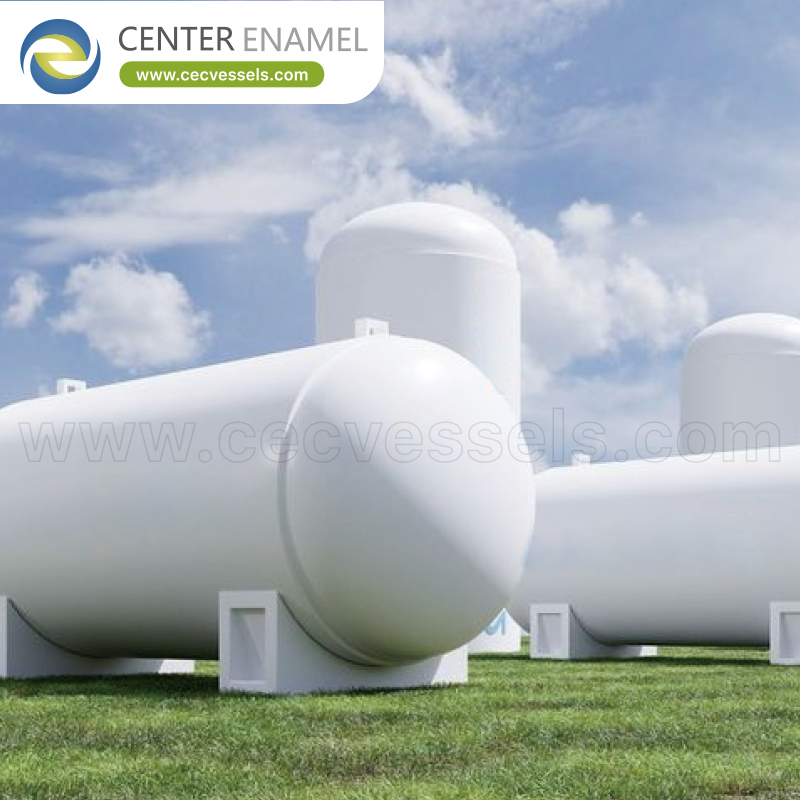
Dished Ends Elliptical Torispherical And Hemispherical Choice
Dished ends are curved vessel closures, but the term covers several distinct geometries whose stress efficiency and required thickness differ sharply. Choosing among them is a geometry decision made before any forming begins.
This guide compares the four dished forms most often specified, using crown and knuckle radii, depth, volume and stress behaviour - not generic head-manufacturing detail, which is covered in the companion heads article.
What Dished Ends Means
In vessel practice, a dished end is any shallow curved closure, but purchasing documents often use the term for a specific form such as an ASME flanged and dished head or a torispherical end. The word alone is therefore not a specification.
The exact geometry must be fixed by its radius definitions, because two ends described as 'dished' can require noticeably different plate thickness for the same diameter and pressure.
The Geometry Family
The common forms are the 2:1 elliptical end, the ASME flanged and dished (F&D) end, the 10% torispherical end and the hemispherical end. Each is defined by a relationship between diameter, crown radius and knuckle radius.
A hemisphere has a crown radius equal to its radius and no knuckle discontinuity. An elliptical end has a continuously varying curvature. Torispherical forms combine a large spherical crown with a small-radius knuckle where most of the stress concentrates.
Crown Radius And Knuckle Radius
The crown radius is the radius of the central spherical cap; the knuckle radius is the transition to the straight flange. In a 10% torispherical end the knuckle radius is limited to about ten percent of the crown diameter, which sets its stress behaviour.
A smaller knuckle radius improves the shallow shape but raises local stress and the required thickness. This single parameter is why geometry, not just nominal diameter, decides how much plate a dished end consumes.
Stress Efficiency Comparison
A hemisphere carries pressure most efficiently and can be thinnest, followed by the 2:1 elliptical end. Torispherical forms are less efficient because of the knuckle, with the ASME F&D form generally more efficient than a 10% torispherical end of the same diameter.
The code thickness formulas carry different coefficients for each family. Reading those coefficients is the reliable way to compare material use, rather than assuming that a shallower end is automatically cheaper once plate thickness is counted.
Depth, Volume And Layout
A shallow dished end saves headspace and adds useful straight-side volume in a vertical vessel, which matters when a vessel must fit a fixed building height. A hemisphere occupies the most depth for the same diameter.
Layout can therefore override pure stress efficiency: a slightly thicker shallow end may be preferred if it avoids a taller vessel, a higher platform or a larger footprint in the plant.
Forming Availability And Cost
Standard diameters of common dished forms are widely available from stock tooling, which reduces cost and lead time for those sizes. Non-standard diameters, knuckle radii or thicknesses require dedicated tooling and a forming trials stage.
Cost comparison should combine plate mass, tooling, forming method and inspection. A geometry that saves plate can still cost more if it needs special tooling or a forming heat treatment.
When A Dished Form Is The Wrong Choice
For high-pressure or heavily cyclic service, a form with a tight knuckle may concentrate enough stress to demand extra thickness or a fatigue assessment. In those cases a 2:1 elliptical or hemispherical end is often the better engineering choice.
The end should also match what the shell can accommodate: flange length, diameter tolerance and thickness transition affect the head-to-shell weld, so an attractive geometry is not useful if it cannot be joined cleanly.
Specifying Dished Ends Correctly
State the diameter basis, the end family, the crown and knuckle radii, the nominal and minimum-after-forming thickness, the material and the applicable code formula. An end bought only by diameter invites a substitute geometry.
Confirm the inspection basis too: thickness mapping and a shape check against a template protect the buyer from an end that looks right but falls below the required minimum at the knuckle.
Dished End Geometry Comparison
| Form | Knuckle | Relative stress |
|---|---|---|
| 2:1 elliptical | Continuous curve | Good |
| ASME F&D | Flanged, moderate | Moderate |
| 10% torispherical | Small (about 10%) | Lower at knuckle |
| Hemispherical | None | Best |
Dished End Geometry Inputs
| Input | Decision effect |
|---|---|
| Diameter basis | Sets all radii |
| End family | Sets code formula |
| Crown radius | Controls curvature |
| Knuckle radius | Controls stress / thickness |
| Straight flange | Sets shell fit-up |
| Thickness after forming | Code acceptance |
| Code and material | Allowable stress |
Conclusion
Dished ends are a geometry choice: hemispherical and 2:1 elliptical forms use plate efficiently, while torispherical and F&D forms buy shallowness at the cost of higher knuckle stress and more thickness.
Specify radii, flange, minimum formed thickness and code together - for the broader topic of head families, forming methods and inspection, use the companion pressure vessel heads article.
About Center Enamel
Center Enamel is a pressure vessel and process equipment manufacturer based in China, producing stainless steel and carbon steel pressure vessels, separators, reactors, heat exchangers and storage tanks for chemical, oil and gas, power, food, pharmaceutical and water-treatment applications.
Fabrication is carried out under ASME VIII Div.1, GB/T 150 and ISO 9001 with CE/PED and NACE MR0175 / ISO 15156 options for sour service. Each unit is supplied with material traceability, documented welding procedures, NDT, hydrostatic testing and an export data book.
- Material range: Stainless steel (304 / 316L), duplex and carbon steel with rubber or epoxy lining for corrosion duty.
- Standards: ASME VIII Div.1, GB/T 150, ISO 9001, CE/PED, NACE MR0175 / ISO 15156.
- Commercial terms: Minimum order quantity 1 unit, typical lead time about 2 months, L/C or T/T.
Frequently Asked Questions (FAQ)
What are dished ends?
Curved vessel end closures; the term covers several geometries with different radii, stress behaviour and required thickness.
What is the difference between a dished end and a head?
Head is the broad component term; dished end usually refers to a curved, shallow closure such as a torispherical or flanged and dished form.
What is a 2:1 elliptical end?
An end whose ellipsoid major and minor axes are in a 2:1 ratio, giving good stress efficiency with moderate depth.
What is an ASME flanged and dished end?
A torispherical form with a crown radius tied to diameter and a straight flange, widely used where a shallow closure is needed.
What does 10% torispherical mean?
A torispherical end whose knuckle radius is limited to roughly ten percent of the head diameter, giving a shallow but less efficient shape.
Why does knuckle radius matter?
A smaller knuckle concentrates stress, which raises the required thickness under the code formula.
Which dished end uses the least plate?
A hemispherical end, because it has the best stress efficiency, though it is the deepest form.
Are dished ends interchangeable?
No. Substituting one geometry for another changes thickness and stress, so the end family and radii must be re-verified.
Does a shallower end save money?
It can save vessel height but may need more plate; total cost combines thickness, tooling and forming.
What is straight flange length?
The short cylindrical portion at the edge of the end that mates with the shell course during welding.
Which form suits cyclic pressure?
A smoothly curved form such as elliptical or hemispherical is generally preferred where a tight knuckle would drive fatigue concerns.
How is a dished end dimensioned?
By diameter basis, crown radius, knuckle radius, flange length and the minimum thickness required after forming.
Can I order by diameter alone?
No. Without family and radii, a supplier may provide a geometry that does not meet your thickness or layout requirement.
What inspection applies?
Thickness mapping around crown and knuckle plus a shape check against a template.
Where do I read about forming and head types?
See the companion pressure vessel heads article for head families, forming methods and inspection.
Suggested CTA: Request a technical quotation with your duty, pressure, temperature and fluid data, or discuss your vessel specification with a Center Enamel engineer for a sized proposal.