-
Glass Fused To Steel Tanks (896)
-
Stainless Steel Tanks (434)
-
Fusion Bonded Epoxy Tanks (660)
-
Galvanized Steel Tanks (321)
-
Aluminum Dome Roofs (1336)
-
Wastewater Storage Tanks (280)
-
Welded Steel Tanks (457)
-
Pressure Vessels (485)
-
Anaerobic Digester (217)
-
Industrial Water Tanks (384)
-
Glass Lined Steel Tanks (180)
-
Bolted Steel Tanks (389)
-
Sludge Storage Tank (115)
-
Biogas Storage Tank (173)
-
Leachate Storage Tanks (133)
-
Agricultural Water Storage Tanks (179)
-
Fire Water Tank (166)
-
Grain Storage Silos (146)
-
Biogas Projects (424)
-
Wastewater Treatment Projects (1832)
-
Double Membrane Roof (223)
|
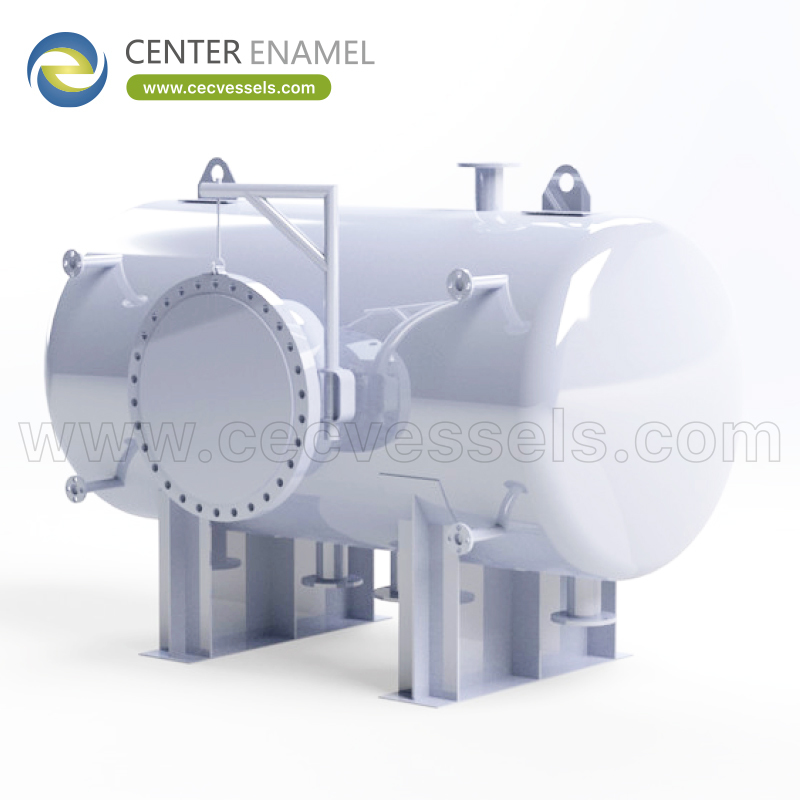
Surge Vessel Water Hammer Protection And Transient Pressure Control
| Place of Origin: | China |
| Brand Name: | Center Enamel |
| Certification: | ISO 9001,CE, NSF/ANSI 61, WRAS, ISO 28765, LFGB, BSCI, ISO 45001 |
| Minimum Order Quantity: | 1 Sets |
| Price: | 2000 |
| Delivery Time: | 2 months |
| Payment Terms: | L/C,T/T |
| Supply Ability: | 200 sets / days |
|
Detail Information |
|||
Product Description
Surge Vessel Water Hammer Protection And Transient Pressure Control
A surge vessel protects a pipeline or process system from water hammer - the pressure spike when flowing liquid is suddenly stopped, started or redirected - by giving the pressure wave an open volume to expand into.
This guide covers the transient problem, the Joukowsky relation, how a surge vessel absorbs the wave, and how it is sized and coded, distinct from a buffer vessel's steady-state holdup.
The Water Hammer Problem
When pump trips, valves close quickly or pipes rupture, the kinetic energy of the moving liquid converts to pressure energy almost instantly. The spike travels back through the line as a compression wave, amplifying at closed valves and bends.
In large pipelines the spike can reach hundreds of psi above normal - far above the pipe rating - damaging pumps, valves and piping. A surge vessel is one of the engineered protections against it.
The Joukowsky Relation
The pressure rise from a sudden velocity change is quantified by the Joukowsky equation: the surge pressure equals fluid density times wave speed times the change in velocity.
For water, a wave speed near 4000 to 4500 ft/s means a velocity change of just 1 ft/s produces roughly 60 to 65 psi; larger lines at 5 to 10 ft/s can produce 300 to 650 psi on a pump trip. The relation sets the protection need.
How A Surge Vessel Works
Connected at a strategic point, the vessel provides a low-resistance path for the wave to dissipate: liquid rises into the tank, converting pressure energy to potential energy, then drains back as the wave subsides.
The vessel does not 'absorb' the wave permanently; it gives it somewhere to go so the spike is not transmitted undiminished to vulnerable downstream equipment.
Surge Vessel Types
Open surge tanks are unpressurised standpipes at or above the hydraulic grade line; closed surge vessels use a gas cushion to maintain pressure; bladder or diaphragm types separate the gas from the liquid to keep the cushion stable.
The choice follows system pressure, pipeline geometry and transient severity - an open standpipe suits a low-pressure gravity system, while a gas-cushioned vessel suits a pressurised pipeline.
Sizing Basis: Velocity And Wave Speed
Surge vessels are sized on pipeline flow velocity and wave speed, and on the transient event being protected against - not on a nominal hold time. The goal is enough open volume at the right location to cap the spike.
This is the core difference from a buffer vessel: surge sizing is transient and velocity-driven, where buffer sizing is steady-state and flow-driven.
Code And ASME Requirement
Surge vessels operating above 15 psig are classified as pressure vessels under ASME VIII Div.1 and must be fabricated and inspected to the applicable requirements, with National Board registration where relevant.
The vessel must therefore carry the rated boundary, the correct stamp and the full data book, the same as any other pressure vessel - the transient duty does not relax the code.
Specification Checklist For Buyers
Provide the pipeline geometry, flow velocity, wave speed, the transient events (pump trip, valve closure), the system pressure and the required code/marking in the request for quotation.
Confirm the builder treats the vessel as a code pressure vessel above 15 psig and sizes on the transient, not a nominal volume, then verify a sample data book.
Surge Versus Buffer Versus Expansion
Type |
Solves |
Response time |
Surge vessel |
Pressure transient |
Milliseconds |
Buffer vessel |
Rate mismatch |
Minutes |
Expansion tank |
Thermal volume |
Hours |
All |
Pressure vessel (if >15 psig) |
Per ASME |
Surge Vessel Specification Inputs
Input |
Why it matters |
Pipeline geometry |
Location of vessel |
Flow velocity |
Sets wave energy |
Wave speed |
Joukowsky term |
Transient events |
Sizing driver |
System pressure |
Code boundary |
Code + marking |
ASME >15 psig |
Conclusion
A surge vessel protects pipelines and pumps from water hammer by giving the pressure wave an open volume to dissipate, sized on flow velocity, wave speed and the transient event - not a hold time.
Above 15 psig it is an ASME VIII Div.1 pressure vessel with the full code boundary and data book; keep it distinct from buffer and expansion duties by response time and sizing basis.
About Center Enamel
Center Enamel is a pressure vessel and process equipment manufacturer based in China, producing stainless steel and carbon steel pressure vessels, separators, reactors, heat exchangers and storage tanks for chemical, oil and gas, power, food, pharmaceutical and water-treatment applications.
Manufacturing is carried out under ASME VIII Div.1, GB/T 150 and ISO 9001 with CE/PED and NACE MR0175 / ISO 15156 options for sour service. Each unit is supplied with material traceability, hydrostatic or pneumatic testing, NDT and export documentation.
- Material range: Stainless steel (304 / 316L), duplex, carbon steel with rubber or epoxy lining for corrosion duty.
- Standards: ASME VIII Div.1, GB/T 150, ISO 9001, CE/PED, NACE MR0175 / ISO 15156.
- Commercial terms: Minimum order quantity 1 unit, typical lead time about 2 months, L/C or T/T.
Frequently Asked Questions (FAQ)
What is a surge vessel?
A pressure vessel connected to a pipeline that absorbs sudden pressure transients (water hammer) by giving the wave an open volume to expand into.
What is water hammer?
A pressure spike when moving liquid is suddenly stopped, started or redirected; it can reach hundreds of psi above rating and damage equipment.
What is the Joukowsky relation?
Surge pressure equals fluid density times wave speed times the velocity change; it quantifies the spike from a sudden velocity change.
How big is a typical spike?
For water, ~60-65 psi per 1 ft/s velocity change; large lines at 5-10 ft/s can hit 300-650 psi on a pump trip.
How does a surge vessel work?
Liquid rises into the vessel, converting pressure energy to potential energy, then drains back as the wave subsides.
What surge vessel types exist?
Open standpipes, gas-cushioned closed vessels, and bladder/diaphragm types that separate gas from liquid.
How is a surge vessel sized?
On pipeline flow velocity, wave speed and the transient event - not a nominal hold time like a buffer.
Is a surge vessel a pressure vessel?
Above 15 psig yes; it is classified under ASME VIII Div.1 and must be fabricated and inspected accordingly.
How is surge different from buffer?
Surge is millisecond transient absorption; buffer is minutes-to-hours steady-state holdup.
Where is the vessel located?
At a strategic point on the pipeline - high points, pump discharge or valve stations - where the wave can dissipate.
What documents prove compliance?
Material certs, WPS/PQR, NDT, hydrostatic test and the data report, plus NB registration where relevant.
How long to fabricate?
About 2 months from a China manufacturer for an engineered vessel scheduled around certification.
What should the RFQ state?
Pipeline geometry, velocity, wave speed, transient events, system pressure and code/marking.
Why verify the data book early?
It proves the vessel is sized on the transient, not a nominal volume, before build.
Can one tank do surge and buffer?
Often if sized for both, but the dominant duty should drive sizing; mixing blindly risks under-protection.
Suggested CTA: Request a technical quotation with your duty, pressure, temperature and fluid data, or discuss your project with a Center Enamel engineer for a sized proposal.