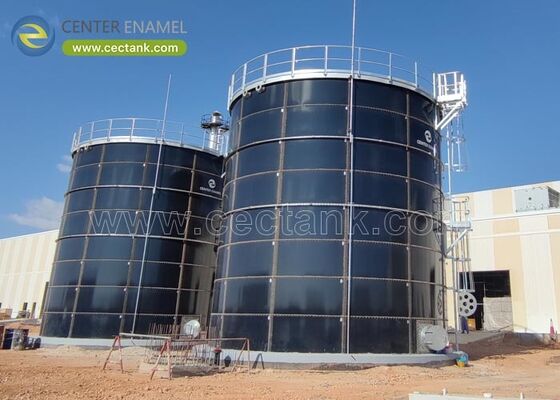
-
Glass Fused To Steel Tanks (882)
-
Stainless Steel Tanks (434)
-
Fusion Bonded Epoxy Tanks (622)
-
Galvanized Steel Tanks (321)
-
Aluminum Dome Roofs (1336)
-
Wastewater Storage Tanks (280)
-
Welded Steel Tanks (457)
-
Pressure Vessels (295)
-
Anaerobic Digester (202)
-
Industrial Water Tanks (349)
-
Glass Lined Steel Tanks (180)
-
Bolted Steel Tanks (389)
-
Sludge Storage Tank (115)
-
Biogas Storage Tank (173)
-
Leachate Storage Tanks (133)
-
Agricultural Water Storage Tanks (179)
-
Fire Water Tank (166)
-
Grain Storage Silos (146)
-
Biogas Projects (424)
-
Wastewater Treatment Projects (1650)
-
Double Membrane Roof (223)


|
Storage Tank: Types, Materials and How to Choose One
| Place of Origin: | China |
| Brand Name: | CEC TANKS |
| Certification: | ISO 9001:2008, AWWA D103 , OSHA , BSCI |
| Model Number: | W |
| Minimum Order Quantity: | 1set |
| Price: | $5000~$20000 one set |
| Packaging Details: | PE poly-foam between each two steel plates ; wooden pallet and wooden |
| Delivery Time: | 10-30 days after deposit received |
| Payment Terms: | L/C,T/T |
| Supply Ability: | 60 sets per month |
|
Detail Information |
|||
| Place of Origin | China | Brand Name | CEC TANKS |
|---|---|---|---|
| Certification | ISO 9001:2008, AWWA D103 , OSHA , BSCI | Model Number | W |
| Tank Body Color: | Dark Green / Can Be Customized | Corrosion Integrity: | Excellent |
| Steel Plates Thickness: | 3mm To 12mm , Depends On The Tank Structure | Chemical Resistance: | Excellent |
| Size Of Panel: | 2.4M * 1.2M | Easy To Clean: | Smooth, Glossy, Inert, Anti-adhesion |
| Highlight: | glass fused to steel storage tank,storage tank material types,how to choose storage tank |
||
Product Description
Storage Tank: Types, Materials and How to Choose One
A storage tank is one of the simplest items on a plant drawing and one of the easiest to get wrong, because the choice is usually made on capacity and price alone. What actually determines whether the tank performs is a shorter list: what is going in it, how the site can be accessed, what the climate does, and who has to maintain it in fifteen years. Capacity comes last, once those are answered.
The market divides along a few clear lines - bolted or welded, coated carbon steel or stainless, and a handful of roof and foundation options. Each has a domain where it is clearly the right answer. Shijiazhuang Zhengzhong Technology Co., Ltd. (Center Enamel) manufactures across the bolted range and supplies welded vessels, so the recommendation is made on the duty rather than on the product line.
1. What Are the Main Types of Storage Tank?
Tanks are classified by how they are built, what they are made of, and what they hold. The categories overlap, and most real specifications name one option from each.
- By Construction: Bolted tanks are assembled from factory-coated panels; welded tanks are fabricated from plate, either in a shop or on site. This is the first and most consequential split.
- By Material: Coated carbon steel in its glass-fused, fusion-bonded epoxy or galvanized forms, stainless steel in 304 or 316L, and concrete for some large municipal duties.
- By Roof: Open top, fixed cone or dome, aluminium geodesic dome, and floating roofs for volatile products. The roof is a process decision as much as a structural one.
- By Service: Atmospheric tanks operate near ambient pressure, while low-pressure vessels cover digester and gas holder duty. The distinction changes the code and the safety devices.
- By Location: Above ground is the norm for inspection and maintenance; below ground is used where space, security or temperature stability requires it, at the cost of inspectability.
2. Bolted or Welded - Which Is Right?
There is no universal winner, but there are clear signals. Bolted construction favours factory-applied coating, remote sites and future relocation; welded construction suits very large or high-pressure duty and sites with good fabrication access.
- Coating Quality: A bolted tank is coated and fired in a factory, then assembled. A welded tank is usually coated after welding, so coating quality depends on site surface preparation and weather.
- Site Access and Schedule: Bolted tanks ship as panels and erect quickly with modest lifting equipment, which suits remote or constrained sites where welding would be slow.
- Capacity and Pressure: Very large atmospheric tanks and anything above low pressure generally move toward welded construction and the applicable pressure or tank code.
- Relocation and Expansion: Bolted tanks can be dismantled, moved and extended. That flexibility is worth real money on leased sites and phased developments.
- Quality Control Location: Bolted construction puts most critical work in the factory. Welded construction puts it on site, where supervision and conditions vary.
3. How Do You Select by Contents and Site?
Work through the stored medium and the site conditions before looking at dimensions. The answers narrow the field quickly and usually leave one or two sensible options.
- Corrosivity and Chemistry: pH, chlorides, sulphides and solvents decide the coating or alloy. For drinking water, product contact approval is a separate and additional requirement.
- Temperature: Elevated temperature accelerates attack and narrows coating choice. Warm chloride-bearing water in particular rules out the common stainless grades.
- Abrasion: Solids in suspension wear surfaces continuously. Where the stream is abrasive, surface hardness becomes a selection criterion alongside corrosion resistance.
- Capacity and Footprint: Available plot area, height limits and access for construction constrain the geometry, which then feeds back into shell and foundation design.
- Climate and Codes: Wind, snow, seismic, freeze risk and the applicable standard - AWWA D103-09 for bolted steel, or the relevant local code - shape the structural design.
| Selection Factor | Favours Bolted Coated Steel | Favours Welded Steel |
| Coating requirement | Factory-fired coating applied under controlled conditions | Coating applied after welding, dependent on site conditions |
| Site access | Remote or constrained sites, modest lifting equipment | Good access with room for fabrication and heavy lifts |
| Capacity and pressure | Atmospheric and low-pressure duty | Very large atmospheric tanks and higher design pressures |
| Future change | Dismantling, relocation and staged expansion | Permanent installation with no relocation intent |
| Delivery schedule | Short site programme, most work done in the factory | Longer site programme with weather exposure |
Engineering Assurance and Project Support
Every tank delivered by Shijiazhuang Zhengzhong Technology Co., Ltd. (Center Enamel) is engineered against AWWA D103-09 and EN 1090 with finite element verification of shell, roof and nozzle loads, fused at 820-930°C under ISO 9001 and ISO 45001 control, holiday tested at 1500 V across one hundred percent of the surface, and assembled with Grade 8.8 bolts and manufacturer-certified sealant. Tanks are supplied across the bolted and welded range with coating or alloy selected for the stored medium, engineered to AWWA D103-09, EN 1090 or the applicable local code, with shell design for the site's wind, snow and seismic conditions, roof options from aluminium geodesic domes to gas-tight covers, factory-formed penetrations, and full coating, test and material documentation.
"Choose the tank by what goes in it and where it stands. Capacity is the last question, not the first."
Frequently Asked Questions (FAQ)
What is the most common mistake when selecting a storage tank?
Choosing on capacity and price before defining the duty. The stored medium's chemistry and temperature, the site's access and climate, and the applicable code will usually eliminate most options on their own - and choosing without them tends to produce a tank that is correct in volume and wrong in every other respect.
Are bolted tanks as strong as welded tanks?
For atmospheric and low-pressure storage, a correctly engineered bolted tank designed to AWWA D103-09 carries the same loads as a welded tank of the same geometry. The differences are in coating quality, site programme, relocation and the applicable code, not in structural adequacy for the intended service.
Which coating should I choose for drinking water?
Start with the product contact approval - NSF/ANSI 61 or WRAS depending on the market - because that is a health effect requirement and not a corrosion one. Then select the coating for the water's chemistry and temperature. The two are independent and both belong in the specification.
Can a storage tank be customized to our requirements?
Yes. Construction type, capacity and geometry, coating or alloy, roof type, nozzle and instrument layout, insulation, access and foundation design are all configured to the stored medium, the site conditions and the applicable standard, and documented before manufacture.