-
Glass Fused To Steel Tanks (704)
-
Stainless Steel Tanks (434)
-
Fusion Bonded Epoxy Tanks (592)
-
Galvanized Steel Tanks (321)
-
Aluminum Dome Roofs (1336)
-
Wastewater Storage Tanks (237)
-
Welded Steel Tanks (457)
-
Pressure Vessels (295)
-
Anaerobic Digester (202)
-
Industrial Water Tanks (349)
-
Glass Lined Steel Tanks (180)
-
Bolted Steel Tanks (389)
-
Sludge Storage Tank (115)
-
Biogas Storage Tank (173)
-
Leachate Storage Tanks (133)
-
Agricultural Water Storage Tanks (179)
-
Fire Water Tank (166)
-
Grain Storage Silos (146)
-
Biogas Projects (424)
-
Wastewater Treatment Projects (1410)
-
Double Membrane Roof (223)

|
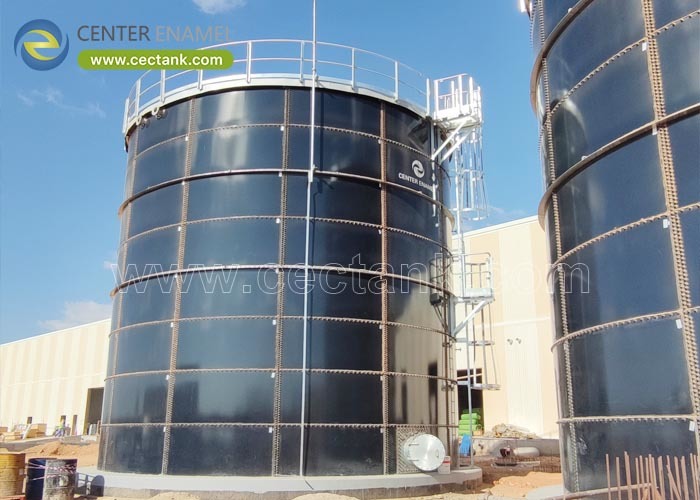
Good Quality Glass Lined Steel Biogas Tanks: The Evidence Behind the Claim
| Place of Origin: | China |
| Brand Name: | CEC TANKS |
| Certification: | ISO 9001:2008, AWWA D103 , OSHA , BSCI |
| Model Number: | J2016012316 |
| Minimum Order Quantity: | 1set |
| Price: | $5000~$20000 one set |
| Packaging Details: | PE poly-foam between each two steel plates ; wooden pallet and wooden box |
| Delivery Time: | 0-60 days after deposit received |
| Payment Terms: | L/C,T/T |
| Supply Ability: | 60 sets per month |
|
Detail Information |
|||
| Place of Origin | China | Brand Name | CEC TANKS |
|---|---|---|---|
| Certification | ISO 9001:2008, AWWA D103 , OSHA , BSCI | Model Number | J2016012316 |
| Acid And Alkalinity Proof: | Standard Coating Suits For PH3 - PH11, Special Coating Suits For PH1 - PH14 | Elastic: | Same As Steel Sheet , Around 500KN/mm |
| Serive Life: | More Than 30 Years | PH Range: | PH 1 - PH 14 |
| Coating Color: | Dark Blue, Dark Green , White, And Customized | Steel Plates Thickness: | 3mm - 12mm , Depends On The Diameter & Height |
| Easy Yo Clean: | Smooth, Glossy, Inert, Anti-adhesion | Coating Thickness: | 4.0.25mm - 0.4mm, Two Coating Internal And External |
| Highlight: | glass lined steel biogas tanks,glass fused to steel tanks with warranty,durable biogas storage tanks |
||
Product Description
Good Quality Glass Lined Steel Biogas Tanks: The Evidence Behind the Claim
Every supplier describes their biogas tanks as high quality, which makes the word useless as a buying criterion. In anaerobic digestion the consequences of getting it wrong are unusually severe and unusually slow to appear. A digester that loses gas tightness does not visibly fail; it simply produces less methane than the design case, and the shortfall is usually attributed to feedstock variability or operator error for years before anyone suspects the vessel. A coating that degrades in warm, acidic digestate does the same thing, and by the time bare steel is visible the plant has already lost a large part of its revenue case.
Quality in a glass lined steel biogas tank is therefore not a claim about finish or appearance. It is a set of measurable manufacturing facts and a set of design decisions about gas tightness, temperature and mixing that can be inspected, tested and documented before the tank ships. Shijiazhuang Zhengzhong Technology Co., Ltd. (Center Enamel) has built glass-fused-to-steel digesters since 2008 and holds close to two hundred enamelling patents; this is the evidence set we would expect any serious buyer to demand.
1. What Does Quality Actually Mean in a Biogas Tank?
For a digester, quality reduces to four measurable things: the coating is genuinely fused, the vessel is gas tight, the shell handles the thermal and mixing loads, and the penetrations are formed under the same quality system as the plates. Everything else is presentation.
- Genuine Fusion: The glass frit must be fired at 820-930 degrees Celsius to form a metallurgical bond. Coatings cured below that range are films, and films undercut, blister and eventually detach in warm digestate.
- Verified Continuity: One hundred percent holiday testing at 1500 V is the only practical way to confirm that no pinholes exist across the whole surface. Sampling is not sufficient on a gas-generating vessel.
- Gas Tightness: A digester is a pressure boundary holding methane at typically 5 to 30 mbar. Every joint, penetration and roof seal is a potential leak, and leaks are lost revenue, odour and safety exposure at the same time.
- Temperature Capability: Mesophilic operation runs at 35-38 degrees Celsius and thermophilic at 50-55. The coating and the joint sealant must both be rated for the upper end of the intended range, including the excursion during pasteurisation if that applies.
- Penetration Integrity: Feed pipes, draw-off points, heating coils, mixing nozzles, gas outlets and instrument ports all breach the shell. Each one must be formed and coated in the factory, not cut on site.
2. Which Tests Actually Predict Coating Life?
Four tests carry real predictive weight: holiday testing, adhesion, hardness and thickness. They measure different failure modes, and a quotation that quotes one without the others is giving you a partial picture.
- Holiday Testing: Applied at 1500 V across one hundred percent of the surface for 2C2F and 3C3F systems, and at 900 V for 2C1F. This detects pinholes invisible to the eye, which is where corrosion starts.
- Adhesion: Measured at 3450 N/cm squared. High adhesion is what prevents a mechanical damage site from propagating sideways beneath the coating.
- Hardness: Approximately 6.0 on the Mohs scale, which is what allows the surface to survive the abrasive action of grit and fibrous digestate, and cleaning with mechanical equipment.
- Thickness: Typically 0.25 to 0.45 mm depending on the coating system: 210-430 microns for 2C1F, 240-460 for 2C2F, 270-480 for 3C3F. Thickness alone is meaningless without fusion and continuity.
- System Selection by Zone: Quality also means matching the system to the zone. The gas zone and the liquid zone of a digester are different duties, and the specification should say so explicitly.
3. How Do You Compare Two Biogas Tank Quotations?
The only honest comparison is a like-for-like one on coating system, test coverage, gas tightness provisions, thermal design and the scope of supply. Most price gaps between quotations turn out to be scope gaps, and the cheapest number usually omits the items that decide whether the plant performs.
- Coating System Named: Insist that 2C1F, 2C2F or 3C3F is named explicitly for each zone, with the thickness range stated. 'Epoxy equivalent' or 'glass lining' without a system reference is not comparable.
- Test Coverage in the ITP: Require holiday voltage and coverage percentage, adhesion and thickness verification to appear in the inspection and test plan, not in marketing literature.
- Gas Tightness Provisions: Bolt grade, sealant specification, roof type, gas outlet arrangement and pressure-vacuum protection should be itemised. Missing pressure-vacuum relief is a safety defect, not a cost saving.
- Thermal and Mixing Scope: Insulation, heating method, mixing type and their penetrations are frequently excluded from the base price and then appear as variations later.
- Reference Installations: Ask for plants of comparable scale and feedstock that have run for more than five years, and ask for one contact you may call.
| Quality Indicator | What Good Looks Like | What It Prevents |
|---|---|---|
| Firing temperature | 820-930 degrees Celsius, with furnace records | Coating behaving as a film instead of a fused layer |
| Holiday test | 100 percent coverage at 1500 V | Pinholes becoming corrosion initiation sites |
| Adhesion | 3450 N/cm squared | Damage spreading beneath the coating |
| Hardness | Approximately 6.0 Mohs | Abrasion from grit and fibrous digestate |
| Gas tightness | Grade 8.8 bolts, rated sealant, pressure-vacuum relief | Methane loss, odour complaints and safety exposure |
Engineering Assurance and Project Support
Every tank delivered by Shijiazhuang Zhengzhong Technology Co., Ltd. (Center Enamel) is engineered against AWWA D103-09 and EN 1090 with finite element verification of shell, roof and nozzle loads, fused at 820-930°C under ISO 9001 and ISO 45001 control, holiday tested at 1500 V across one hundred percent of the surface, and assembled with Grade 8.8 bolts and manufacturer-certified sealant. Biogas tanks are engineered against AWWA D103-09 and EN 1090 under ISO 9001 and ISO 45001, supplied with heating and insulation provisions, mixing penetrations, gas outlet and pressure-vacuum protection formed under factory control, and delivered with coating test records, hydrostatic testing documentation and commissioning support.
Frequently Asked Questions (FAQ)
Is glass lined steel the same as glass-fused-to-steel?
Yes. Glass lined steel, glass-fused-to-steel and vitreous enamel all describe a glass frit fused to steel at 820-930 degrees Celsius. The terms are used interchangeably in different markets, and the manufacturing evidence behind them matters more than the label.
What temperature range can a glass lined digester handle?
Mesophilic operation at 35-38 degrees Celsius and thermophilic at 50-55 are both well within capability, and pasteurisation excursions can be accommodated with the appropriate coating system and joint sealant. The sealant rating is usually the limiting component, not the coating.
How much gas loss should be expected from a well-built digester?
A properly specified and erected bolted digester should be effectively gas tight. Measurable methane loss is a symptom of a specification or erection defect - usually sealant, bolt torque or roof penetrations - rather than an inherent characteristic of bolted construction.
Can the digester be configured to our feedstock and operating temperature?
Yes. Volume, aspect ratio, coating system by zone, heating method, insulation, mixing type and gas handling are all configured to the feedstock and the operating regime. Provide the feedstock analysis, target temperature and retention time and the vessel is engineered to suit.