-
Glass Fused To Steel Tanks (704)
-
Stainless Steel Tanks (434)
-
Fusion Bonded Epoxy Tanks (592)
-
Galvanized Steel Tanks (321)
-
Aluminum Dome Roofs (1336)
-
Wastewater Storage Tanks (237)
-
Welded Steel Tanks (457)
-
Pressure Vessels (295)
-
Anaerobic Digester (202)
-
Industrial Water Tanks (349)
-
Glass Lined Steel Tanks (180)
-
Bolted Steel Tanks (389)
-
Sludge Storage Tank (115)
-
Biogas Storage Tank (173)
-
Leachate Storage Tanks (133)
-
Agricultural Water Storage Tanks (179)
-
Fire Water Tank (166)
-
Grain Storage Silos (146)
-
Biogas Projects (424)
-
Wastewater Treatment Projects (1410)
-
Double Membrane Roof (223)

|
Enamel Water Tank: What the Coating Does That Paint Cannot
| Place of Origin: | China |
| Brand Name: | CEC TANKS |
| Certification: | ISO 9001:2008, AWWA D103 , OSHA , BSCI |
| Model Number: | J2016012316 |
| Minimum Order Quantity: | 1set |
| Price: | $5000~$20000 one set |
| Packaging Details: | PE poly-foam between each two steel plates ; wooden pallet and wooden box |
| Delivery Time: | 0-60 days after deposit received |
| Payment Terms: | L/C,T/T |
| Supply Ability: | 60 sets per month |
|
Detail Information |
|||
| Place of Origin | China | Brand Name | CEC TANKS |
|---|---|---|---|
| Certification | ISO 9001:2008, AWWA D103 , OSHA , BSCI | Model Number | J2016012316 |
| Acid And Alkalinity Proof: | Standard Coating Suits For PH3 - PH11, Special Coating Suits For PH1 - PH14 | Elastic: | Same As Steel Sheet , Around 500KN/mm |
| Serive Life: | More Than 30 Years | PH Range: | PH 1 - PH 14 |
| Coating Color: | Dark Blue, Dark Green , White, And Customized | Steel Plates Thickness: | 3mm - 12mm , Depends On The Diameter & Height |
| Easy Yo Clean: | Smooth, Glossy, Inert, Anti-adhesion | Coating Thickness: | 4.0.25mm - 0.4mm, Two Coating Internal And External |
| Highlight: | enamel water tank coating,glass fused steel tanks,enamel coated water tank |
||
Product Description
Enamel Water Tank: What the Coating Does That Paint Cannot
Potable water storage has a problem that other liquid duties do not: whatever protects the steel ends up in the water. Every lining is a potential source of taste, odour, extractables and eventually visible flakes, and every lining is also a maintenance commitment that a water utility has to schedule, budget and take a tank out of service to perform. Paint systems handle this acceptably for a while and then start chalking, and the moment chalking begins the utility is balancing water quality complaints against the cost and disruption of draining and relining a tank that is still structurally sound.
An enamel water tank approaches the problem differently. Instead of applying a barrier film to the steel, a glass frit is fused to the plate at 820-930 degrees Celsius so that the protective layer becomes part of the surface itself. Shijiazhuang Zhengzhong Technology Co., Ltd. (Center Enamel) has manufactured glass-fused-to-steel water tanks since 2008 and holds close to two hundred enamelling patents. The practical result is a potable contact surface that does not chalk, does not flake and has no scheduled relining interval.
1. What Is an Enamel Water Tank?
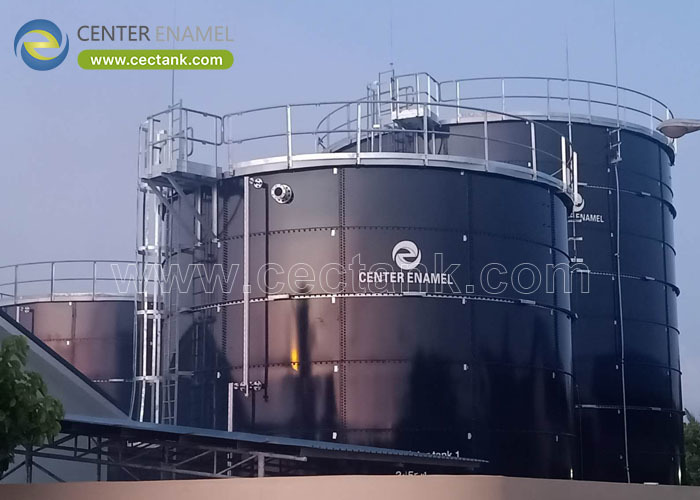
An enamel water tank is a bolted steel tank whose plates carry a vitreous glass coating fused to the steel at high temperature. The coating is inorganic and inert, the bond is metallurgical rather than mechanical, and the plates are assembled on site with sealed, torque-controlled bolted joints.
- Fused, Not Applied: Glass frit is applied to the prepared steel and fired at 820-930 degrees Celsius, producing a bond measured at 3450 N/cm squared in adhesion testing.
- Inorganic Surface: Because the finished surface is glass rather than an organic polymer, it does not support microbial growth the way a roughened film does and it does not release organic extractables into the water.
- Bolted Assembly: Plates are joined with Grade 8.8 bolts and manufacturer-certified sealant, which allows a tank of any practical diameter to be built on a prepared foundation without site welding.
- Coating Systems: Two-coat-one-fire is the standard potable system; two-coat-two-fire and three-coat-three-fire are used where the water is aggressive, the temperature is elevated, or the chemistry is unusual.
- Full Range of Sizes: Bolted enamel tanks are produced from small community supplies through to municipal and industrial installations of tens of thousands of cubic metres.
2. How Is Enamel Different From a Painted Lining?
The difference is the bond and what happens at a defect. A paint film relies on adhesion to a prepared surface and fails by undercutting once water reaches the steel. A fused enamel layer is continuous with the substrate, so damage stays exactly where it is instead of spreading.
- Failure Mode: Paint undercuts and lifts beyond the visible defect. Fused enamel does not, because there is no organic layer for water to travel beneath.
- Chalking and Flaking: Organic films degrade under disinfection residual and ultraviolet exposure at the waterline, producing chalk and eventually flakes in the water. Fired glass is inert to both.
- Hardness: At approximately 6.0 Mohs, the fired surface resists cleaning equipment, ice and grit in a way that a polymer film cannot.
- Disinfection Compatibility: The surface tolerates free chlorine, chloramine and the periodic shock chlorination that a tank has to survive during commissioning and after any water quality incident.
- Relining Interval: Paint systems carry a relining interval of roughly 8 to 15 years depending on the system and the water. Fused enamel has no scheduled relining interval.
3. Is Enamel Suitable for Potable Water, and How Long Does It Last?
Yes, and this is the application the technology was developed for. The surface is certified to NSF/ANSI 61 for potable water contact, and with the appropriate coating system it handles the full range of potable chemistry including aggressive soft water and water with elevated chloride.
- Potable Certification: Systems are available certified to NSF/ANSI 61 for drinking water contact, with WRAS approval for the United Kingdom market and LFGB and FDA 21 CFR 175.300 compliance for food contact applications.
- Taste and Odour: The inert fired surface contributes no taste or odour, which matters particularly for a tank that may hold water for extended periods during low demand.
- Aggressive Water: Soft, low-alkalinity water is corrosive to steel and to concrete, and it is a common reason for specifying enamel. With pH from 3 to 11 as standard and 1 to 14 available on special specification, the range covers essentially all potable chemistry.
- Design Life: Thirty years or more is the design expectation, and because there is no relining cycle the whole-life cost profile is dominated by the initial investment rather than by repeated maintenance campaigns.
- What Actually Ages: The fired coating does not wear out in service. The components with a genuine service interval are the joint sealant, the roof fittings and the external coating, and all three are inspectable and replaceable.
| Evaluation Criterion | Enamel Water Tank (Center Enamel) | Epoxy-Lined Steel | Concrete Reservoir |
|---|---|---|---|
| Bond to substrate | Fused at 820-930 degrees Celsius | Mechanical adhesion to prepared steel | Not applicable |
| Behaviour at a defect | Stays local, no undercutting | Undercuts and spreads beneath film | Cracking exposes reinforcement |
| Potable certification | NSF/ANSI 61, WRAS available | Depends on system and applicator | Requires internal coating in aggressive water |
| Disinfection tolerance | Inert to chlorine and chloramine | Chalks at the waterline over time | Joint materials need periodic renewal |
| Relining interval | None scheduled | Roughly 8 to 15 years | Patch repair and coating renewal |
Engineering Assurance and Project Support
Every tank delivered by Shijiazhuang Zhengzhong Technology Co., Ltd. (Center Enamel) is engineered against AWWA D103-09 and EN 1090 with finite element verification of shell, roof and nozzle loads, fused at 820-930°C under ISO 9001 and ISO 45001 control, holiday tested at 1500 V across one hundred percent of the surface, and assembled with Grade 8.8 bolts and manufacturer-certified sealant. Water tanks are engineered against AWWA D103-09 and EN 1090 under ISO 9001 and ISO 45001, holiday tested at 1500 V across one hundred percent of the surface, assembled with Grade 8.8 bolts and certified sealant, and supplied with aluminum geodesic dome or other roof options, manways, ladders, platforms, level instrumentation and screened vents.
Frequently Asked Questions (FAQ)
Is enamel safe for drinking water?
Yes. The fired glass surface is inert and certified to NSF/ANSI 61 for potable water contact, with WRAS approval available for the UK. Because the surface is inorganic and fully fused, it does not release organic extractables and does not contribute taste or odour to stored water.
Can an enamel tank handle chlorinated water?
Yes. The fired surface is inert to free chlorine and chloramine, including the elevated concentrations used during shock chlorination at commissioning or after a water quality incident. This is one of the areas where the difference from organic linings is most apparent over time.
What maintenance does an enamel water tank need?
Routine inspection of the joint sealant, roof fittings, vents and external coating, and periodic internal inspection and cleaning as the water quality regime requires. There is no scheduled relining, which is the principal whole-life difference from a painted tank.
Can the tank be customised for our capacity and site?
Yes. Diameter, height, coating system, roof type, colour, penetrations, access and instrumentation are all configured to the project. Provide the required capacity, water analysis, available footprint and any certification requirement and the tank will be engineered to match.