-
Glass Fused To Steel Tanks (596)
-
Stainless Steel Tanks (434)
-
Fusion Bonded Epoxy Tanks (592)
-
Galvanized Steel Tanks (321)
-
Aluminum Dome Roofs (1336)
-
Wastewater Storage Tanks (232)
-
Welded Steel Tanks (457)
-
Pressure Vessels (295)
-
Anaerobic Digester (201)
-
Industrial Water Tanks (349)
-
Glass Lined Steel Tanks (180)
-
Bolted Steel Tanks (389)
-
Sludge Storage Tank (115)
-
Biogas Storage Tank (173)
-
Leachate Storage Tanks (133)
-
Agricultural Water Storage Tanks (179)
-
Fire Water Tank (166)
-
Grain Storage Silos (146)
-
Biogas Projects (425)
-
Wastewater Treatment Projects (828)
-
Double Membrane Roof (223)
|
Floating Tank Roofs: The Definitive 2026 Engineering Guide
| Place of Origin: | China |
| Brand Name: | Center Enamel |
| Certification: | ISO 9001 |
| Model Number: | Aluminum Dome Roofs |
| Minimum Order Quantity: | 1 |
| Price: | 100-50000 |
| Packaging Details: | 2000 |
| Delivery Time: | 8 weeks |
| Payment Terms: | L/C,T/T |
| Supply Ability: | 6000 |
|
Detail Information |
|||
Product Description
In the industrial petrochemical and energy sectors, the floating tank roof is the industry-standard solution for containing highly volatile liquids such as crude oil, gasoline, and aviation fuel. By design, these tanks are engineered to prevent evaporation, mitigate fire hazards, and ensure environmental compliance by minimizing the escape of Volatile Organic Compounds (VOCs).
Unlike traditional fixed-roof tanks, which leave a large air pocket (vapor space) above the liquid, a floating roof rests directly on the liquid's surface, rising and falling in tandem with filling and emptying cycles.
The operational efficacy of a floating roof tank relies on two primary physical principles: Buoyancy and Rim Sealing.
- Buoyancy: The roof is constructed to be inherently buoyant. It floats atop the stored product, ensuring that there is virtually no vapor space ("ullage") between the liquid surface and the roof. Because there is little to no space for the liquid to evaporate into, "working losses" and "breathing losses" are reduced by up to 98%.
- Rim Seal Systems: Because the roof must move vertically within the tank shell, there is a small gap between the edge of the roof and the tank wall. This gap is closed by a flexible, engineered rim seal (usually a primary and secondary seal configuration). This prevents vapors from escaping into the atmosphere and keeps contaminants out of the product.
Floating roof tanks are generally classified into two categories based on their design and exposure to the environment.
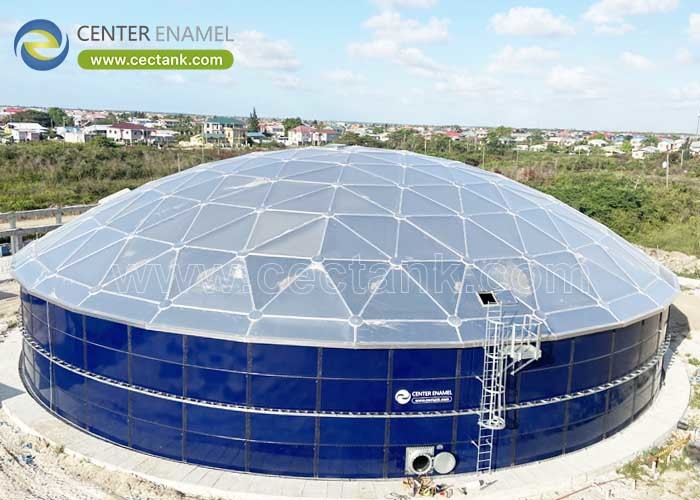
These tanks feature a permanent fixed roof (often an aluminum geodesic dome) above the floating deck.
- Best For: Highly volatile products or regions with significant rain/snow.
- Key Advantage: The fixed outer roof acts as a weather shield, protecting the floating deck from UV radiation, precipitation, and wind, which drastically increases the lifespan of the rim seals.
These tanks do not have a fixed outer roof; the floating deck is directly exposed to the elements.
- Best For: Massive-scale storage in arid or temperate climates.
- Key Advantage: Cost-effective for massive diameters; however, they require complex, articulated drainage systems to handle rainwater.
| Feature | Internal Floating Roof (IFR) | External Floating Roof (EFR) |
|---|---|---|
| Environmental Protection | Fully protected by a fixed roof | Exposed to rain, snow, and wind |
| Emission Control | Excellent (Combined barrier) | Good (Dependent on seal integrity) |
| Maintenance Needs | Low (Protected environment) | Moderate/High (Requires drain cleaning) |
| Typical Product | Refined fuels, jet fuel, chemicals | Crude oil, heavy petroleum |
| Cost Profile | Higher initial CapEx (Dome + Deck) | Lower initial CapEx (Deck only) |
The design and installation of floating roof tanks are governed by strict international standards to ensure safety and emission compliance.
- API 650: The primary standard (American Petroleum Institute) for welded, aboveground storage tanks. Appendices C and H specifically define the requirements for floating roofs, including buoyancy calculations, seal materials, and structural load limits.
- Environmental Mandates: Modern ESG (Environmental, Social, and Governance) targets make the use of floating roofs, particularly IFRs, nearly mandatory for refineries and terminals to avoid fines associated with fugitive VOC emissions.
Why is a floating roof considered "safer" than a fixed-roof tank?
The primary danger in storage tanks is the formation of a flammable vapor-air mixture in the headspace. By resting directly on the liquid, a floating roof eliminates the vapor space entirely, significantly reducing the risk of a fire or explosion.
Can I convert an existing fixed-roof tank to a floating roof tank?
Yes. This is a common retrofit process. Often, a modular, aluminum internal floating roof is installed inside the existing tank shell. This provides the environmental and safety benefits of a floating roof without requiring a total tank replacement.
What happens if the rim seal fails?
If a rim seal fails or deteriorates, the tank will begin to emit VOCs into the atmosphere. This is a major regulatory violation and a safety risk. Regular inspections (typically annually) are required to monitor seal integrity and ensure they remain in continuous contact with the tank shell.
Whether you are choosing between an IFR or an EFR, the decision hinges on the volatility of your product and local climate conditions. For most modern terminal and refinery applications, the Internal Floating Roof (IFR) is preferred for its superior emissions control and reduced maintenance requirements, while External Floating Roof (EFR) tanks remain a cost-effective solution for massive, low-volatility storage in controlled climates. Always ensure your design adheres to API 650 standards for structural and safety compliance.