-
Glass Fused To Steel Tanks (596)
-
Stainless Steel Tanks (434)
-
Fusion Bonded Epoxy Tanks (592)
-
Galvanized Steel Tanks (321)
-
Aluminum Dome Roofs (1336)
-
Wastewater Storage Tanks (232)
-
Welded Steel Tanks (457)
-
Pressure Vessels (295)
-
Anaerobic Digester (201)
-
Industrial Water Tanks (349)
-
Glass Lined Steel Tanks (180)
-
Bolted Steel Tanks (389)
-
Sludge Storage Tank (115)
-
Biogas Storage Tank (173)
-
Leachate Storage Tanks (133)
-
Agricultural Water Storage Tanks (179)
-
Fire Water Tank (166)
-
Grain Storage Silos (146)
-
Biogas Projects (425)
-
Wastewater Treatment Projects (828)
-
Double Membrane Roof (223)
|
The 2026 Engineering Guide to External Floating Roof (EFR) Tanks
| Place of Origin: | China |
| Brand Name: | Center Enamel |
| Certification: | ISO 9001 |
| Model Number: | Aluminum Dome Roofs |
| Minimum Order Quantity: | 1 |
| Price: | 100-50000 |
| Packaging Details: | 2000 |
| Delivery Time: | 8 weeks |
| Payment Terms: | L/C,T/T |
| Supply Ability: | 6000 |
|
Detail Information |
|||
Product Description
In the heavy industrial and petrochemical sectors, large-scale storage of crude oil and other volatile hydrocarbons requires a solution that balances massive capacity with rigorous safety. The External Floating Roof (EFR) tank is the industry standard for these requirements. Unlike fixed-roof or internal floating roof tanks, the EFR operates in an open-top environment, where the roof deck is exposed directly to the elements while resting on the liquid surface.
This engineering guide examines the structural mechanics, material typologies, and operational necessities of EFR tanks in 2026.
An EFR tank relies on a simple yet highly effective principle: hydrostatic buoyancy. The roof is engineered to float directly on the liquid product. By maintaining constant contact with the liquid, the roof eliminates the vapor space (ullage) where flammable gases accumulate.
- Buoyancy & Displacement: The roof deck is designed with a specific buoyancy factor. It must be light enough to float but robust enough to support its own weight, the weight of the rim seals, and any temporary external loads (like accumulated rain or snow) without submerging.
- Rim Seal Systems: Because the tank shell is rarely perfectly circular, the roof requires a flexible "interface" to bridge the gap between the deck edge and the steel wall. This is achieved through Primary and Secondary Rim Seals, which are mandatory under international emission standards to prevent volatile organic compounds (VOCs) from leaking into the atmosphere.
- Grounding: To prevent static discharge (and subsequent ignition), EFRs use flexible stainless steel shunts to maintain electrical continuity between the floating roof and the tank shell, ensuring the entire system is effectively grounded.
EFR designs are categorized by their structural deck configuration. The choice depends on the stored product's volatility and the regional climate.
The most common EFR design, utilizing a ring of closed, buoyant pontoons around the perimeter of the deck.
- Advantages: Cost-effective and provides reliable buoyancy.
- Engineering Note: The center of the deck is typically thinner, making the pontoon arrangement the primary source of the roof's structural integrity.
Constructed with a continuous top and bottom deck separated by structural bulkheads, effectively creating a "sandwich" of closed compartments.
- Advantages: Offers superior insulation, which keeps volatile liquids cooler and reduces evaporation rates.
- Safety: Because of the compartmentalized construction, even if one section is punctured, the roof retains significant reserve buoyancy.
The primary differentiator of an EFR is that it is open-top. This exposes the deck to precipitation (rain and snow), which introduces a unique engineering constraint: Roof Drainage.
If rainwater is allowed to accumulate on the deck, it adds massive, uneven weight that can tilt or sink the roof. To manage this, engineers install:
- Articulated or Flexible Drains: A continuous piping system that runs from the center of the roof, through the stored liquid, to a discharge point at the tank bottom.
- Emergency Siphons: Safety valves that allow trapped water to drain safely if the primary drainage system becomes clogged or fails.
When procuring storage infrastructure, engineering teams must weigh the specific advantages of an External Floating Roof against an Internal Floating Roof (IFR).
| Feature | External Floating Roof (EFR) | Internal Floating Roof (IFR) |
|---|---|---|
| Environmental Exposure | Fully exposed (Open-top) | Shielded (Housed under a dome) |
| Drainage Needs | High (Requires active drain maintenance) | None (Protected from rain/snow) |
| Emission Control | Good (Seal-dependent) | Superior (Double-barrier protection) |
| Primary Risk Factor | Sinking due to blocked drains | Seal deterioration (due to lack of ventilation) |
| Best Application | Large-scale Crude/Refineries | Highly volatile/Chemical storage |
The design and maintenance of EFRs are governed strictly by API 650 (Appendices C and H). Compliance is not optional; it is the benchmark for operational safety.
- Seal Gap Integrity: API 650 mandates regular measurements of the "gap" between the seal and the tank shell. Excessive gaps lead to non-compliance with environmental air quality permits.
- Buoyancy Calculations: The design must account for "worst-case" scenarios, ensuring the roof remains stable even if multiple pontoon compartments are flooded.
- ESG Reporting: Because EFRs are sources of fugitive emissions, modern industrial sites are increasingly required to report VOC leakage rates, making the selection of high-performance seals (such as mechanical shoe seals with wiper backups) critical for long-term compliance.
Q: Why would a facility choose an EFR over an IFR with a dome?
A: EFRs are often chosen for massive-diameter tanks (often exceeding 60+ meters) where the cost of a clear-span aluminum geodesic dome would be prohibitive. In arid climates with minimal rainfall, EFRs provide a cost-effective solution for high-volume storage.
Q: Can I retrofit an existing EFR to an IFR?
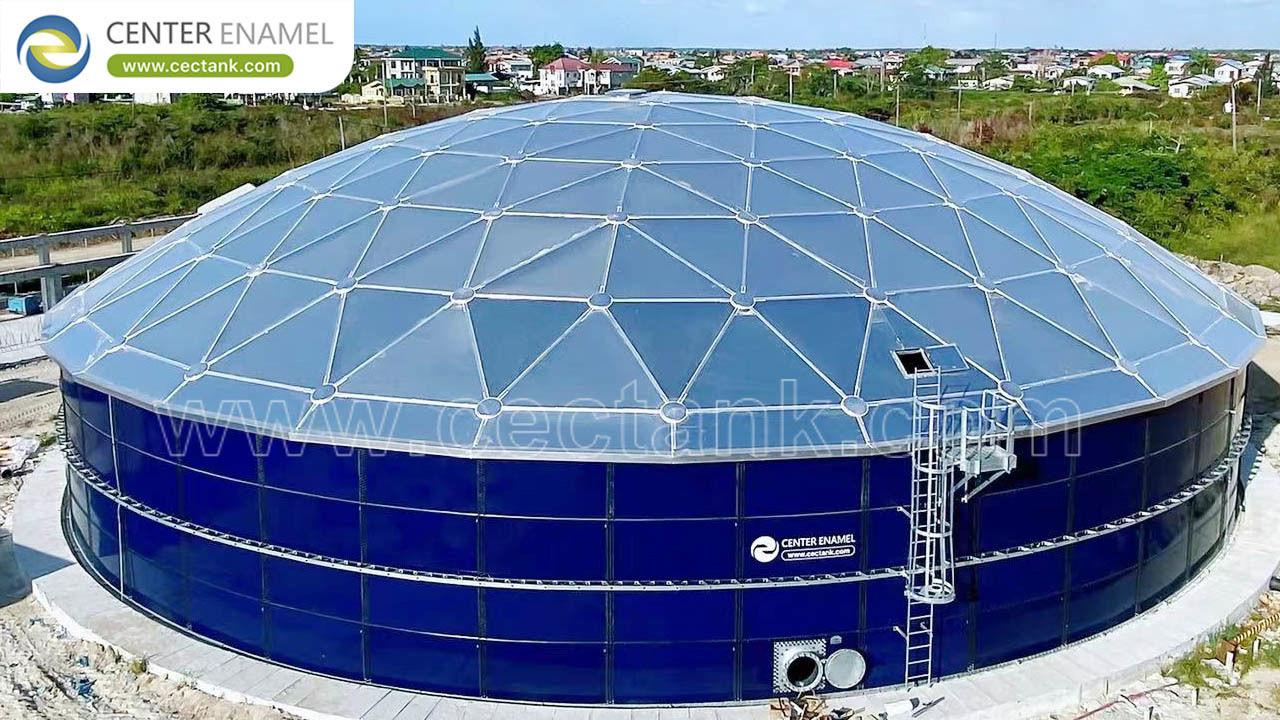
A: Yes, and it is a common upgrade for aging infrastructure. By retrofitting an EFR with an aluminum geodesic dome, facilities can convert it into an IFR. This eliminates the need for complex roof drains and provides an immediate ~90% reduction in VOC emissions.
Q: What is the biggest maintenance risk for an EFR?
A: Drain system failure. If the flexible piping fails or the drain intake becomes clogged with debris, water will pool on the roof, potentially compromising the roof’s structural integrity.
Selecting the right floating roof technology is a long-term infrastructure decision. Whether you are conducting a new build or an EFR-to-IFR conversion, ensure your engineering partner adheres to the latest API 650 standards to guarantee decades of operational safety and emission control.
Would you like to explore the specific materials and seal configurations best suited for preventing VOC emissions in your specific climate zone?