-
Glass Fused To Steel Tanks (596)
-
Stainless Steel Tanks (434)
-
Fusion Bonded Epoxy Tanks (592)
-
Galvanized Steel Tanks (321)
-
Aluminum Dome Roofs (1336)
-
Wastewater Storage Tanks (232)
-
Welded Steel Tanks (457)
-
Pressure Vessels (295)
-
Anaerobic Digester (201)
-
Industrial Water Tanks (349)
-
Glass Lined Steel Tanks (180)
-
Bolted Steel Tanks (389)
-
Sludge Storage Tank (115)
-
Biogas Storage Tank (173)
-
Leachate Storage Tanks (133)
-
Agricultural Water Storage Tanks (179)
-
Fire Water Tank (166)
-
Grain Storage Silos (146)
-
Biogas Projects (425)
-
Wastewater Treatment Projects (828)
-
Double Membrane Roof (223)
|
How to Create a Floating Roof: The Complete Engineering and Construction Guide
| Place of Origin: | China |
| Brand Name: | Center Enamel |
| Certification: | ISO 9001 |
| Model Number: | Aluminum Dome Roofs |
| Minimum Order Quantity: | 1 |
| Price: | 100-50000 |
| Packaging Details: | 2000 |
| Delivery Time: | 8 weeks |
| Payment Terms: | L/C,T/T |
| Supply Ability: | 6000 |
|
Detail Information |
|||
Product Description
A Comprehensive Blueprint for Designing, Assembling, and Testing API-Compliant Floating Roofs for Industrial Storage Tanks
The creation of a floating roof is one of the most critical engineering feats in industrial bulk liquid storage. Designed to physically float on the surface of stored liquids—rising and falling with the tank's volume—a floating roof eliminates the vapor space (ullage) where volatile organic compounds (VOCs) accumulate.
Whether you are engineering an External Floating Roof (EFR) for massive crude oil reservoirs or an Internal Floating Roof (IFR) paired with an Aluminum Geodesic Dome to protect refined petrochemicals, the design and construction process must strictly adhere to international codes such as API 650. The floating-roof tank has served as the industry standard for volatile petroleum storage since its inception, continually evolving to meet stringent environmental regulations regarding evaporative emissions (Gallagher & Desjardins, 2000).
This guide outlines the complete process of creating a floating roof, optimized for engineers, facility operators, and procurement teams.
To satisfy quick search queries and AI Overviews, here is the direct, five-step process to create an industrial floating roof:
- Engineering & API 650 Calculation: Perform buoyancy and stress analysis to ensure the deck can support its dead weight plus environmental loads (rain, snow) under a punctured-pontoon scenario.
- Material Fabrication: Manufacture the central deck plates and outer pontoons from carbon steel, stainless steel, or aluminum alloys based on chemical compatibility.
- On-Site Deck Assembly: Weld or bolt the pontoon rings and inner deck plates directly on the floor of the tank shell, installing support legs for resting phases.
- Rim Seal & Drainage Integration: Install mechanical shoe seals or elastomeric wipers along the perimeter to close the gap between the moving roof and the stationary tank wall. Install flexible roof drains.
- Testing and Commissioning: Conduct vacuum-box testing on all weld seams, followed by a full-capacity hydrostatic water test to verify flotation equilibrium and seal integrity.
Before construction begins, the roof must be digitally engineered. The fundamental physics of a floating roof rely on Archimedes' principle. To ensure the roof does not sink under heavy rainfall or structural failure, engineers calculate the minimum buoyant force (FB) required to offset the dead weight of the deck (W{deck}) and transient loads
Where SF is the mandated safety factor. API 650 design procedures dictate the structural thickness and load calculations, though modern engineers increasingly utilize nonlinear dynamic analysis and 3D Finite Element Analysis (FEA) to ensure structural integrity under seismic and large-deformation scenarios (Fallah Daryavarsari & Nascimbene, 2024).
The physical creation of the roof depends heavily on the chosen typology and the specific industrial application:
- Pontoon Roofs: Feature a buoyant outer ring of compartmentalized pontoons surrounding a single-thickness central deck. Ideal for mild climates and standard crude oil.
- Double-Deck Roofs: Feature an upper and lower deck separated by bulkheads. This provides maximum insulation and structural rigidity for high-capacity tanks (over 60 meters in diameter) in extreme weather conditions.
For maximum VOC reduction, an IFR is installed beneath a fixed roof. Modern IFRs are often manufactured from lightweight, high-strength aluminum panels and extruded pontoons. These modular systems can be installed without hot work (welding) and are frequently paired with Glass-Fused-to-Steel (Enamel) Tanks or Stainless Steel Tanks for superior chemical resistance. Vapor migration in these internal systems is heavily influenced by deck height and ventilation, requiring precise sizing of the tank's vents (Zhang et al., 2020).
Because floating roofs are massive structures, they are entirely assembled inside the tank shell. The tank floor serves as the workbench. Support legs are installed first to establish a temporary clearance height (usually 1 to 2 meters) to allow workers to move beneath the deck.
For steel roofs, the outer perimeter pontoons are constructed first. Bulkheads are welded to create independent, liquid-tight compartments. This is critical for safety: if one compartment fails or fractures, the adjacent compartments will keep the roof buoyant.
The steel plates of the central deck are laid out, overlapping slightly, and joined using continuous fillet welds. For aluminum IFR systems, the panels are bolted and sealed using chemical-resistant elastomers.
- Roof Drains: Articulated pipe joints or heavy-duty flexible hoses are installed. These travel through the liquid product, allowing rainwater collected on the EFR deck to exit through the bottom of the tank without contaminating the stored chemical.
- Anti-Rotation Devices: Vertical guide poles are installed to prevent the floating deck from spinning as it rises and falls.
- Grounding Shunts: High-conductivity cables are attached to the roof perimeter to dissipate static electricity into the tank shell, eliminating the risk of sparks and vapor fires.
A physical gap must exist between the floating roof and the tank wall to prevent friction binding. This gap is closed using a Dual-Seal System:
- Primary Seal: A mechanical shoe (metal plates pressed against the tank wall by springs) or a liquid-filled tube.
- Secondary Seal: A rubber wiper blade that sweeps residual liquid film off the wall as the roof descends.
A floating roof cannot be certified until it proves it can actually float. During the Hydrostatic Test, the tank is slowly filled with millions of gallons of water.
Inspectors monitor the roof as it lifts off its support legs. They check for:
- Equilibrium: Ensuring the roof does not tilt or list to one side.
- Seal Contact: Verifying the primary and secondary seals maintain constant contact with the shell across the entire vertical travel path.
- Leakage: Ensuring no water breaches the pontoon compartments or the central deck.
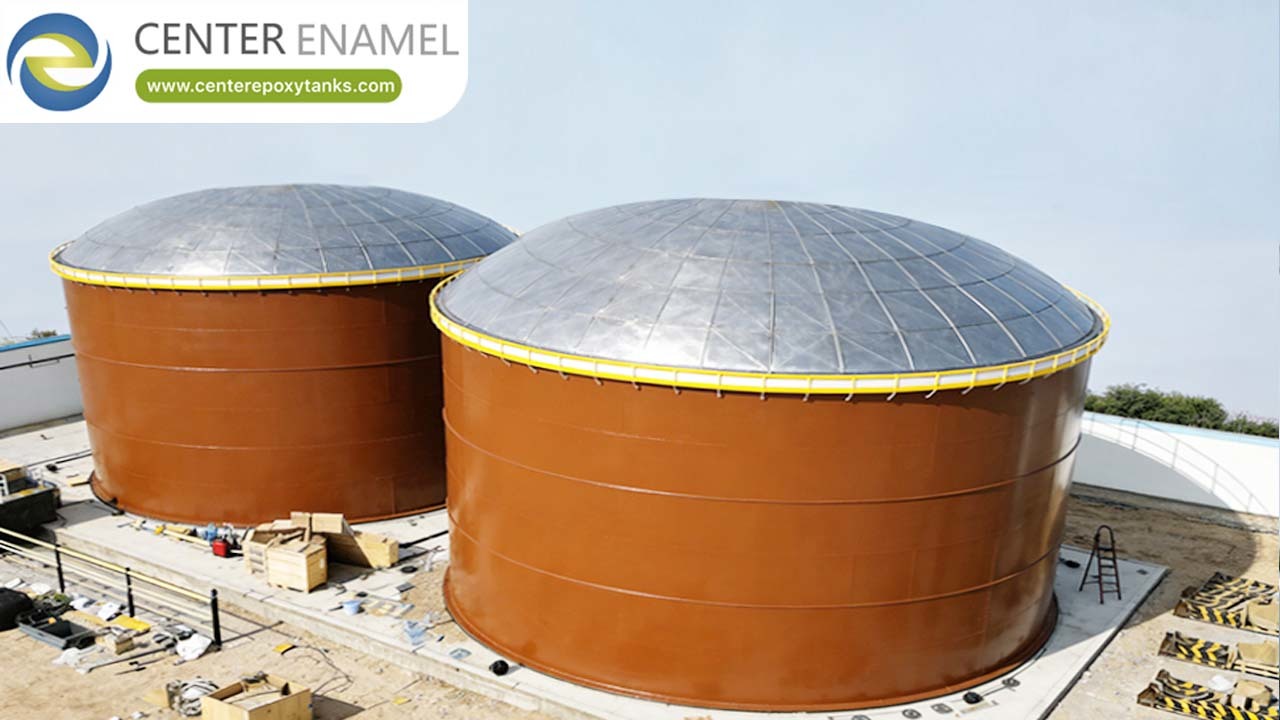
Creating a new floating roof is not limited to new tank construction. Many aging industrial facilities upgrade their existing open-top tanks by installing a clear-span Aluminum Geodesic Dome.
Adding a self-supporting geodesic dome effectively converts an EFR tank into an IFR tank. This immediately eliminates rainwater accumulation on the floating deck (bypassing the need for complex roof drains), protects the rim seals from UV degradation, and drastically lowers life-cycle maintenance costs.
As a global leader in bulk liquid containment and industrial storage solutions, Shijiazhuang Zhengzhong Technology Co., Ltd. (Center Enamel) specializes in the design, engineering, and manufacturing of highly advanced Bolted Tanks, Glass-Fused-to-Steel (Enamel) Tanks, Stainless Steel Tanks, and fully compliant Internal Floating Roofs.
With over 30 years of manufacturing excellence and a massive portfolio of successful deployments in over 100 countries, Center Enamel delivers custom-engineered clear-span Aluminum Geodesic Domes and API 650 floating roof solutions that guarantee absolute environmental safety, emissions reduction, and asset longevity.