-
Glass Fused To Steel Tanks (896)
-
Stainless Steel Tanks (434)
-
Fusion Bonded Epoxy Tanks (652)
-
Galvanized Steel Tanks (321)
-
Aluminum Dome Roofs (1336)
-
Wastewater Storage Tanks (280)
-
Welded Steel Tanks (457)
-
Pressure Vessels (341)
-
Anaerobic Digester (202)
-
Industrial Water Tanks (349)
-
Glass Lined Steel Tanks (180)
-
Bolted Steel Tanks (389)
-
Sludge Storage Tank (115)
-
Biogas Storage Tank (173)
-
Leachate Storage Tanks (133)
-
Agricultural Water Storage Tanks (179)
-
Fire Water Tank (166)
-
Grain Storage Silos (146)
-
Biogas Projects (424)
-
Wastewater Treatment Projects (1692)
-
Double Membrane Roof (223)

|
What Is a Chemical Reactor? Principles, Types & Applications
| Place of Origin: | China |
| Brand Name: | Center Enamel |
| Certification: | ISO 9001,CE, NSF/ANSI 61, WRAS, ISO 28765, LFGB, BSCI, ISO 45001 |
| Minimum Order Quantity: | 1 Sets |
| Price: | 2000 |
| Delivery Time: | 2 months |
| Payment Terms: | L/C,T/T |
| Supply Ability: | 200 sets / days |
|
Detail Information |
|||
Product Description
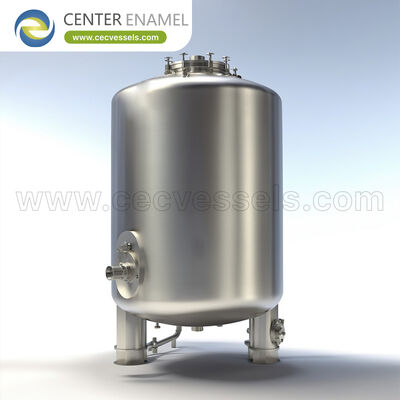
What Is a Chemical Reactor? Principles, Types & Applications
Answering the core question: What is a chemical reactor, and how does its design govern the conversion of raw materials into chemical products? A chemical reactor is a vessel or system in which chemical reactions take place under controlled conditions of temperature, pressure, mixing, and residence time to convert raw materials (reactants) into desired products. The reactor is the heart of any chemical process: its design determines the reaction rate (how fast products form), conversion (fraction of reactant consumed), selectivity (ratio of desired to undesired products), and yield (amount of desired product per unit of reactant fed). All downstream unit operations—separation, purification, formulation—are designed around the reactor output.
1. Core Operating Principles of Chemical Reactors
- **Mass and Energy Balance** The fundamental design equations are derived from conservation of mass and energy. For any reactor: Input − Output + Generation − Consumption = Accumulation. At steady state (continuous reactors), accumulation equals zero. For batch reactors, the time-dependent accumulation term determines reaction progress. The energy balance must account for the heat of reaction (ΔHr), which can be exothermic (heat released, ΔH < 0) or endothermic (heat absorbed, ΔH > 0), and requires matching heat removal or supply to maintain target temperature.
- **Reaction Kinetics and Rate Laws** The reaction rate depends on reactant concentrations, temperature, and catalyst activity, expressed as r = k × C^n where k is the rate constant (following Arrhenius: k = A × e^(-Ea/RT)), C is concentration, and n is reaction order. Reactor design must provide sufficient residence time for the desired conversion at the operating temperature. For a first-order reaction at 90% conversion, the required residence time is t = -ln(0.1)/k = 2.3/k. Temperature sensitivity is high: a 10°C increase typically doubles the rate.
- **Ideal Reactor Models** Three ideal models serve as design baselines: (1) Batch Reactor—uniform concentration, changes with time; (2) CSTR—uniform concentration equal to exit concentration, at steady state; (3) PFR—concentration varies along length, no back-mixing. For the same conversion, a PFR requires less volume than a CSTR for positive-order reactions because the average reaction rate (driven by higher average concentration) is greater. Real reactors approach these ideals to varying degrees.
2. Major Types of Chemical Reactors
- **Batch Stirred-Tank Reactor** A closed vessel charged with reactants, operated isothermally or with programmed temperature profiles, and discharged after the reaction reaches target conversion. Maximum flexibility for multi-product facilities. Conversion increases with batch time; selectivity may decrease if side reactions are significant. Standard for fine chemicals, pharmaceuticals, and specialty chemicals. Volumes from 50 L to 20,000 L.
- **Continuous Stirred-Tank Reactor (CSTR)** Reactants continuously fed and products withdrawn, with the vessel contents at uniform concentration and temperature equal to the exit stream. At steady state, conversion is determined by residence time (τ = V/F). Multiple CSTRs in series approximate plug-flow behavior while maintaining the mixing benefits of back-mixed operation. Standard for polymerization, neutralization, and continuous crystallization.
- **Tubular / Plug-Flow Reactor (PFR)** A long tubular vessel where concentration and temperature vary along the length but are uniform at any cross-section. Achieves the highest conversion per unit volume for positive-order reactions. Can be adiabatic (temperature rises with conversion for exothermic reactions) or with heat exchange (multi-tubular design for temperature control). Standard for gas-phase catalytic reactions, polymerization, and petrochemical processing.
Chemical Reactor Types Comparison Matrix
Reactor Type |
Flow Behavior |
Volume Efficiency |
Primary Application |
Batch Stirred-Tank |
Uniform, time-varying |
Low (downtime between batches) |
Fine chemicals, pharma, multi-product |
CSTR |
Back-mixed, uniform |
Medium (lower than PFR for n>0) |
Polymerization, neutralization, crystallization |
Tubular PFR |
Plug flow, spatially varying |
Highest (for positive-order reactions) |
Gas-phase catalytic, petrochemical, polymerization |
Frequently Asked Questions (FAQ)
What is the fundamental difference between a batch reactor and a continuous reactor?
In a batch reactor, reactants are charged at the start and products discharged at the end of each cycle; concentration changes over time. In a continuous reactor (CSTR or PFR), reactants are continuously fed and products continuously withdrawn; at steady state, conditions are invariant over time. Batch reactors offer maximum flexibility and are preferred for small-volume or multi-product processes; continuous reactors offer higher throughput per unit volume and are preferred for large-volume single-product processes.
Why does a PFR achieve higher conversion than a CSTR for the same volume?
In a PFR, the reaction occurs along the tube length, with the highest reactant concentration at the inlet and decreasing concentration toward the outlet. The average reaction rate (proportional to concentration for positive-order reactions) is higher than in a CSTR, where the entire reactor operates at the low exit concentration. This means the PFR achieves the same conversion with less volume, or higher conversion with the same volume. The advantage increases with reaction order and target conversion.
What is the relationship between temperature and reaction rate?
The Arrhenius equation (k = A × e^(-Ea/RT)) shows that the rate constant k increases exponentially with temperature. For a typical activation energy of 80 kJ/mol, a 10°C increase around 25°C approximately doubles the reaction rate. This sensitivity means that temperature control is critical: a 5°C hot spot in an exothermic reactor can cause a 30–50% local rate increase, leading to runaway conditions if heat removal is insufficient.
What factors determine the choice of reactor type for a new process?
Key factors include: (1) reaction kinetics—fast reactions favor continuous; slow reactions may need batch for practical residence times; (2) production volume—large volumes favor continuous for efficiency; (3) product mix—multi-product facilities favor batch for flexibility; (4) phase system—gas-phase reactions typically use tubular reactors; liquid-phase may use stirred tanks; (5) heat effects—highly exothermic reactions need efficient heat transfer (microreactors, multi-tubular, fluidized beds); (6) safety—continuous flow with small inventory is safer for hazardous chemistry.