-
Glass Fused To Steel Tanks (896)
-
Stainless Steel Tanks (434)
-
Fusion Bonded Epoxy Tanks (652)
-
Galvanized Steel Tanks (321)
-
Aluminum Dome Roofs (1336)
-
Wastewater Storage Tanks (280)
-
Welded Steel Tanks (457)
-
Pressure Vessels (341)
-
Anaerobic Digester (202)
-
Industrial Water Tanks (349)
-
Glass Lined Steel Tanks (180)
-
Bolted Steel Tanks (389)
-
Sludge Storage Tank (115)
-
Biogas Storage Tank (173)
-
Leachate Storage Tanks (133)
-
Agricultural Water Storage Tanks (179)
-
Fire Water Tank (166)
-
Grain Storage Silos (146)
-
Biogas Projects (424)
-
Wastewater Treatment Projects (1692)
-
Double Membrane Roof (223)
|
What Is a High-Pressure Reactor? Safety, Design & Industrial Applications
| Place of Origin: | China |
| Brand Name: | Center Enamel |
| Certification: | ISO 9001,CE, NSF/ANSI 61, WRAS, ISO 28765, LFGB, BSCI, ISO 45001 |
| Minimum Order Quantity: | 1 Sets |
| Price: | 2000 |
| Delivery Time: | 2 months |
| Payment Terms: | L/C,T/T |
| Supply Ability: | 200 sets / days |
|
Detail Information |
|||
Product Description
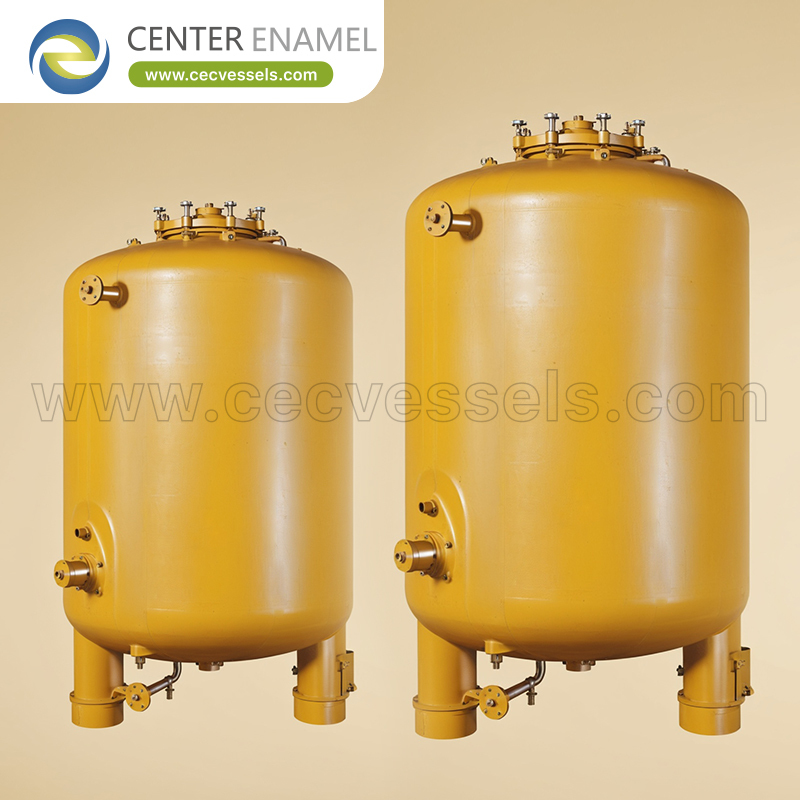
What Is a High-Pressure Reactor? Safety, Design & Industrial Applications
Answering the core question: What is a high-pressure reactor, and how is it engineered for safe operation above standard pressure limits? A high-pressure reactor is a pressure vessel designed to conduct chemical reactions at internal pressures exceeding 15 psi (1.03 bar), the threshold above which ASME Boiler and Pressure Vessel Code Section VIII mandates specialized design, fabrication, and inspection. These reactors are constructed from forged carbon steel, stainless steel (304/316L), or exotic alloys such as Inconel 625 and Hastelloy C-276, with wall thicknesses calculated to withstand design pressures ranging from 10 bar to over 1,500 bar in extreme applications such as low-density polyethylene (LDPE) production.
1. Core Design and Safety Principles of High-Pressure Reactors
- **ASME Code Compliance and Wall Thickness Calculation** Every high-pressure reactor is designed per ASME Section VIII Division 1 or Division 2. Wall thickness is determined by the formula t = (P × R) / (S × E − 0.6 × P), where P is design pressure, R is radius, S is allowable stress, and E is joint efficiency. For pressures above 1,000 bar, Division 2 with finite element analysis (FEA) is mandatory.
- **Multi-Layer Safety Architecture** High-pressure reactors integrate redundant safety devices: a rupture disc (burst disc) set at 110% of design pressure as primary overpressure protection, a spring-loaded safety relief valve as secondary protection, and interlock systems that prevent opening the reactor head while internal pressure exceeds 0.5 bar. Magnetic drive couplings eliminate dynamic seals, achieving zero-leak containment for toxic or flammable media.
- **Thermal Management and Stress Analysis** Rapid heating or cooling generates thermal gradients that create secondary stresses in the vessel wall. Designers use FEA to verify that combined primary plus secondary stresses remain below ASME allowable limits. Multi-zone jackets or internal cooling coils provide heat removal rates of 50–500 kW/m³, essential for highly exothermic reactions such as catalytic hydrogenation.
2. Major Types of High-Pressure Reactors
- **Catalytic Hydrogenation Reactor** Operates at 20–200 bar with hydrogen gas over supported metal catalysts (Pd/C, Pt, Ni). Used for fat hydrogenation, fine chemical synthesis, and petroleum refining. Magnetic drive agitators ensure leak-free hydrogen containment, and internal cooling coils remove the 120–150 kJ/mol heat of hydrogenation.
- **Supercritical Fluid Reactor** Operates above the critical point of the process fluid (e.g., CO2 at 31.1°C and 73.8 bar, or water at 374°C and 221 bar). Supercritical reactors enable waste destruction (SCWO), pharmaceutical particle formation, and green extraction processes. Materials must withstand both high pressure and high temperature simultaneously.
- **Polymerization Reactor (Autoclave or Tubular)** LDPE autoclave reactors operate at 1,500–3,000 bar and 150–300°C. The hypercompressor design and multi-zone agitation control free-radical ethylene polymerization. Tubular reactors for the same process can reach 3,500 bar with internal diameters as small as 50 mm, requiring specialized high-pressure tube forging.
High-Pressure Reactor Types Comparison Matrix
Reactor Type |
Pressure Range |
Key Safety Device |
Primary Application |
Hydrogenation |
20–200 bar |
Rupture disc + interlock |
Fat hardening, fine chemicals, pharma APIs |
Supercritical Fluid |
74–350 bar |
Burst disc + thermal relief |
SCWO, extraction, particle formation |
Polymerization (LDPE) |
1,500–3,500 bar |
Multi-burst disc + interlock |
Ethylene polymerization, copolymerization |
Frequently Asked Questions (FAQ)
What pressure threshold qualifies a reactor as "high-pressure" under ASME?
ASME Boiler and Pressure Vessel Code Section VIII applies to vessels operating above 15 psi (approximately 1.03 bar). Any reactor exceeding this pressure must meet ASME design, fabrication, inspection, and stamping requirements, including U-stamp certification and third-party inspection.
What is the difference between a rupture disc and a safety relief valve?
A rupture disc is a one-time, non-reclosing device that bursts at a precisely calibrated pressure, providing instantaneous full-bore venting. A safety relief valve is a spring-loaded mechanical valve that opens proportionally and re-closes once pressure drops below the set point. High-pressure reactors typically use both in series: the rupture disc as primary protection and the relief valve as secondary.
Why are magnetic drive couplings used in high-pressure reactors?
Magnetic drives transmit torque through a non-magnetic isolation shell, eliminating the dynamic shaft seal that is the most common leak path in stirred reactors. This achieves a hermetically sealed system critical for handling hydrogen, toxic gases, or pyrophoric materials at high pressures.
What materials are used for reactors operating above 1,000 bar?
Forged low-alloy steels (such as SA-372) with autofrettage treatment are used for ultra-high-pressure autoclaves. For corrosive environments, cladding with Inconel 625 or Hastelloy C-276 provides chemical resistance while the base steel provides structural strength. Internal surfaces may also be hard-faced with stellite for wear resistance.