-
Glass Fused To Steel Tanks (896)
-
Stainless Steel Tanks (434)
-
Fusion Bonded Epoxy Tanks (652)
-
Galvanized Steel Tanks (321)
-
Aluminum Dome Roofs (1336)
-
Wastewater Storage Tanks (280)
-
Welded Steel Tanks (457)
-
Pressure Vessels (341)
-
Anaerobic Digester (202)
-
Industrial Water Tanks (349)
-
Glass Lined Steel Tanks (180)
-
Bolted Steel Tanks (389)
-
Sludge Storage Tank (115)
-
Biogas Storage Tank (173)
-
Leachate Storage Tanks (133)
-
Agricultural Water Storage Tanks (179)
-
Fire Water Tank (166)
-
Grain Storage Silos (146)
-
Biogas Projects (424)
-
Wastewater Treatment Projects (1692)
-
Double Membrane Roof (223)

|
What Is a Glass Lined Reactor? Principles, Types & Applications
| Place of Origin: | China |
| Brand Name: | Center Enamel |
| Certification: | ISO 9001,CE, NSF/ANSI 61, WRAS, ISO 28765, LFGB, BSCI, ISO 45001 |
| Minimum Order Quantity: | 1 Sets |
| Price: | 2000 |
| Delivery Time: | 2 months |
| Payment Terms: | L/C,T/T |
| Supply Ability: | 200 sets / days |
|
Detail Information |
|||
Product Description
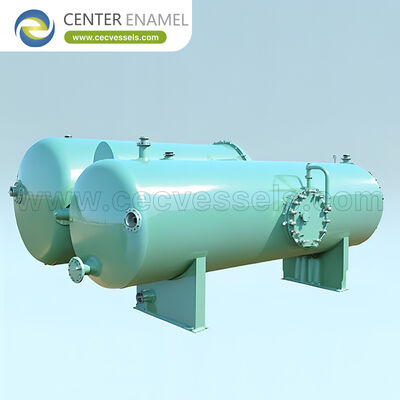
Answering the core question: What is a glass lined reactor, and how does it combine corrosion resistance with structural strength? A glass lined reactor is a pressure vessel whose interior surface is fused with a layer of borosilicate glass at temperatures above 800°C, creating a chemically inert barrier that withstands concentrated mineral acids, alkalis, and solvents while the carbon steel or stainless steel outer shell provides mechanical strength and pressure containment. This dual-material construction makes glass lined reactors the standard choice for pharmaceutical, specialty chemical, and agrochemical processes where product purity and corrosion resistance are paramount.
- **Glass-to-Metal Fusion** The borosilicate glass frit is applied as a slurry to the vessel interior and fired at 800–930°C in a controlled furnace. The glass melts and chemically bonds to the steel substrate, forming a monolithic, non-porous lining that cannot delaminate under thermal cycling. This fusion creates a bond strength exceeding 80 MPa.
- **Chemical Inertness** The fused glass surface resists attack by all concentrations of hydrochloric acid, sulfuric acid, nitric acid, and most organic solvents at temperatures up to 200°C. Unlike metallic alloys, the glass lining does not introduce metal ions into the product, making it ideal for pharmaceutical and food-grade processes requiring absolute purity.
- **Thermal Shock Resistance** Quality glass linings withstand thermal shock differentials of up to 120°C (heating) and 110°C (cooling) per cycle. This means a reactor can transition from 180°C process temperature to ambient cooling water without cracking the glass, provided the rate of temperature change does not exceed the manufacturer-specified delta-T limit.
- **Standard Open-Top Reactor (AE Type)** Features a removable clamped cover with a large opening for agitator access. The AE-type design allows inspection, cleaning, and glass lining repair without entering the vessel body. Typical volumes range from 500 L to 30,000 L, with design pressures up to 0.6 MPa.
- **Closed Welded Reactor (CE Type)** A fully welded, one-piece vessel with no removable cover. The CE-type eliminates the large flange gasket, reducing leak paths and enabling higher design pressures (up to 1.6 MPa). It is preferred for hazardous or toxic processes requiring hermetic containment.
- **Jacketed Glass Lined Reactor** Equipped with an outer steel jacket for heating or cooling fluid circulation. The jacket enables precise temperature control from -30°C to +250°C using steam, hot oil, or chilled glycol. Multi-zone jackets allow temperature profiling along the vessel height for optimized reaction kinetics.
Reactor Type |
Design Feature |
Pressure Rating |
Primary Application |
AE Open-Top |
Removable clamped cover |
Up to 0.6 MPa |
General chemical, pharma R&D, frequent cleaning |
CE Closed Welded |
One-piece welded body |
Up to 1.6 MPa |
Hazardous/toxic processes, hermetic containment |
Jacketed Type |
Full or multi-zone jacket |
0.1–1.0 MPa |
Exothermic/endothermic reactions, precise T control |
The glass lining itself is stable up to 300°C, but practical operating limits are typically 200°C for standard borosilicate linings. Above this temperature, the thermal expansion differential between glass and steel may exceed safe limits, risking lining damage.
How is the integrity of a glass lining inspected?The standard method is a high-voltage spark test using a Tesla or holiday detector at 2,000–5,000 V. An intact lining shows no arcing; any pinhole or crack produces a visible spark, pinpointing the defect location for repair.
Can a damaged glass lining be repaired without replacing the reactor?Yes, small defects (under 50 mm diameter) can be repaired using tantalum plugs or proprietary two-part repair compounds (fluoropolymer-based). For larger areas, the reactor must be returned to the manufacturer for re-firing.
How does a glass lined reactor compare to a Hastelloy reactor for acid service?Glass lining resists all concentrations of HCl, H2SO4, and HNO3 at lower cost than Hastelloy C-276. However, glass is brittle and susceptible to mechanical damage, while Hastelloy tolerates physical impacts and higher pressures. The choice depends on whether chemical resistance or mechanical robustness is the priority.