-
Glass Fused To Steel Tanks (896)
-
Stainless Steel Tanks (434)
-
Fusion Bonded Epoxy Tanks (652)
-
Galvanized Steel Tanks (321)
-
Aluminum Dome Roofs (1336)
-
Wastewater Storage Tanks (280)
-
Welded Steel Tanks (457)
-
Pressure Vessels (341)
-
Anaerobic Digester (202)
-
Industrial Water Tanks (349)
-
Glass Lined Steel Tanks (180)
-
Bolted Steel Tanks (389)
-
Sludge Storage Tank (115)
-
Biogas Storage Tank (173)
-
Leachate Storage Tanks (133)
-
Agricultural Water Storage Tanks (179)
-
Fire Water Tank (166)
-
Grain Storage Silos (146)
-
Biogas Projects (424)
-
Wastewater Treatment Projects (1692)
-
Double Membrane Roof (223)

|
What Is a Chemical Synthesis Reactor? Principles, Types & Applications
| Place of Origin: | China |
| Brand Name: | Center Enamel |
| Certification: | ISO 9001,CE, NSF/ANSI 61, WRAS, ISO 28765, LFGB, BSCI, ISO 45001 |
| Minimum Order Quantity: | 1 Sets |
| Price: | 2000 |
| Delivery Time: | 2 months |
| Payment Terms: | L/C,T/T |
| Supply Ability: | 200 sets / days |
|
Detail Information |
|||
Product Description
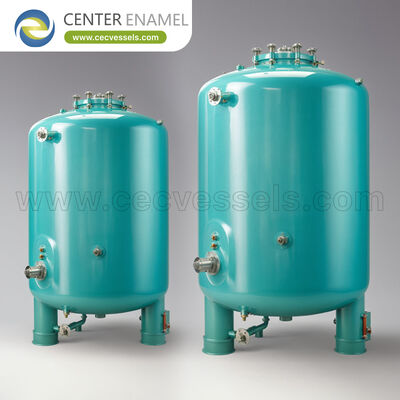
What Is a Chemical Synthesis Reactor? Principles, Types & Applications
Answering the core question: What is a chemical synthesis reactor, and how does it control reaction conditions to maximize yield and selectivity? A chemical synthesis reactor is a pressure vessel engineered to convert raw materials (reactants) into desired chemical products through one or more chemical reactions under precisely controlled conditions of temperature, pressure, mixing, and residence time. The reactor's design directly determines reaction yield (percentage of reactant converted to desired product), selectivity (ratio of desired to undesired products), and throughput (production rate per unit volume), making it the critical equipment choice in chemical and pharmaceutical manufacturing.
1. Core Operating Principles of Chemical Synthesis Reactors
- **Reaction Kinetics and Residence Time Control** The rate of a chemical reaction follows the Arrhenius equation: k = A * e^(-Ea/RT), where k is the rate constant, Ea is activation energy, R is the gas constant, and T is absolute temperature. Synthesis reactors control T to within ±0.5–2°C to maintain reproducible kinetics. Residence time (batch holding time or continuous flow-through time) determines conversion: too short gives incomplete reaction, too long causes degradation or side reactions.
- **Phase Contact and Mass Transfer** Many synthesis reactions involve multiple phases (gas-liquid, liquid-liquid, gas-solid-liquid). The reactor must provide sufficient interfacial area for reactants to contact and react. In gas-liquid hydrogenation, the kLa (volumetric gas-liquid mass transfer coefficient) determines the rate of hydrogen dissolution; values of 0.05–0.5 s⁻¹ are typical for catalytic hydrogenation reactors.
- **Thermodynamic Equilibrium Management** Reversible reactions (esterification, amidation) approach equilibrium conversion that depends on temperature, pressure, and concentration. Le Chatelier's principle governs equilibrium shifting: removing a product (e.g., water via Dean-Stark trap or molecular sieves) drives conversion forward. For exothermic equilibria, lower temperatures favor higher equilibrium conversion but slower kinetics—reactor design must balance these opposing effects.
2. Major Types of Chemical Synthesis Reactors
- **Batch Stirred Tank Reactor (BSTR)** A closed vessel where all reactants are charged at the start and products are discharged at the end. Offers maximum flexibility for multi-product synthesis and easy cleaning between campaigns. Temperature is controlled by jacket or coil, and agitator speed adjusts mixing intensity. Standard for fine chemicals, pharmaceutical APIs, and specialty chemical synthesis at volumes from 50 L to 10,000 L.
- **Continuous Stirred Tank Reactor (CSTR)** Reactants are continuously fed and products continuously withdrawn, with the reactor contents at uniform concentration and temperature. Ideal for fast reactions, gas-liquid systems, and processes requiring steady-state product quality. Multiple CSTRs in series approximate plug-flow behavior while maintaining back-mixing benefits. Used for polymerization, nitration, and continuous crystallization.
- **Catalytic Fixed-Bed Reactor** A tubular vessel packed with solid catalyst pellets (1–5 mm diameter) through which reactants flow. Provides high catalyst surface area per unit volume (1,000–5,000 m²/m³) and is standard for gas-phase catalytic synthesis (ammonia, methanol, Fischer-Tropsch). Temperature control is challenging in highly exothermic reactions; multi-tubular designs with catalyst in tubes and coolant in the shell provide isothermal operation.
Chemical Synthesis Reactor Types Comparison Matrix
Reactor Type |
Operation Mode |
Temperature Range |
Primary Application |
Batch Stirred Tank |
Charged/discharged per batch |
-20 to 250°C |
Fine chemicals, pharma APIs, multi-product |
CSTR |
Continuous steady-state |
-20 to 300°C |
Polymerization, nitration, crystallization |
Catalytic Fixed-Bed |
Continuous flow through catalyst |
100 to 600°C |
Ammonia, methanol, Fischer-Tropsch synthesis |
Frequently Asked Questions (FAQ)
What determines the choice between batch and continuous synthesis reactors?
Batch reactors are preferred for multi-product facilities, small-volume production, and reactions requiring different conditions at different stages (e.g., sequential reagent addition). Continuous reactors are preferred for large-volume products with stable demand, hazardous chemistry requiring small inventory, and reactions needing precise residence time control. The break-even volume for continuous vs. batch is typically 500–5,000 tons/year for fine chemicals.
What is the role of activation energy in reactor design?
Activation energy (Ea) determines how sensitive the reaction rate is to temperature changes. A reaction with Ea of 80 kJ/mol will double in rate for every 10°C temperature increase. This sensitivity means that a hot spot in a reactor can cause thermal runaway—a self-accelerating temperature rise that exceeds the cooling capacity. Reactor design must ensure that heat removal capacity always exceeds maximum heat generation, with safety margins of 1.5–2.0*.
How is catalyst selectivity measured in synthesis reactors?
Selectivity is defined as the ratio of desired product formed to reactant consumed, expressed as a percentage. For example, if 100 mol of reactant produces 85 mol of desired product and 15 mol of by-product, the selectivity is 85%. Catalyst selectivity depends on temperature, pressure, reactant ratios, and catalyst composition. In multi-step syntheses, selectivity at each step multiplies: three sequential steps at 90% selectivity each yield only 73% overall selectivity.
What is the difference between homogeneous and heterogeneous catalysis in synthesis reactors?
In homogeneous catalysis, the catalyst is dissolved in the same phase as the reactants (e.g., acid catalysis in liquid-phase esterification), providing uniform contact but requiring catalyst separation. In heterogeneous catalysis, the catalyst is a separate solid phase (e.g., Pd/C in hydrogenation), enabling easy separation by filtration but introducing mass transfer limitations. Most industrial synthesis reactors use heterogeneous catalysts for easier catalyst recovery and recycling.