-
Glass Fused To Steel Tanks (837)
-
Stainless Steel Tanks (434)
-
Fusion Bonded Epoxy Tanks (622)
-
Galvanized Steel Tanks (321)
-
Aluminum Dome Roofs (1336)
-
Wastewater Storage Tanks (280)
-
Welded Steel Tanks (457)
-
Pressure Vessels (295)
-
Anaerobic Digester (202)
-
Industrial Water Tanks (349)
-
Glass Lined Steel Tanks (180)
-
Bolted Steel Tanks (389)
-
Sludge Storage Tank (115)
-
Biogas Storage Tank (173)
-
Leachate Storage Tanks (133)
-
Agricultural Water Storage Tanks (179)
-
Fire Water Tank (166)
-
Grain Storage Silos (146)
-
Biogas Projects (424)
-
Wastewater Treatment Projects (1610)
-
Double Membrane Roof (223)

|
Thermal Storage Tanks for Data Center Cooling: Design Parameters
| Place of Origin: | China |
| Brand Name: | CEC TANKS |
| Certification: | ISO 9001:2008, AWWA D103 , OSHA , BSCI |
| Model Number: | W201609013 |
| Minimum Order Quantity: | 1set |
| Price: | $5000~$20000 one set |
| Packaging Details: | PE poly-foam between each two steel plates ; wooden pallet and wooden box |
| Delivery Time: | 0-60 days after deposit received |
| Payment Terms: | L/C,T/T |
| Supply Ability: | 60 sets per month |
|
Detail Information |
|||
| Place of Origin | China | Brand Name | CEC TANKS |
|---|---|---|---|
| Certification | ISO 9001:2008, AWWA D103 , OSHA , BSCI | Model Number | W201609013 |
| Coating Thickness: | 0.25mm~0.40mm & Double Coating | Adhesion: | 3,450N/cm |
| Service Life: | ≥30 Years | Holiday Test: | >1500v |
| Elastic: | Same As Steel Sheet ,around 500KN /mm | Capacity: | 20 M3 To 18,000 M3 |
| Highlight: | thermal storage tanks data center cooling,glass fused steel thermal tanks,data center cooling tank design |
||
Product Description
Once you have chosen a stratified TES system, the tank itself needs designing, not just buying. The parameters that decide performance are stratification quality, usable delta-T, diffuser design, and the height-to-diameter ratio. This article goes deep on the tank as a hydraulic device.
A thermal storage tank for data center cooling is designed around four parameters: a wide usable delta-T to maximize storage per cubic meter, a diffuser that preserves the thermocline, a height-to-diameter ratio that favors stratification, and low heat ingress through insulation and roof. Get these right and a simple tank performs like a precision device.
Storage density equals volume times usable delta-T times water properties. Widening the allowable supply-temperature swing stores more per cubic meter and shrinks the tank. The limit is your chiller and coil tolerance, so set delta-T from the cooling system, not from a rule of thumb.
- Storage density = volume x delta-T.
- Wider swing shrinks tank.
- Limit set by chiller and coil.
- Set from system, not thumb.
The diffuser is the component that makes stratification real. It introduces water at near-tank temperature across a large area at low velocity, so layers do not mix. A poorly designed diffuser collapses the thermocline and the tank behaves like a mixed, smaller-volume vessel.
- Low-velocity, large-area inlet.
- Matches incoming to layer temp.
- Protects the thermocline.
- Bad diffuser wastes volume.
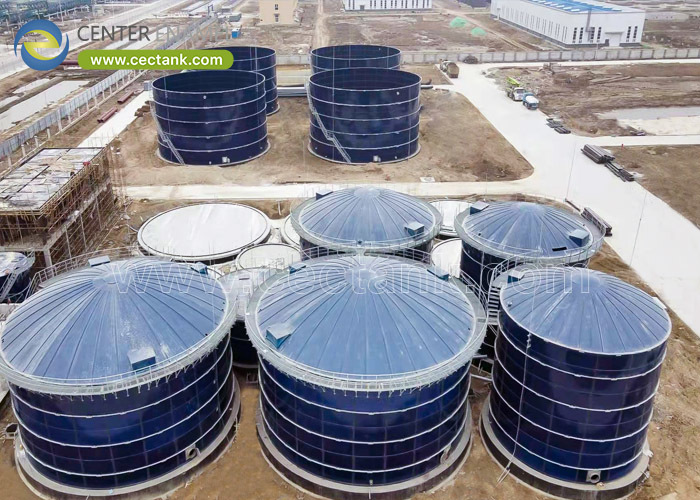
Taller, narrower tanks stratify better because the thermocline area is small relative to volume. A squat tank has more sidewall and a larger thermocline footprint. The Italy Sardinia tank (2025, 30,549 m3) and Singapore buffer tank (2020, 3,462 m3) are large coated tanks we delivered, analogous evidence of build scale, not data-center projects.
- Taller favors stratification.
- Squat tanks lose more to sidewall.
- Thermocline area vs volume.
- Height is a design lever.
Insulation, roof, and a sealed shell limit heat gain that would erode the thermocline and waste stored cooling. The lining (GFS or FBE) also keeps the water clean so biological growth does not disturb stratification. The table lists the main parameters.
- Insulation and roof limit gain.
- Sealed shell protects thermocline.
- Lining keeps water clean.
- Losses erode stored cooling.
Parameter |
Effect |
Design lever |
Usable delta-T |
Storage density |
Widen from system |
Diffuser |
Stratification |
Low velocity inlet |
H/D ratio |
Stratification |
Taller preferred |
Heat ingress |
Losses |
Insulate + roof |
We have no data-center TES tank in this library. The large coated tanks cited (Italy Sardinia 30,549 m3, Singapore 3,462 m3) are analogous industrial and process deliveries, not data-center projects.
- No data-center TES in library.
- Citations analogous, not claims.
- Large lined tank build is real.
- Design needs your system spec.
The widest allowable supply-temperature swing your chiller and coil tolerate; wider delta-T stores more per cubic meter and shrinks the tank.
It introduces water at near-layer temperature at low velocity, preserving the thermocline. A poor diffuser mixes the tank and effectively shrinks usable volume.
Generally yes for stratification: a taller, narrower tank has a smaller thermocline area relative to volume than a squat one.
Indirectly. A clean, inert lining (GFS or FBE) prevents biological growth that could disturb stratification and keeps stored water usable.
Enough to keep heat ingress from eroding the thermocline over the storage cycle; the exact level follows climate and cycle length.
Not in our project library. We cite large coated tanks at other clients as analogous capability, not data-center deliveries.
A thermal storage tank performs as a hydraulic device, not just a box of water. Maximize usable delta-T from your cooling system, design a diffuser that protects the thermocline, favor a taller height-to-diameter ratio, and limit heat ingress through insulation and roof. The lining keeps the water clean so biology does not disturb stratification. These four parameters, not the brand, decide whether a simple tank stores cooling efficiently.