-
Glass Fused To Steel Tanks (822)
-
Stainless Steel Tanks (434)
-
Fusion Bonded Epoxy Tanks (622)
-
Galvanized Steel Tanks (321)
-
Aluminum Dome Roofs (1336)
-
Wastewater Storage Tanks (280)
-
Welded Steel Tanks (457)
-
Pressure Vessels (295)
-
Anaerobic Digester (202)
-
Industrial Water Tanks (349)
-
Glass Lined Steel Tanks (180)
-
Bolted Steel Tanks (389)
-
Sludge Storage Tank (115)
-
Biogas Storage Tank (173)
-
Leachate Storage Tanks (133)
-
Agricultural Water Storage Tanks (179)
-
Fire Water Tank (166)
-
Grain Storage Silos (146)
-
Biogas Projects (424)
-
Wastewater Treatment Projects (1600)
-
Double Membrane Roof (223)

|
TES Tanks Explained: How Thermal Storage Tanks Work
| Place of Origin: | China |
| Brand Name: | CEC TANKS |
| Certification: | ISO 9001:2008, AWWA D103 , OSHA , BSCI |
| Model Number: | W |
| Minimum Order Quantity: | 1set |
| Price: | $5000~$20000 one set |
| Packaging Details: | PE poly-foam between each two steel plates ; wooden pallet and wooden |
| Delivery Time: | 10-30 days after deposit received |
| Payment Terms: | L/C,T/T |
| Supply Ability: | 60 sets per month |
|
Detail Information |
|||
| Place of Origin | China | Brand Name | CEC TANKS |
|---|---|---|---|
| Certification | ISO 9001:2008, AWWA D103 , OSHA , BSCI | Model Number | W |
| Tank Body Color: | Dark Green / Can Be Customized | Corrosion Integrity: | Excellent |
| Steel Plates Thickness: | 3mm To 12mm , Depends On The Tank Structure | Chemical Resistance: | Excellent |
| Size Of Panel: | 2.4M * 1.2M | Easy To Clean: | Smooth, Glossy, Inert, Anti-adhesion |
Product Description
TES Tanks Explained: How Thermal Storage Tanks Work
A thermal energy storage (TES) tank stores cooling or heat for later use instead of making it on demand. In simple terms it is a thermal battery: charge it when energy is cheap or abundant, discharge it when demand or price peaks. This article explains how TES tanks work without assuming a data center background.
A TES tank works by storing energy as a temperature change (sensible storage, e.g. chilled or hot water) or a phase change (latent storage, e.g. ice or PCM). You charge it with a chiller or heater off-peak and discharge through the building's coils or exchangers during peak. Chilled-water sensible tanks are the most common because they are simple and robust.
Sensible vs latent storage
Sensible storage holds energy by changing temperature - heat or chill water, and the temperature swing is the storage. Latent storage holds energy by changing phase - freeze water to ice - at a fixed temperature, packing more energy per volume. Sensible is simpler; latent is denser but more complex.
- Sensible: energy as temperature change.
- Latent: energy as phase change (ice, PCM).
- Sensible is simpler and robust.
- Latent is denser but complex.
Charging and discharging
Charging uses a chiller or heater to push the medium to its target state; discharging reverses it through the load. A stratified chilled-water tank keeps cold below warm so the two do not mix. The Singapore buffer tank (2020, 3,462 m3) and Italy Sardinia chilled process water tank (2025, 30,549 m3) are real stored-water loops at different scales.
- Charge off-peak with chiller or heater.
- Discharge through load at peak.
- Stratification keeps layers separate.
- Real loops at 3,000 to 30,000 m3.
Common types
The mainstream TES tanks are stratified chilled-water tanks, ice-storage tanks, and hot-water tanks for heating. PCM tanks exist for narrow bands. For most buildings, including data centers, stratified chilled water is the entry point because it reuses the existing chilled-water plant.
- Stratified chilled-water tank.
- Ice-storage tank.
- Hot-water tank for heating.
- PCM for narrow bands.
When TES pays off
TES pays when there is a spread between off-peak and peak energy cost, a free-cooling opportunity, or a demand-charge problem. It also backs up cooling during short chiller outages. The Mozambique buffer tank (2019, 316 m3) and Hungary sludge buffer (2022) show buffer-style stored-water loops used across industries.
- Off-peak vs peak price spread.
- Free-cooling opportunity.
- Demand-charge reduction.
- Short chiller-outage backup.
| Driver | Example benefit |
|---|---|
| Price spread | Lower energy cost |
| Free-cooling | Free cooling hours captured |
| Demand charge | Peak kW reduced |
| Resilience | Ride short outages |
Building TES tanks
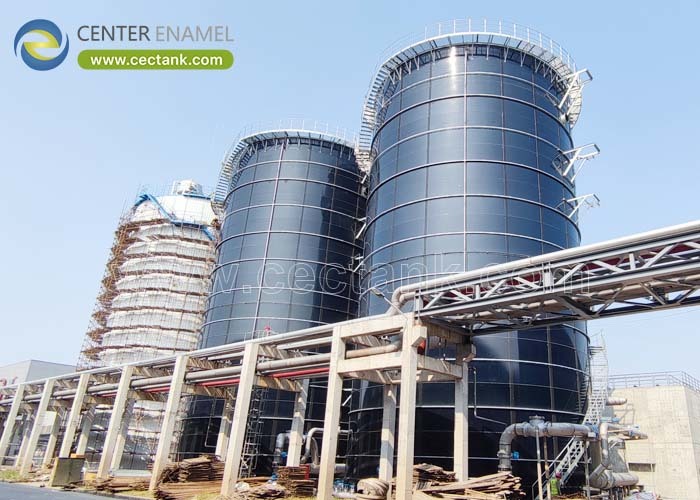
Center Enamel builds bolted, coated, roofed water tanks that scale to TES duty, with in-house enameling and insulation options. From a 316 m3 buffer to a 30,549 m3 process tank, the same panel system serves sensible-heat storage.
- Bolted, coated, roofed tanks.
- In-house enameling and insulation.
- 316 m3 to 30,000 m3 class.
- One panel system for TES.
Frequently Asked Questions
What is a TES tank in one sentence?
A TES tank stores cooling or heat for later use, charged off-peak and discharged at peak - a thermal battery.
Sensible or latent storage - which is better?
Sensible (chilled/hot water) is simpler and robust; latent (ice/PCM) stores more per volume but is more complex. Most sites start with sensible.
Do I need special equipment for a TES tank?
A stratified chilled-water TES reuses your existing chilled-water plant plus a tank and diffusers; ice storage needs an ice maker.
When does TES make financial sense?
When off-peak and peak energy prices differ, free-cooling is available, or demand charges are high.
Is a TES tank the same as a buffer tank?
No. TES stores hours of cooling for peak shifting; a buffer tank is small and prevents chiller short-cycling.
Can you build a large TES tank?
Bolted coated tanks have been delivered at 30,000 m3 class, suitable for campus-scale sensible TES.
A TES tank is a thermal battery: it stores cooling or heat as a temperature change or phase change and releases it when needed. Sensible chilled-water storage is the simplest and most common, reusing the existing chilled-water plant with a stratified tank. TES pays off where energy price spreads, free-cooling, or demand charges exist, and bolted coated tanks deliver it at any scale.
Suggested CTA: Tell us your energy profile and we will explain whether a sensible or latent TES tank fits, and size a coated tank for your duty.