-
Glass Fused To Steel Tanks (822)
-
Stainless Steel Tanks (434)
-
Fusion Bonded Epoxy Tanks (622)
-
Galvanized Steel Tanks (321)
-
Aluminum Dome Roofs (1336)
-
Wastewater Storage Tanks (280)
-
Welded Steel Tanks (457)
-
Pressure Vessels (295)
-
Anaerobic Digester (202)
-
Industrial Water Tanks (349)
-
Glass Lined Steel Tanks (180)
-
Bolted Steel Tanks (389)
-
Sludge Storage Tank (115)
-
Biogas Storage Tank (173)
-
Leachate Storage Tanks (133)
-
Agricultural Water Storage Tanks (179)
-
Fire Water Tank (166)
-
Grain Storage Silos (146)
-
Biogas Projects (424)
-
Wastewater Treatment Projects (1600)
-
Double Membrane Roof (223)


|
Why TES Tanks Are Critical for Data Center Cooling: Peak Shaving and PUE
| Place of Origin: | China |
| Brand Name: | CEC TANKS |
| Certification: | ISO 9001:2008, AWWA D103 , OSHA , BSCI |
| Model Number: | W |
| Minimum Order Quantity: | 1set |
| Price: | $5000~$20000 one set |
| Packaging Details: | PE poly-foam between each two steel plates ; wooden pallet and wooden |
| Delivery Time: | 10-30 days after deposit received |
| Payment Terms: | L/C,T/T |
| Supply Ability: | 60 sets per month |
|
Detail Information |
|||
| Place of Origin | China | Brand Name | CEC TANKS |
|---|---|---|---|
| Certification | ISO 9001:2008, AWWA D103 , OSHA , BSCI | Model Number | W |
| Tank Body Color: | Dark Green / Can Be Customized | Corrosion Integrity: | Excellent |
| Steel Plates Thickness: | 3mm To 12mm , Depends On The Tank Structure | Chemical Resistance: | Excellent |
| Size Of Panel: | 2.4M * 1.2M | Easy To Clean: | Smooth, Glossy, Inert, Anti-adhesion |
Product Description
Cooling is the largest non-IT energy load in most data centers, and it is also the most flexible. Thermal energy storage attacks that load directly: it lets you make cooling when power is cheap or free and use it when the grid is stressed. For operators chasing PUE and demand charges, TES is not a nice-to-have - it is a core lever. This article makes the case.
TES tanks are critical for data center cooling because they decouple cooling production from cooling demand, letting chillers run off-peak or during free-cooling and discharge at peak. That cuts demand charges, can shrink chiller capacity, supports lower PUE, and provides short-term cooling resilience - benefits that compound across a large campus.
Data centers pay not just for energy but for peak demand (kW). A TES tank lets you charge off-peak and ride the peak without spinning extra chillers, directly cutting the billed peak. For campuses with volatile loads, this is often the fastest payback.
- Cuts billed peak demand (kW).
- Charge off-peak, ride the peak.
- Fastest payback on volatile loads.
- Protects against demand spikes.
With TES covering peak hours, you can specify smaller chillers for the average load instead of the peak. The capital saved on chillers can partly fund the tank. The Italy Sardinia tank (2025, 30,549 m3, largest Asian GFS supplier) and Indonesia Cilincing (2024, 21,088 m3) show the delivery scale for such storage.
- Smaller chillers for average load.
- Capital shift from chillers to tank.
- Large storage proven at 20,000-30,000 m3.
- Balances capex across the plant.
TES extends free-cooling hours: store the cooling made during cool nights or surplus renewables and use it during warm afternoons. This lowers the energy per IT watt. The effect on PUE is real but depends on climate and charge strategy.
- Extends free-cooling hours.
- Stores surplus renewable cooling.
- Lowers energy per IT watt.
- PUE gain depends on climate.
A charged TES tank is minutes-to-hours of cooling buffer during a chiller trip or brief power event, buying time for generators or graceful load shed. It is not a substitute for redundancy but a cheap layer on top.
- Minutes-to-hours cooling buffer.
- Buys time on chiller trip.
- Supports graceful load shed.
- Cheap layer over redundancy.
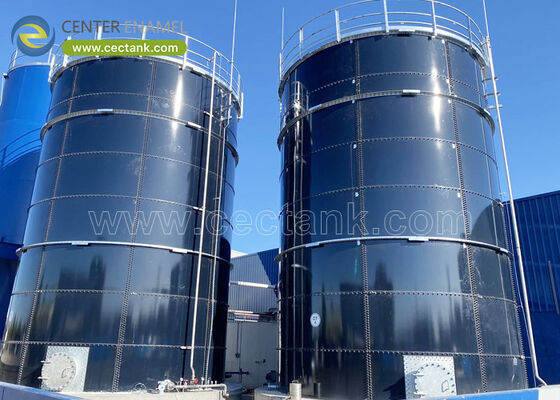
Center Enamel supplies the bolted, coated, roofed tanks that make campus-scale TES practical. With delivery proven at 30,549 m3 (Italy) and 21,088 m3 (Indonesia), the storage side of the TES business case is buildable today.
- Bolted coated tanks for campus TES.
- Delivery proven at 30,000 m3 class.
- Storage side buildable today.
- Pairs with your chiller strategy.
| Benefit | Mechanism |
|---|---|
| Lower demand charge | Off-peak charge, peak discharge |
| Smaller chillers | Tank covers peak hours |
| Lower PUE | Free-cooling hours extended |
| Resilience | Buffer on chiller trip |
Mainly by cutting peak demand charges - charge off-peak, discharge at peak - and by allowing smaller chillers.
It can, by extending free-cooling and capturing surplus renewable cooling, but the size of the PUE gain depends on climate and charge strategy.
Often yes. If the tank covers peak hours, chillers can be sized for average load rather than peak.
It is a cheap buffer layer: a charged tank gives minutes-to-hours of cooling during a chiller trip, not a substitute for redundancy.
Large, because water storage density is low; campus TES commonly runs in the 10,000s of m3, proven at 30,000 m3 class.
Bolted coated tanks have been delivered at 30,549 m3 (Italy) and 21,088 m3 (Indonesia), confirming the scale.
TES tanks earn their place in data center cooling because they attack the largest flexible load with the highest-leverage moves: peak shaving cuts demand charges, smaller chillers shift capex, free-cooling hours lower PUE, and a charged tank adds resilience. None of it requires exotic technology - just a large, stratified, coated water store, and that is buildable today at campus scale.
Suggested CTA: Share your demand profile and chiller plan and we will quantify the peak-shaving and PUE case for a stratified TES tank on your site.