-
Glass Fused To Steel Tanks (822)
-
Stainless Steel Tanks (434)
-
Fusion Bonded Epoxy Tanks (622)
-
Galvanized Steel Tanks (321)
-
Aluminum Dome Roofs (1336)
-
Wastewater Storage Tanks (280)
-
Welded Steel Tanks (457)
-
Pressure Vessels (295)
-
Anaerobic Digester (202)
-
Industrial Water Tanks (349)
-
Glass Lined Steel Tanks (180)
-
Bolted Steel Tanks (389)
-
Sludge Storage Tank (115)
-
Biogas Storage Tank (173)
-
Leachate Storage Tanks (133)
-
Agricultural Water Storage Tanks (179)
-
Fire Water Tank (166)
-
Grain Storage Silos (146)
-
Biogas Projects (424)
-
Wastewater Treatment Projects (1600)
-
Double Membrane Roof (223)

|
What a Data Center Chilled Water Buffer Tank Does (and Why It Matters)
| Place of Origin: | China |
| Brand Name: | CEC TANKS |
| Certification: | ISO 9001:2008, AWWA D103 , OSHA , BSCI |
| Model Number: | W |
| Minimum Order Quantity: | 1set |
| Price: | $5000~$20000 one set |
| Packaging Details: | PE poly-foam between each two steel plates ; wooden pallet and wooden |
| Delivery Time: | 10-30 days after deposit received |
| Payment Terms: | L/C,T/T |
| Supply Ability: | 60 sets per month |
|
Detail Information |
|||
| Place of Origin | China | Brand Name | CEC TANKS |
|---|---|---|---|
| Certification | ISO 9001:2008, AWWA D103 , OSHA , BSCI | Model Number | W |
| Foundation: | Concrete Or Glass Fused Steel | Steel Plates Thickness: | 3mm To 12mm , Depends On The Tank Structure |
| Roof Available: | Glass Fused Steel Roof , Membrane Roof, Aluminum Roof , GRP Roof | Easy To Clean: | Smooth, Glossy, Inert, Anti-adhesion |
| Feature: | Eco-friendly, Durability | Capactiy Available: | 20 M3 To 18,000 M3 |
Product Description
What a Data Center Chilled Water Buffer Tank Does (and Why It Matters)
A chilled water buffer tank is a small-volume, thermally insulated storage vessel placed on the chilled-water side of a data center cooling plant. Its job is to decouple chiller run-time from instantaneous load swings so the compressors do not start and stop too often. For a data center, where IT load and free-cooling share shift minute to minute, the buffer tank is one of the cheapest reliability upgrades available.
A data center chilled water buffer tank protects chillers from short-cycling by absorbing small, rapid load changes in stored chilled water instead of forcing the compressor to modulate. Sized correctly, it extends equipment life, stabilizes supply temperature, and lets fewer chillers carry the base load.
What the buffer tank actually does
In a variable-speed chilled-water loop, the buffer tank stores a volume of water at supply temperature. When server load dips or free-cooling kicks in, that stored water satisfies the instantaneous demand while the chiller keeps running at efficient part-load instead of tripping off. When demand spikes, the tank tops up flow until the chiller responds. It is a thermal shock absorber for the whole plant.
- Decouples chiller run-time from minute-to-minute IT load.
- Stabilizes supply temperature during free-cooling transitions.
- Reduces compressor start-stop cycles and wear.
- Lets fewer chillers serve the base load efficiently.
Why data centers specifically need one
Data centers run 24/7 with load profiles that swing as compute schedules, weather, and redundancy modes change. Without a buffer, a chiller sized for peak may cycle on and off near part-load, which wastes energy and wears contactors and valves. A buffer tank flattens that behavior. Our delivered water tanks show the same principle at larger scale: the Singapore bioreactor and raw-material buffer tank project (2020, 3,462 m3) and the Italy Sardinia chilled process water tank (2025, 30,549 m3) both rely on stored water to stabilize a process loop.
- 24/7 load with frequent part-load operation.
- Free-cooling blends create supply-temperature swings.
- Redundancy mode changes shift flow demand quickly.
- Buffer volume smooths all of the above.
Where it sits in the loop
The buffer tank is normally piped on the chilled-water supply or common header, in bypass with the chillers, sized so flow passes through it during low-load periods. It is not the same as the thermal energy storage (TES) tank used for peak shaving; the buffer is small and fast, the TES is large and slow. The table contrasts the two roles.
- Piped on chilled-water supply or common header.
- Bypassed with chillers, active at low load.
- Separate from the large TES tank for peak shaving.
| Attribute | Buffer tank | TES tank |
|---|---|---|
| Primary purpose | Stop short-cycling | Shift load to off-peak |
| Typical volume | Small (minutes of runtime) | Large (hours of cooling) |
| Response speed | Seconds to minutes | Hours |
| Loop location | Chilled-water supply/bypass | Chilled-water or ice side |
Materials and construction
Buffer tanks for chilled water are usually steel, either glass-fused-to-steel (GFS), fusion-bonded-epoxy (FBE) coated, or stainless. GFS and FBE give a hard, inert lining that resists corrosion in continuously wet service, while stainless suits high-purity or small skids. Bolted-panel construction lets the tank be delivered flat-packed and erected on a tight mechanical room schedule.
- GFS / FBE lining for corrosion resistance in wet service.
- Stainless for high-purity or compact skids.
- Bolted panels for flat-pack delivery and fast erection.
- Insulation jacket sized to the local ambient swing.
How we build it
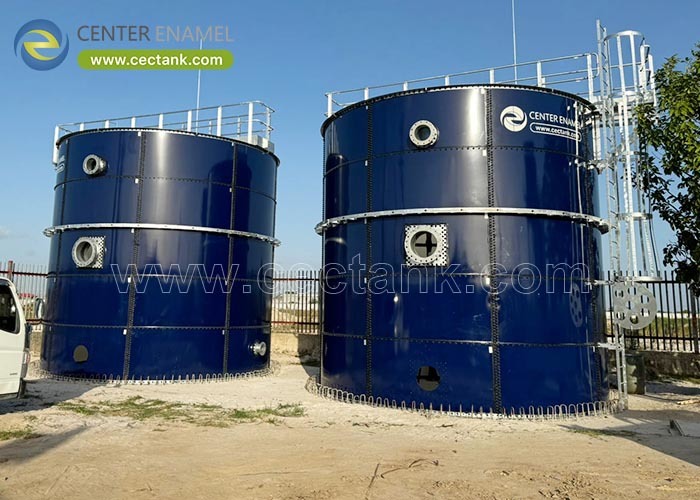
Center Enamel supplies bolted steel water tanks with in-house enameling and coating QA, shipped as panels with sealant and bolts for local erection. The Italy Sardinia chilled process water tank (30,549 m3, 2025) demonstrates our capability to deliver very large, coated, roofed water tanks for process duty; the same engineering applies at buffer-tank scale.
- In-house enamel and epoxy coating lines.
- Factory holiday-test and hydrostatic-test records.
- Panels shipped for local erection.
- Volume matched to your chiller cycling analysis.
Frequently Asked Questions
What size buffer tank does a data center need?
Buffer volume is usually driven by chiller minimum run-time and the load swing you want to absorb, often expressed as minutes of chiller runtime. An engineer sizes it from the chiller's minimum modulation and the expected load step.
Is a buffer tank the same as a TES tank?
No. A buffer tank is small and absorbs rapid, short-term swings to prevent short-cycling. A TES tank is large and stores hours of cooling for peak shaving or off-peak shifting.
Should the buffer tank be pressurized or atmospheric?
Most chilled-water buffer tanks are atmospheric or lightly pressurized, depending on the loop. Pressurized designs are covered where the system pressure requires it.
What material is best for a chilled water buffer tank?
GFS or FBE coated steel for corrosion resistance in continuous wet service, stainless for high-purity or small skids. Material choice follows water quality and budget.
Can a buffer tank be added to an existing plant?
Yes. A retrofit buffer is piped in bypass on the chilled-water header; the main constraint is mechanical-room space and pump head.
Does a buffer tank improve PUE?
Indirectly. By letting chillers run at efficient part-load instead of cycling, it can lower compressor energy, though the direct PUE win is usually smaller than that from TES or free-cooling.
A chilled water buffer tank is a low-cost, high-reliability addition to a data center chiller plant. It protects compressors from short-cycling, stabilizes supply temperature through free-cooling transitions, and is straightforward to specify once the chiller cycling profile is known. Treat it as a thermal shock absorber, separate from the larger TES tank used for peak shaving.
Suggested CTA: Discuss your chiller cycling profile with our engineers and we will size a coated, bolted buffer tank that fits your mechanical room and your load steps.