-
Glass Fused To Steel Tanks (822)
-
Stainless Steel Tanks (434)
-
Fusion Bonded Epoxy Tanks (622)
-
Galvanized Steel Tanks (321)
-
Aluminum Dome Roofs (1336)
-
Wastewater Storage Tanks (280)
-
Welded Steel Tanks (457)
-
Pressure Vessels (295)
-
Anaerobic Digester (202)
-
Industrial Water Tanks (349)
-
Glass Lined Steel Tanks (180)
-
Bolted Steel Tanks (389)
-
Sludge Storage Tank (115)
-
Biogas Storage Tank (173)
-
Leachate Storage Tanks (133)
-
Agricultural Water Storage Tanks (179)
-
Fire Water Tank (166)
-
Grain Storage Silos (146)
-
Biogas Projects (424)
-
Wastewater Treatment Projects (1600)
-
Double Membrane Roof (223)


|
Data Center Water Storage Tanks: Fire, Process, and Cooling in One Site Plan
| Place of Origin: | China |
| Brand Name: | CEC TANKS |
| Certification: | ISO 9001:2008, AWWA D103 , OSHA , BSCI |
| Model Number: | W |
| Minimum Order Quantity: | 1set |
| Price: | $5000~$20000 one set |
| Packaging Details: | PE poly-foam between each two steel plates ; wooden pallet and wooden |
| Delivery Time: | 10-30 days after deposit received |
| Payment Terms: | L/C,T/T |
| Supply Ability: | 60 sets per month |
|
Detail Information |
|||
| Place of Origin | China | Brand Name | CEC TANKS |
|---|---|---|---|
| Certification | ISO 9001:2008, AWWA D103 , OSHA , BSCI | Model Number | W |
| Tank Body Color: | Dark Green / Can Be Customized | Corrosion Integrity: | Excellent |
| Steel Plates Thickness: | 3mm To 12mm , Depends On The Tank Structure | Chemical Resistance: | Excellent |
| Size Of Panel: | 2.4M * 1.2M | Easy To Clean: | Smooth, Glossy, Inert, Anti-adhesion |
Product Description
A data center is a small water utility. It needs fire-protection water, process or make-up water for cooling, and sometimes potable or equipment water, each with its own standard and duty. Planning these as one system avoids duplicate civil works, conflicts, and compliance gaps. This article lays out the on-site water storage picture.
A data center site typically needs three water stores: a fire-protection tank sized to NFPA 22 duration and demand, a process or make-up tank for cooling towers, and sometimes a potable or equipment tank. Plan them together so foundations, fill, and controls do not conflict, while each tank still meets its own code.
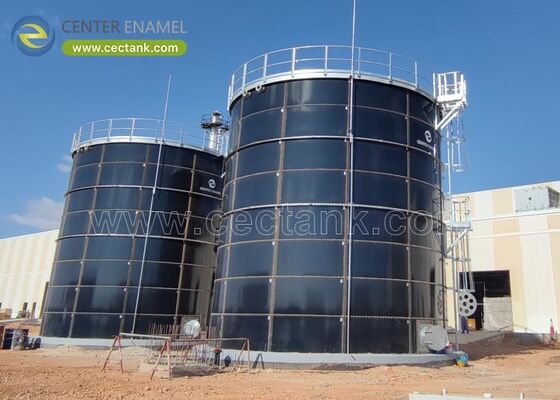
Fire water is the most regulated store. It must meet NFPA 22 for capacity, duration, and reliability, sized from the sprinkler and hydrant demand. The Dubai fire water project (2025, 652 m3) and the Indonesia cigarette-manufacture fire tank (2018, a 34.8 m tall GFS tank) show bolted fire tanks built to demanding site constraints.
- NFPA 22 governs capacity and duration.
- Sized from sprinkler plus hydrant demand.
- Bolted tanks suit tight or tall sites.
- Reliability and redundancy matter.
The cooling loop needs make-up and basin storage sized from the tower water balance (see the cooling-tower article). This is the largest day-to-day store. The Indonesia Cilincing drinking water tank (2024, 21,088 m3) and the Italy Sardinia chilled process water tank (2025, 30,549 m3) are examples of very large bolted water tanks for process duty.
- Largest day-to-day volume.
- Sized from evaporation, drift, blowdown.
- Very large bolted tanks proven at 20,000-30,000 m3.
- Often the dominant store on site.
Some sites need potable water for amenities or equipment testing, and many need a dedicated buffer for chillers. These are smaller but should be lined for their use. The Namibia freshwater program (2022, 6 x 11,230 m3) and Maldives drinking water (2024, 760 m3) show both large and small potable stores.
- Smaller but use-specific.
- Lining follows water use.
- Potable needs appropriate certification.
- Buffer tanks serve the chiller plant.
| Store | Standard driver | Typical size |
| Fire protection | NFPA 22 | Demand x duration |
| Cooling make-up | Water balance | Largest, 10,000s m3 |
| Potable / buffer | Use-specific | Hundreds to thousands m3 |
Plan foundations, fill points, and level controls together. A single supplier for all three stores simplifies QA and spares; a single liner specification eases maintenance. Keep fire water hydraulically separate per code while sharing civil and erection crews.
- Shared civil and erection crews.
- One liner spec eases maintenance.
- Fire loop hydraulically separate per code.
- Single QA and spares list.
Center Enamel supplies GFS, FBE, and stainless bolted tanks across all three duties, with in-house coating and roof systems. From a 652 m3 fire tank in Dubai to a 30,549 m3 process tank in Italy, the same engineering covers the whole site water plan.
- GFS / FBE / stainless across duties.
- In-house coating and roof systems.
- 652 m3 to 30,000 m3 class.
- One supplier for the full site plan.
Usually at least a fire-protection tank (NFPA 22), a cooling make-up tank, and often a potable or buffer tank. Plan them as one site system.
Generally no; fire water is kept hydraulically separate per code. Keep them as distinct stores even if one supplier builds both.
The cooling make-up and basin storage is normally the largest, often in the 10,000s of m3 for big campuses.
NFPA 22 for capacity, duration, and reliability, sized from sprinkler and hydrant demand.
Where water use allows, one lining spec (GFS or FBE) simplifies QA, spares, and maintenance across the site.
Yes. Bolted GFS, FBE, and stainless tanks cover fire, process, and potable duties from one supplier with unified QA.
On-site water storage for a data center is three stores planned as one: a code-driven fire tank, a water-balance-driven cooling tank, and use-specific potable or buffer tanks. Coordinating foundations, linings, and controls up front avoids conflicts and duplication, while each tank still meets its own standard. Bolted coated tanks let one supplier deliver the whole plan at any scale.