-
Glass Fused To Steel Tanks (837)
-
Stainless Steel Tanks (434)
-
Fusion Bonded Epoxy Tanks (622)
-
Galvanized Steel Tanks (321)
-
Aluminum Dome Roofs (1336)
-
Wastewater Storage Tanks (280)
-
Welded Steel Tanks (457)
-
Pressure Vessels (295)
-
Anaerobic Digester (202)
-
Industrial Water Tanks (349)
-
Glass Lined Steel Tanks (180)
-
Bolted Steel Tanks (389)
-
Sludge Storage Tank (115)
-
Biogas Storage Tank (173)
-
Leachate Storage Tanks (133)
-
Agricultural Water Storage Tanks (179)
-
Fire Water Tank (166)
-
Grain Storage Silos (146)
-
Biogas Projects (424)
-
Wastewater Treatment Projects (1610)
-
Double Membrane Roof (223)
|
Off-Peak Chilled Water Storage: Tariff Arbitrage and Load Shifting
| Place of Origin: | China |
| Brand Name: | CEC TANKS |
| Certification: | ISO 9001:2008, AWWA D103 , OSHA , BSCI |
| Model Number: | W20160907009 |
| Minimum Order Quantity: | 1set |
| Price: | $5000~$20000 one set |
| Packaging Details: | PE poly-foam between each two steel plates ; wooden pallet and wooden box |
| Delivery Time: | 0-60 days after deposit received |
| Payment Terms: | L/C,T/T |
| Supply Ability: | 60 sets per month |
|
Detail Information |
|||
Product Description
Off-peak chilled water storage is the commercial heart of TES: charge the tank with cheap night power, discharge during expensive day peaks, and let the tariff delta pay for the steel. For a data center where cooling is a large, steady load, the arbitrage case can be stronger than the PUE story. This article focuses on the bill, not the ratio.
Off-peak chilled water storage cuts data center cooling cost by charging a stratified tank with chillers during low-tariff night hours and discharging it during high-tariff peaks, shifting kWh consumption from expensive to cheap periods. The payback follows the size of the time-of-use price gap, the rounds of charge-discharge per day, and the capital cost of the tank and extra chiller hours.
The wider the spread between off-peak and peak electricity price, the more each cubic meter of stored cooling is worth. In markets with strong time-of-use or demand charges, a TES tank can shave the peak kW that sets the demand bill, not just the energy kWh. Model the local tariff before sizing.
- Price spread sets storage value.
- Demand charges may dominate.
- Local tariff must be modeled first.
- Value varies by market sharply.
A tank that charges once per night and discharges once per day captures one arbitrage cycle. Sites with midday solar or two peaks may capture more. Each round adds value but also wear and pumping energy, so the optimum is not necessarily max cycles.
- One cycle per day is typical.
- Extra peaks can add rounds.
- More cycles add pump energy.
- Optimum is not max cycles.
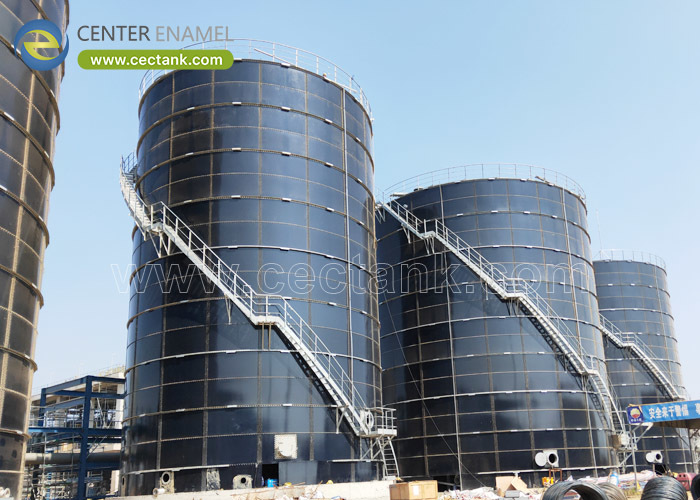
Size the tank to the peak-hour cooling you want to erase, at the usable delta-T your loop allows. A wider allowable supply swing stores more per cubic meter and lowers capital. The Italy Sardinia tank (2025, 30,549 m3) and the Namibia array (6 x 11,230 m3) are large coated storage we delivered for other clients, analogous evidence of build scale, not data-center projects.
- Volume targets peak-hour cooling erased.
- Usable delta-T sets storage density.
- Larger swing lowers capital.
- Scale proven on large arrays.
The business case balances tank capital and extra chiller pumping against the tariff savings. The table lists the moving parts a procurement team should model. Insulation and pump power are small but real; the tariff model is the dominant term.
- Tank capital and lining.
- Extra chiller and pump energy.
- Tariff savings (energy + demand).
- Insulation and auxiliary load.
| Factor | Effect on payback |
| Tariff spread | Larger -> faster |
| Demand charge | If high -> strong |
| Tank capital | Larger -> slower |
| Pump energy | Small -> minor |
We have no data-center TES in this library. The large water and array tanks cited (Italy Sardinia 30,549 m3, Namibia 6 x 11,230 m3) are analogous industrial and utility deliveries, not data-center projects, offered as evidence of our ability to build large coated storage.
- No data-center TES in library.
- Citations analogous, not claims.
- Large build scale is real.
- Tariff model needs your rates.
Only where the time-of-use or demand-charge spread is large enough to beat tank capital and extra pump energy. Model the local tariff first.
Not directly. Off-peak storage shifts when energy is bought and can cut cost and demand charges, while PUE measures efficiency. The two can coexist but are different levers.
One night charge and one day discharge is typical; sites with multiple peaks or solar may add rounds, though each adds pump energy.
Use the widest allowable supply-temperature swing your loop tolerates; a larger swing stores more per cubic meter and reduces tank size.
Yes, charging and discharging move water, but pump energy is usually small next to the tariff savings where the spread is meaningful.
Not in our project library. We cite large coated water and array tanks at other clients as analogous capability, not data-center deliveries.
Off-peak chilled water storage is a billing strategy first and a cooling strategy second. Charge on cheap power, discharge on expensive peaks, and let the tariff spread pay for the tank, with demand-charge shaving often the biggest prize. Size the tank to the peak-hour cooling you want to erase at your usable delta-T, and model the local tariff before committing capital, because the spread, not the steel, decides the payback.
Suggested CTA: Provide your electricity tariff and cooling load profile and we will size an off-peak TES tank and estimate the demand-charge and energy savings for your site.