-
Glass Fused To Steel Tanks (837)
-
Stainless Steel Tanks (434)
-
Fusion Bonded Epoxy Tanks (622)
-
Galvanized Steel Tanks (321)
-
Aluminum Dome Roofs (1336)
-
Wastewater Storage Tanks (280)
-
Welded Steel Tanks (457)
-
Pressure Vessels (295)
-
Anaerobic Digester (202)
-
Industrial Water Tanks (349)
-
Glass Lined Steel Tanks (180)
-
Bolted Steel Tanks (389)
-
Sludge Storage Tank (115)
-
Biogas Storage Tank (173)
-
Leachate Storage Tanks (133)
-
Agricultural Water Storage Tanks (179)
-
Fire Water Tank (166)
-
Grain Storage Silos (146)
-
Biogas Projects (424)
-
Wastewater Treatment Projects (1610)
-
Double Membrane Roof (223)

|
Hyperscale Data Center TES Tanks: Sizing, Logistics, and Multi-Tank Arrays
| Place of Origin: | China |
| Brand Name: | CEC TANKS |
| Certification: | ISO 9001:2008, AWWA D103 , OSHA , BSCI |
| Model Number: | J2016012316 |
| Minimum Order Quantity: | 1set |
| Price: | $5000~$20000 one set |
| Packaging Details: | PE poly-foam between each two steel plates ; wooden pallet and wooden box |
| Delivery Time: | 0-60 days after deposit received |
| Payment Terms: | L/C,T/T |
| Supply Ability: | 60 sets per month |
|
Detail Information |
|||
| Place of Origin | China | Brand Name | CEC TANKS |
|---|---|---|---|
| Certification | ISO 9001:2008, AWWA D103 , OSHA , BSCI | Model Number | J2016012316 |
| Acid And Alkalinity Proof: | Standard Coating Suits For PH3 - PH11, Special Coating Suits For PH1 - PH14 | Elastic: | Same As Steel Sheet , Around 500KN/mm |
| Serive Life: | More Than 30 Years | PH Range: | PH 1 - PH 14 |
| Coating Color: | Dark Blue, Dark Green , White, And Customized | Steel Plates Thickness: | 3mm - 12mm , Depends On The Diameter & Height |
| Easy Yo Clean: | Smooth, Glossy, Inert, Anti-adhesion | Coating Thickness: | 4.0.25mm - 0.4mm, Two Coating Internal And External |
| Highlight: | Hyperscale Data Center TES Tanks,Glass Fused Steel TES Tanks,Multi-Tank TES Array Logistics |
||
Product Description
Hyperscale data centers turn TES from a single tank into an array problem. Tens of thousands of cubic meters, tight schedules, and parallel construction mean the challenge is as much logistics and repeatability as thermal design. This article covers TES at hyperscale.
Hyperscale data center TES uses very large, often multi-tank storage arrays, sized to the campus cooling load and peak-shaving target, delivered as repeated bolted-panel modules for parallel erection. The engineering focus shifts from a single elegant tank to consistent modules, coordinated logistics, and a build sequence that keeps pace with the mechanical fit-out.
Sizing the campus arrayTotal TES volume follows the aggregate cooling load and the hours of peak you want to shave, at the usable delta-T. At hyperscale this becomes tens of thousands of cubic meters, usually split into modules for constructability. The Italy Sardinia tank (2025, 30,549 m3) and Indonesia Cilincing tank (2024, 21,088 m3) are large coated tanks we delivered, analogous evidence of single-tank scale, not data-center projects.
- Volume = aggregate load x peak hours.
- Usable delta-T sets density.
- Tens of thousands of m3 typical.
- Split into modules for build.
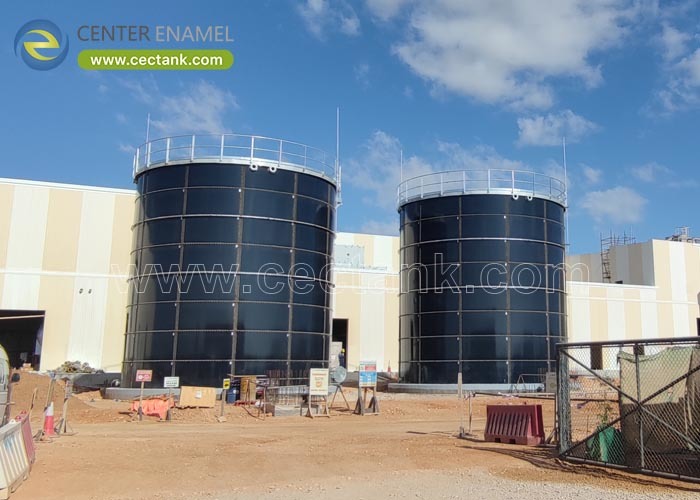
A single enormous tank is hard to site, anchor, and erect, and a leak is catastrophic. Multiple modules let crews work in parallel, isolate a fault, and stage delivery. Our Namibia installation of six tanks (6 x 11,230 m3, total 67,380 m3) shows a coordinated multi-tank array delivered as repeated units.
- Parallel crews and staging.
- Fault isolation per module.
- Repeatable bolted modules.
- Easier anchor and site layout.
Hyperscale rewards identical modules: one panel set, one lining spec, one erection method repeated dozens of times. That repetition compresses schedule and QA. Flat-pack panels ship efficiently and local crews erect tier by tier, keeping the tank build off the critical path of the campus.
- One panel set repeated.
- One lining and QA spec.
- Flat-pack shipping efficiency.
- Local tiered erection.
Coordinate tank erection with the cooling loop and BMS fit-out so each module is commissioned as it completes. The table contrasts single large versus array strategy at scale.
- Erect in step with loop fit-out.
- Commission module by module.
- Align with BMS rollout.
- Staggered, not all-at-once.
Aspect | Single giant tank | Multi-tank array |
Siting | Hard | Flexible |
Fault impact | High | Isolated |
Erection | Serial | Parallel |
Leak risk | Catastrophic | Contained |
We have no hyperscale data-center TES in this library. The large and array tanks cited (Namibia 6 x 11,230 m3, Italy Sardinia 30,549 m3, Indonesia 21,088 m3) are analogous utility and industrial deliveries, not data-center projects.
- No hyperscale DC TES in library.
- Citations analogous, not claims.
- Array logistics proven.
- Campus design needs your spec.
Tens of thousands of cubic meters, sized from aggregate campus load and peak-shaving hours at the usable delta-T, usually split into modules.
One big tank or an array?An array is preferred at scale: parallel erection, fault isolation, and easier siting than a single catastrophic-leak vessel.
Does repeatability really help?Yes. Identical bolted modules let one panel set, one lining spec, and one erection method repeat dozens of times, compressing schedule and QA.
How are arrays built without blocking the campus?Flat-pack panels ship efficiently and local crews erect tier by tier, keeping tank work off the mechanical critical path.
What is the leak risk of a huge tank?A single giant tank concentrates risk; an array contains a leak to one module, which is why hyperscale favors arrays.
Have you built this for data centers?Not in our project library. We cite large and array tanks at other clients as analogous capability, not data-center deliveries.
Hyperscale TES is an array problem, not a single-tank problem. Size the total volume from campus load and peak-shaving hours, then deliver it as repeated bolted modules for parallel erection, fault isolation, and logistics efficiency. The reward of hyperscale is repetition: one panel set, one lining spec, and one erection method done dozens of times, keeping the tank build off the campus critical path. A multi-tank array also contains a leak to one module, which a single monster tank cannot.
Suggested CTA: Provide your campus cooling load and peak-shaving target and we will lay out a repeated-module TES array with a build sequence for your hyperscale site.