-
Glass Fused To Steel Tanks (837)
-
Stainless Steel Tanks (434)
-
Fusion Bonded Epoxy Tanks (622)
-
Galvanized Steel Tanks (321)
-
Aluminum Dome Roofs (1336)
-
Wastewater Storage Tanks (280)
-
Welded Steel Tanks (457)
-
Pressure Vessels (295)
-
Anaerobic Digester (202)
-
Industrial Water Tanks (349)
-
Glass Lined Steel Tanks (180)
-
Bolted Steel Tanks (389)
-
Sludge Storage Tank (115)
-
Biogas Storage Tank (173)
-
Leachate Storage Tanks (133)
-
Agricultural Water Storage Tanks (179)
-
Fire Water Tank (166)
-
Grain Storage Silos (146)
-
Biogas Projects (424)
-
Wastewater Treatment Projects (1610)
-
Double Membrane Roof (223)
|
Cooling Water Storage Tanks: Closed-Loop vs Open-Loop and Treatment
| Place of Origin: | China |
| Brand Name: | CEC TANKS |
| Certification: | ISO 9001:2008, AWWA D103 , OSHA , BSCI |
| Model Number: | W20161227006 |
| Minimum Order Quantity: | 1set |
| Price: | $5000~$20000 one set |
| Packaging Details: | PE poly-foam between each two steel plates ; wooden pallet and wooden box |
| Delivery Time: | 0-60 days after deposit received |
| Payment Terms: | L/C,T/T |
| Supply Ability: | 60 sets per month |
|
Detail Information |
|||
Product Description
Data center cooling water lives in two worlds: a closed chilled loop that must stay clean, and an open condenser or cooling-tower loop exposed to air, evaporation, and treatment chemicals. The storage tank design and lining differ between them, and so does the failure mode. This article covers the tank through the lens of loop type and water treatment.
A cooling water storage tank for a data center must match the loop it serves: a closed chilled-water tank favors a clean, inert lining (GFS or FBE) with minimal oxygen ingress, while an open condenser or cooling-tower tank must tolerate treatment chemicals, blowdown, and biological growth. The right lining and ventilation, not just volume, decide service life.
Closed chilled-water loops circulate treated, low-oxygen water, so the tank mainly needs an inert, holiday-tested lining and a tight seal to keep oxygen out. GFS and FBE give a glass or epoxy surface that resists the corrosion drivers in treated water. The Italy Sardinia chilled process water tank (2025, 30,549 m3, enamel and membrane roof) is a large coated process tank we delivered, analogous evidence, not a data-center project.
- Inert GFS / FBE lining.
- Tight seal limits oxygen ingress.
- Low corrosion-driver exposure.
- Roof limits contamination.
Open cooling-tower loops concentrate dissolved solids and biocide, and the tank sees drift, blowdown, and atmospheric exposure. The lining must resist the treatment chemistry, and the tank needs ventilation and easy access for cleaning. Stainless may be specified for smaller, aggressive-duty sections.
- Resist treatment chemistry.
- Ventilation and access for cleaning.
- Blowdown and drift managed.
- Stainless for aggressive small sections.
Scale, biocide, and pH all attack the wrong lining. Specify the lining against the actual treatment program, not a generic water assumption. A holiday-tested GFS or FBE surface gives a known, documented barrier; verify the supplier's chemical resistance list for your program.
- Lining matched to treatment program.
- Verify chemical resistance list.
- Holiday test documents the barrier.
- Do not assume generic water.
Lining |
Resists |
Watch-out |
GFS (glass fired 820-930C) |
Treated-water corrosion |
Confirm chemical list |
FBE epoxy |
Biocide and scale |
Match to program |
Stainless 304/316L |
Aggressive small duty |
Cost vs need |
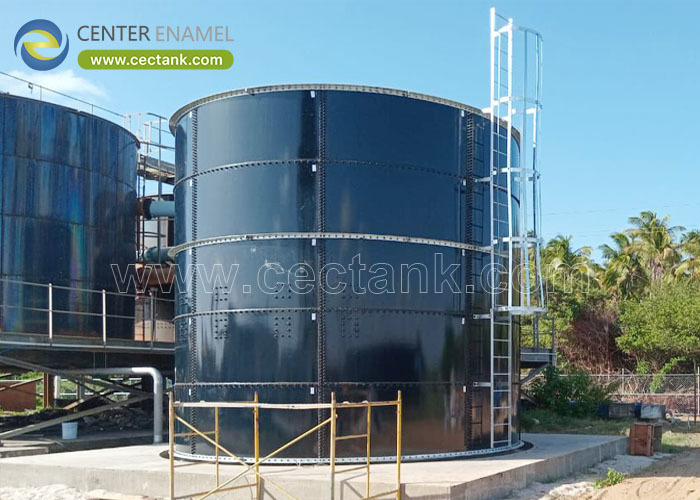
Bolted-panel tanks ship flat-packed and erect quickly, which matters when a mechanical room or plant yard is on a critical path. A comparable project was erected by 6 people in 12 days, illustrating the schedule compression versus welded builds. The tank arrives as coated panels with sealant and bolts for local assembly.
- Flat-pack panels cut shipping.
- Fast erection off critical path.
- 6-person / 12-day comparable example.
- Coated panels shipped ready.
We have no data-center cooling-water tank in this library. The coated process and chilled-water tanks cited (Italy Sardinia 30,549 m3, Thailand 6-person / 12-day) are analogous industrial deliveries, not data-center projects, offered as evidence of our ability to build lined, fast-erected cooling-water tanks.
- No data-center cooling tank in library.
- Citations analogous, not claims.
- Lined, fast-erected capability real.
- Treatment program defines lining.
Closed loops need a clean, inert, sealed lining with low oxygen ingress; open cooling-tower loops need a lining that resists treatment chemicals, biocide, and blowdown, plus ventilation and access.
GFS or FBE linings with a documented chemical-resistance list for your treatment program; stainless for smaller aggressive sections. Match the lining to the actual chemistry.
Yes. Open loops concentrate solids and grow biology, so the tank needs blowdown management, access for cleaning, and periodic inspection of the lining.
Often yes, if the loop pressure allows; pressurized closed tanks are specified where system pressure must be held at the tank.
Bolted-panel tanks erect in days; a comparable project was set by 6 people in 12 days, versus weeks for field welding.
Not in our project library. We cite coated process and chilled-water tanks at other clients as analogous capability, not data-center deliveries.
Cooling water storage for a data center is two different tank problems: a closed chilled loop that must stay clean behind an inert lining, and an open condenser loop that must survive treatment chemistry and biology. Choose the lining against the actual treatment program, ventilate and access the open tank for cleaning, and use bolted panels to keep erection off the critical path. The loop type, not the volume, sets the design.