-
Glass Fused To Steel Tanks (822)
-
Stainless Steel Tanks (434)
-
Fusion Bonded Epoxy Tanks (622)
-
Galvanized Steel Tanks (321)
-
Aluminum Dome Roofs (1336)
-
Wastewater Storage Tanks (280)
-
Welded Steel Tanks (457)
-
Pressure Vessels (295)
-
Anaerobic Digester (202)
-
Industrial Water Tanks (349)
-
Glass Lined Steel Tanks (180)
-
Bolted Steel Tanks (389)
-
Sludge Storage Tank (115)
-
Biogas Storage Tank (173)
-
Leachate Storage Tanks (133)
-
Agricultural Water Storage Tanks (179)
-
Fire Water Tank (166)
-
Grain Storage Silos (146)
-
Biogas Projects (424)
-
Wastewater Treatment Projects (1590)
-
Double Membrane Roof (223)


|
GFS Water Tanks for Data Centers: Fire, Process, and Make-up Water in One Bolted System
| Place of Origin: | China |
| Brand Name: | CEC TANKS |
| Certification: | ISO 9001:2008, AWWA D103 , OSHA , BSCI |
| Model Number: | W20160705006 |
| Minimum Order Quantity: | 1set |
| Price: | $5000~$20000 one set |
| Packaging Details: | PE poly-foam between each two steel plates ; wooden pallet and wooden box |
| Delivery Time: | 0-60 days after deposit received |
| Payment Terms: | L/C,T/T |
| Supply Ability: | 60 sets per month |
|
Detail Information |
|||
| Place of Origin | China | Brand Name | CEC TANKS |
|---|---|---|---|
| Certification | ISO 9001:2008, AWWA D103 , OSHA , BSCI | Model Number | W20160705006 |
| Coating Thickness: | 0.25mm~0.40mm , Two Layer Of Coating Internal And External | Tank Material: | Glass Fused To Steel |
| Steel Grade: | ART 310 | Roof Available: | Glass Fused Steel Roof , Membrane Roof, Aluminum Roof , GRP Roof |
| Highlight: | Glass fused steel water tanks,Data center water storage tanks,Bolted water tank system |
||
Product Description
A data center consumes water in three distinct ways: fire suppression reserves, potable or make-up water for cooling and staff, and process top-up for chillers and humidification. Specifying three different tank technologies multiplies interfaces and spares. A Glass-Fused-to-Steel (GFS) bolted tank handles all three duties with one construction family, one set of spares and one maintenance regime.
GFS bolted water tanks suit every data center water duty - fire reserve, potable/make-up and cooling top-up - because the fired glass-to-steel shell is inert, cleanable and corrosion-resistant across these waters, and the bolted format scales from a small fire tank to a 20,000 m3-plus potable reservoir. One tank family simplifies spare parts, training and inspection across the campus.
Fire water is stored and rarely used but must be instantly available and code-compliant. Potable and make-up water feed cooling and humane use and must stay hygienic. Process top-up replaces losses in closed loops. Each has different turnover and code exposure, but all benefit from a corrosion-proof, leak-tight shell.
- Fire reserve: code-compliant, standby.
- Potable/make-up: hygienic, NSF 61 where potable.
- Process top-up: closed-loop loss replacement.
The GFS face is a fired glass layer (0.25-0.45 mm per face, 820-930C fusion) that is inert to a wide range of waters and does not rust. For potable duty the lining is selected for NSF/ANSI 61 health-effect compliance; for fire and process duty the same inert face resists corrosion without recoating. The bolted shell is designed to AWWA D103-09.
| Duty | GFS advantage | Standard note |
|---|---|---|
| Fire reserve | No rust, long standby life | AWWA D103-09 shell. |
| Potable / make-up | Inert, NSF 61 lining | Health-effect compliance. |
| Process top-up | Corrosion-proof face | No recoat cycle. |
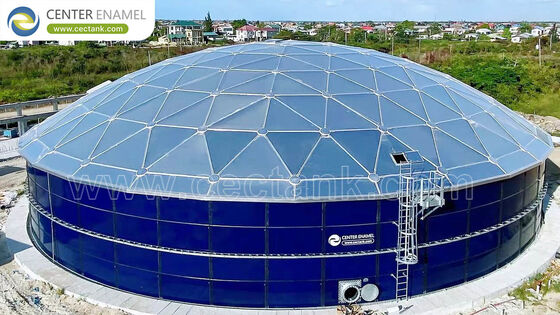
A data center fire tank may be a few hundred cubic meters, while a campus potable reservoir can exceed 20,000 m3 in a single shell. The same bolted panel system covers both. The UAE Dubai fire-water tank at 652 m3 (2025) and the Indonesia Cilincing potable installation at 21,088 m3 (2024, aluminum dome roof) show the range of one GFS family.
- UAE Dubai 2025: 652 m3 fire water tank.
- Indonesia Cilincing 2024: 21,088 m3 potable, aluminum dome.
Using GFS across duties means one bolt grade, one sealant type, one inspection method and one coating test record. That reduces the operations team training and the spare holding, which is a quiet but real data center O&M saving.
- Common bolts, sealant and QA.
- Single inspection playbook.
- Smaller spare inventory.
Center Enamel manufactures GFS bolted tanks designed to AWWA D103-09 with NSF 61-listed linings for potable duty, delivering both fire-water and potable/process tanks across climates from small units to 20,000 m3-plus single shells.
Yes - the same bolted shell and inert glass face work for both; the potable version uses an NSF 61-listed lining and the fire version is specified to AWWA D103-09.
From a few hundred m3 fire tank to over 20,000 m3 in one shell, as demonstrated by the 21,088 m3 Indonesia Cilincing potable tank.
Where potable contact applies, the lining is selected and documented for NSF/ANSI 61 health-effect compliance; it is an inert fired glass face.
No - the fired glass face does not rust, giving a 30-50 year design life in suitable duty without a recoat cycle.
Bolted panels ship flat, erect fast on a critical path, and avoid field welding quality risk; the same panels scale across duties.
Keep them as separate shellassets with their own suction; the GFS family lets you do that without multiplying technologies.
For a data center, GFS bolted water tanks turn three water duties into one manageable system: one construction family, one coating record, one spare set. The result is lower interface risk and a quieter operations life, which is exactly what a campus water strategy should deliver.
Suggested CTA: Describe your fire, potable and process volumes and we will propose a GFS tank layout with capacities, roof types and an NSF 61 lining plan for potable duty.