-
Glass Fused To Steel Tanks (807)
-
Stainless Steel Tanks (434)
-
Fusion Bonded Epoxy Tanks (607)
-
Galvanized Steel Tanks (321)
-
Aluminum Dome Roofs (1336)
-
Wastewater Storage Tanks (280)
-
Welded Steel Tanks (457)
-
Pressure Vessels (295)
-
Anaerobic Digester (202)
-
Industrial Water Tanks (349)
-
Glass Lined Steel Tanks (180)
-
Bolted Steel Tanks (389)
-
Sludge Storage Tank (115)
-
Biogas Storage Tank (173)
-
Leachate Storage Tanks (133)
-
Agricultural Water Storage Tanks (179)
-
Fire Water Tank (166)
-
Grain Storage Silos (146)
-
Biogas Projects (424)
-
Wastewater Treatment Projects (1570)
-
Double Membrane Roof (223)

|
EGSB Tank: High-Rate Anaerobic Treatment Explained
| Place of Origin: | China |
| Brand Name: | CEC TANKS |
| Certification: | ISO 9001:2008, AWWA D103 , OSHA , BSCI |
| Model Number: | W20160901011 |
| Minimum Order Quantity: | 1set |
| Price: | $5000~$20000 one set |
| Packaging Details: | PE poly-foam between each two steel plates ; wooden pallet and wooden box |
| Delivery Time: | 0-60 days after deposit received |
| Payment Terms: | L/C,T/T |
| Supply Ability: | 60 sets per month |
|
Detail Information |
|||
| Place of Origin | China | Brand Name | CEC TANKS |
|---|---|---|---|
| Certification | ISO 9001:2008, AWWA D103 , OSHA , BSCI | Model Number | W20160901011 |
| Adhesion: | 3,450N/cm | Hardness: | 6.0Mohs |
| Holiday Test: | >1500v | Elastic: | Same As Steel Sheet ,around 500KN /mm |
| Capacity: | 20 M3 To 18,000 M3 | Coating Thickness: | 0.25mm~0.40mm , Two Layer Of Coating Internal And External |
| Highlight: | EGSB anaerobic wastewater treatment tank,high-rate anaerobic treatment system,wastewater storage tank with EGSB |
||
Product Description
EGSB Tank: High-Rate Anaerobic Treatment Explained
An EGSB (Expanded Granular Sludge Bed) tank is one of the highest-rate anaerobic reactors built - a machine for treating soluble industrial wastewater in hours instead of days. It is closely related to the better-known UASB but tuned for a faster, expanded bed.
An EGSB tank is a high-rate anaerobic reactor: an upflow bed of granular sludge in an 'expanded' (partly fluidized) zone that treats soluble industrial wastewater at 5-15 kg COD/m3/day with a hydraulic retention time measured in hours, versus 20-40 days for a CSTR. Its real capacity ceiling is the three-phase separator at the top - it must separate gas, liquid and solids at the chosen upflow velocity (about 0.5-1.2 m/h) or the granular sludge washes out.
Expanded Granular Sludge Bed, Plainly
Like a UASB, an EGSB holds a bed of dense, settleable granular sludge through which wastewater flows upward. The 'expanded' part means the upflow velocity is high enough that the bed loosens and the granules circulate, improving contact without mechanical mixing. Biogas rises, the liquid and gas separate in a three-phase separator at the top, and treated water overflows. There are no moving parts in the reactor itself.
- Upflow through a granular sludge bed, no mechanical mixing.
- 'Expanded' = higher upflow, gentle circulation.
- Gas/liquid/solid split in a top three-phase separator.
The Numbers That Define Success
The operating window is tight. Upflow velocity at the top is about 0.5-1.2 m/h - push it too high and granules wash into the separator and out; too low and the bed sits dormant. Organic loading is 5-15 kg COD/m3/day for readily degradable industrial streams, and the HRT is hours, which is why an EGSB can be far smaller than an equivalent CSTR. Temperature is mesophilic (35-38C), and methane yield tracks treatment performance at about 0.25-0.35 m3 per kg COD removed.
| Parameter | EGSB typical | Note |
|---|---|---|
| Upflow velocity | 0.5-1.2 m/h at top | Sets the wash-out limit. |
| Organic loading | 5-15 kg COD/m3/day | Readily degradable industrial feed. |
| HRT | Hours (not days) | Drives small footprint. |
| Temperature | 35-38C mesophilic | Stability beats setpoint. |
| Methane yield | 0.25-0.35 m3/kg COD | Follows performance. |
EGSB vs UASB, and Where It Fits
EGSB is essentially a higher-upflow cousin of UASB: same granular-sludge principle, smaller footprint, higher load - but it demands better influent distribution and a more robust separator. It suits soluble, warm, readily degradable industrial wastewater with COD typically above 1,500-2,000 mg/L: food and beverage, brewery, pulp and paper, some pharma. It is the wrong tool for cold dilute municipal sewage, high suspended solids (which blind the bed), or heavy FOG that coats granules.
- Fits: soluble, warm, high-COD industrial effluent.
- Avoid: dilute cold sewage, high TSS, heavy FOG.
- Needs good influent distribution + strong separator.
Project Reference
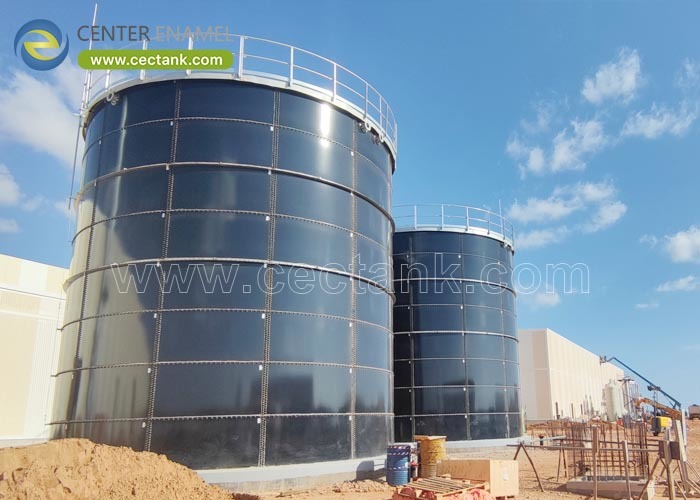
A real EGSB delivery: the Malaysia Coca-Cola Plant Wastewater Treatment Project (2016) included an EGSB tank with enamel roof at 7.64 m diameter x 17.4 m, plus an adjusting tank with aluminum deck roof at 9.17 m x 16.8 m - anaerobic treatment of food/beverage wastewater using the granular-sludge approach.
- Malaysia Coca-Cola WWTP 2016: EGSB tank (enamel roof) Ø7.64 x 17.4 m.
- Adjusting tank (aluminum deck roof) Ø9.17 x 16.8 m.
Company Expertise
Center Enamel engineers anaerobic reactors - UASB and EGSB - as GFS or stainless vessels with the hydraulic internals (influent distribution, three-phase separator, gas collection) designed as part of the tank, not resolved on site.
Frequently Asked Questions
What does EGSB stand for?
Expanded Granular Sludge Bed - an upflow anaerobic reactor with a partly fluidized granular-sludge bed.
EGSB vs UASB - what is the difference?
Same granular-sludge principle, but EGSB runs higher upflow velocity for a smaller footprint and higher load; it needs better distribution and a stronger separator.
What upflow velocity should I design for?
About 0.5-1.2 m/h at the top. Higher risks washing granular sludge out; lower leaves the bed under-used.
What wastewater is EGSB good for?
Soluble, warm, readily degradable industrial effluent with COD typically above 1,500-2,000 mg/L - food, beverage, brewery, pulp and paper, some pharma.
Why is the three-phase separator the limit?
It must separate gas, liquid and solids at the chosen upflow rate; if it cannot, granules wash out and the reactor loses its bed.
How long does an EGSB take to start up?
With granular seed sludge, load builds over weeks to months; the bed is the asset, so good seed sludge shortens commissioning.
An EGSB tank is a high-rate anaerobic machine: granular sludge, hours of retention, and a separator that is the true capacity limit. Specified for soluble, warm, high-COD industrial wastewater, it delivers a small-footprint reactor that turns waste into methane.
Send us your wastewater COD, temperature and flow and we will assess whether an EGSB (vs UASB or CSTR) is the right anaerobic reactor for your plant.