-
Glass Fused To Steel Tanks (807)
-
Stainless Steel Tanks (434)
-
Fusion Bonded Epoxy Tanks (607)
-
Galvanized Steel Tanks (321)
-
Aluminum Dome Roofs (1336)
-
Wastewater Storage Tanks (280)
-
Welded Steel Tanks (457)
-
Pressure Vessels (295)
-
Anaerobic Digester (202)
-
Industrial Water Tanks (349)
-
Glass Lined Steel Tanks (180)
-
Bolted Steel Tanks (389)
-
Sludge Storage Tank (115)
-
Biogas Storage Tank (173)
-
Leachate Storage Tanks (133)
-
Agricultural Water Storage Tanks (179)
-
Fire Water Tank (166)
-
Grain Storage Silos (146)
-
Biogas Projects (424)
-
Wastewater Treatment Projects (1570)
-
Double Membrane Roof (223)

|
Sludge Holding Tank Design: Mixing, Roofing, and Corrosion
| Place of Origin: | China |
| Brand Name: | CEC TANKS |
| Certification: | ISO 9001:2008, AWWA D103 , OSHA , BSCI |
| Model Number: | W |
| Minimum Order Quantity: | 1set |
| Price: | $5000~$20000 one set |
| Packaging Details: | PE poly-foam between each two steel plates ; wooden pallet and wooden |
| Delivery Time: | 10-30 days after deposit received |
| Payment Terms: | L/C,T/T |
| Supply Ability: | 60 sets per month |
|
Detail Information |
|||
| Place of Origin | China | Brand Name | CEC TANKS |
|---|---|---|---|
| Certification | ISO 9001:2008, AWWA D103 , OSHA , BSCI | Model Number | W |
| Foundation: | Concrete Or Glass Fused Steel | Steel Plates Thickness: | 3mm To 12mm , Depends On The Tank Structure |
| Roof Available: | Glass Fused Steel Roof , Membrane Roof, Aluminum Roof , GRP Roof | Easy To Clean: | Smooth, Glossy, Inert, Anti-adhesion |
| Feature: | Eco-friendly, Durability | Capactiy Available: | 20 M3 To 18,000 M3 |
| Highlight: | sludge holding tank mixing design,wastewater storage tank roofing,corrosion resistant sludge holding tank |
||
Product Description
Sludge Holding Tank Design: Mixing, Roofing, and Corrosion
A sludge holding tank sits between process steps - equalizing what arrives against what the next stage can accept. It looks like a simple vessel but the design decisions (mixing, roof, material) decide whether it quietly does its job or becomes a maintenance sink.
A sludge holding tank is an intermediate buffer that stores raw or thickened sludge between process steps, and its design lives on three points: enough mixing (about 5-15 W/m3) to stop settling and crusting, a sealed roof to control odor and the H2S-rich gas space, and a corrosion-resistant shell (GFS or FBE bolted, versus slower concrete). Pump access and a draw-off that avoids re-suspending grit complete the picture.
Why a Sludge Holding Tank Exists
Treatment trains are rarely balanced hour to hour - a digester, dewatering press or truck-out schedule cannot absorb every surge. A holding tank buffers those swings so upstream and downstream run steady. It is sized to the imbalance it must cover, not to the plant's average flow, which is why a small buffer (such as the 200 m3 class) and a large one serve very different purposes.
- Buffers surges between process steps.
- Sized to imbalance, not average flow.
- Small (200 m3) and large buffers have different purposes.
Mixing: Stop Settling and Crusting
Sludge left still drops its solids and forms a crust that is far harder to move than the liquid below. The accepted mixing duty is about 5-15 W/m3 of installed power, delivered by submersible or jet mixers sized to the volume and rheology, with access to service the mixer without emptying the tank. Too little mixing and you get a settling pit; too much wastes energy.
- 5-15 W/m3 installed mixing power.
- Submersible or jet mixers, serviceable in-tank.
- Crusting is harder to handle than the liquid.
Roofing and Corrosion
The worst corrosion in a sludge tank is usually in the gas space, where H2S and moisture attack the shell and any exposed steel. A sealed roof (aluminum dome, enamel, or double membrane depending on gas handling) contains that environment, while the liquid-side liner - GFS or FBE - resists the slurry itself. Concrete is robust but slow to build and hard to seal at penetrations.
|
Element |
Recommendation |
Reason |
|
Mixing |
5-15 W/m3 |
Prevent settle/crust. |
|
Roof |
Sealed (dome/enamel/membrane) |
Contain H2S gas space. |
|
Liner |
GFS or FBE |
Resist slurry + gas. |
|
Access |
Pump + in-tank mixer service |
Operability. |
Project Reference
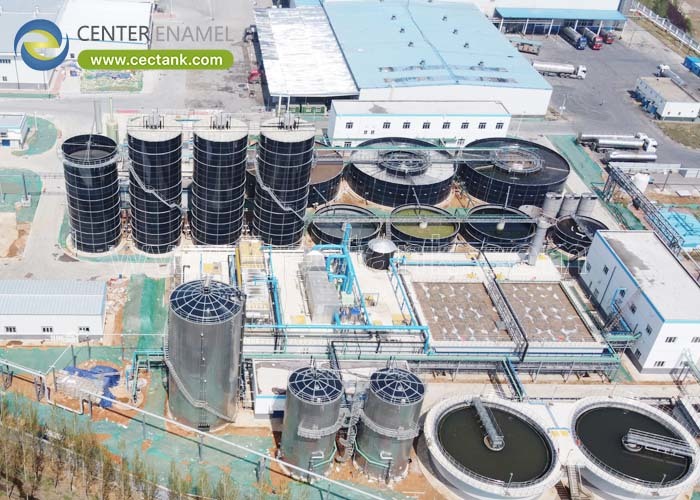
A delivered multi-tank leachate train shows the family in aggressive service: the HK Veolia Landfill Leachate Treatment Project (2019) included equalization, SBR, sludge holding and thickened-sludge tanks built with GFS roofs - real sludge-holding engineering with the corrosive gas space sealed.
- HK Veolia Landfill Leachate 2019: EQ/SBR/sludge holding/thickener tanks with GFS roofs.
- Demonstrates sealed, corrosion-resistant sludge tanks.
Company Expertise
Center Enamel builds GFS and FBE sludge holding tanks to ISO 28765 / AWWA D103-09 with a 100% 1500 V holiday-tested shell and bolted erection that reaches both small buffers and large multistage trains.
Frequently Asked Questions
What is a sludge holding tank for?
It buffers surges between process steps so upstream and downstream run steady; size it to the imbalance, not average flow.
How much mixing does a sludge holding tank need?
About 5-15 W/m3 of installed mixing power, by submersible or jet mixers, to prevent settling and crusting.
Why seal the roof on a sludge tank?
Because the H2S-rich gas space above the slurry is the most corrosive zone; sealing contains it and controls odor.
GFS or concrete for sludge holding?
Bolted GFS or FBE is usually faster to erect and easier to seal than cast concrete, with an inert liner that resists the slurry and gas.
How do I avoid re-suspending grit?
Draw from above the grit blanket and keep mixing gentle; design the draw-off with the solids profile in mind.
What standards apply?
ISO 28765 for GFS design, AWWA D103-09 for structure, with a 100% holiday test on the enamel.
Conclusion
A sludge holding tank is a buffer first and a vessel second: get the mixing, the sealed roof and the corrosion-resistant liner right and it smooths the whole train. GFS or FBE bolted construction delivers those properties quickly, at any volume from a 200 m3 buffer to a multi-tank train.
Suggested CTA: Tell us the sludge type, surge it must cover and available footprint and we will design a mixed, sealed sludge holding tank to match your train.