-
Glass Fused To Steel Tanks (807)
-
Stainless Steel Tanks (434)
-
Fusion Bonded Epoxy Tanks (607)
-
Galvanized Steel Tanks (321)
-
Aluminum Dome Roofs (1336)
-
Wastewater Storage Tanks (280)
-
Welded Steel Tanks (457)
-
Pressure Vessels (295)
-
Anaerobic Digester (202)
-
Industrial Water Tanks (349)
-
Glass Lined Steel Tanks (180)
-
Bolted Steel Tanks (389)
-
Sludge Storage Tank (115)
-
Biogas Storage Tank (173)
-
Leachate Storage Tanks (133)
-
Agricultural Water Storage Tanks (179)
-
Fire Water Tank (166)
-
Grain Storage Silos (146)
-
Biogas Projects (424)
-
Wastewater Treatment Projects (1570)
-
Double Membrane Roof (223)
|
What Makes a Good-Quality Enamel Steel Wastewater Tank?
| Place of Origin: | China |
| Brand Name: | CEC TANKS |
| Certification: | ISO 9001:2008, AWWA D103 , OSHA , BSCI |
| Model Number: | W |
| Minimum Order Quantity: | 1set |
| Price: | $5000~$20000 one set |
| Packaging Details: | PE poly-foam between each two steel plates ; wooden pallet and wooden |
| Delivery Time: | 10-30 days after deposit received |
| Payment Terms: | L/C,T/T |
| Supply Ability: | 60 sets per month |
|
Detail Information |
|||
Product Description
What Makes a Good-Quality Enamel Steel Wastewater Tank?
'Good quality' is the phrase every tank buyer uses and almost no one defines. For an enamel (Glass-Fused-to-Steel, GFS) wastewater tank, quality is not a finish you can judge by eye - it is a set of measurable process controls from the kiln to the final spark test.
A good-quality enamel steel wastewater tank is defined by measurable controls, not appearance: 0.25-0.45 mm enamel per face, firing at 820-930C, a 100% 1500 V holiday (spark) test, adhesion around 3450 N/cm2, hardness near 6.0 Mohs, and design to ISO 28765 and AWWA D103-09. Ask a supplier for the holiday-test record and the firing-temperature curve - those two documents separate real quality from a glossy panel.
The Enamel Face: Thickness and Firing
The glass lining is fused to the steel at 820-930C, forming a bond that is both inert and load-bearing. A good two-coat system lands around 0.25-0.45 mm per face; thinner and it chips at edges, thicker and the firing window tightens. The kiln profile - not the brochure photo - is the real quality variable, because a few degrees off the window produces under- or over-fired enamel with weak adhesion.
- 0.25-0.45 mm enamel per face (two-coat typical).
- Firing window 820-930C; the temperature curve is the control document.
- Under/over firing destroys adhesion - audit the curve, not the picture.
The Three Tests That Cannot Be Faked
Three checks separate a controlled process from a hopeful one. A 100% 1500 V holiday (spark) test finds every pinhole across the whole surface. Adhesion near 3450 N/cm2 confirms the glass-to-steel bond survives handling and thermal cycling. Hardness near 6.0 Mohs tells you the face resists abrasion from sludge and grit. If a supplier cannot show the holiday record, walk away.
- 1500 V 100% surface holiday test - no sampling.
- Adhesion ~3450 N/cm2.
- Hardness ~6.0 Mohs (resists abrasive sludge).
Standards and Structure
Quality also means the panel and bolt geometry are engineered, not guessed. ISO 28765 governs GFS tank design; AWWA D103-09 governs the bolted steel structure; 8.8-grade bolts and a compatible sealant complete the shell. A quality tank arrives with panel numbering for traceability so any defect maps back to a furnace batch.
| Control | Good value | What it proves |
|---|---|---|
| Enamel thickness | 0.25-0.45 mm / face | Coverage without firing risk. |
| Firing temperature | 820-930C (curve on file) | Controlled glass-to-steel bond. |
| Holiday test | 1500 V, 100% surface | No pinholes / leaks. |
| Adhesion | ~3450 N/cm2 | Bond survives handling & cycles. |
| Hardness | ~6.0 Mohs | Abrasion resistance. |
| Standards | ISO 28765 + AWWA D103-09 | Engineered, not improvised. |
Project Reference
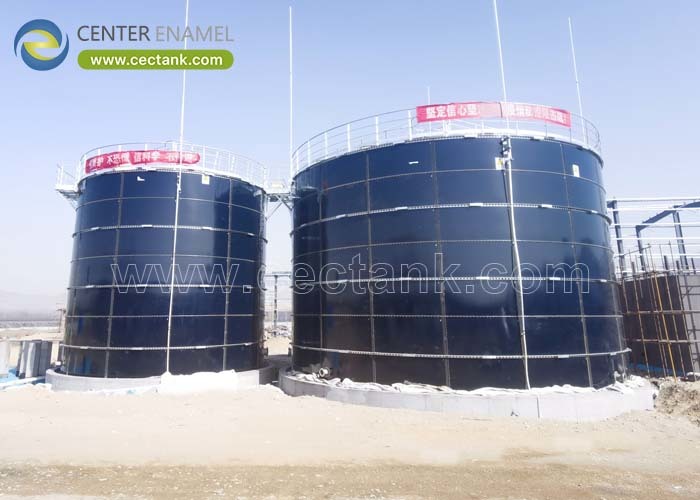
Quality claims are easiest to trust when backed by delivered plants. The Kazakhstan Urban Waste Water Treatment Plant (2013) used two GFS tanks at 17.05 m diameter x 15.6 m; the Russia KuibyshevAzot Chemical Wastewater Treatment Plant (2020) used two GFS tanks at 9.17 m x 8.4 m with aluminum alloy deck roofs - both in aggressive wastewater service.
- Kazakhstan Urban WWTP 2013: 2 x GFS, Ø17.05 x 15.6 m.
- Russia KuibyshevAzot 2020: 2 x GFS Ø9.17 x 8.4 m, aluminum alloy deck roof.
Company Expertise
Center Enamel operates its own enameling with furnace-temperature control, 100% 1500 V holiday testing and panel traceability, and designs to ISO 28765 / AWWA D103-09. The company was China's first GFS tank manufacturer (founded 2008) with an export base of 100+ countries.
Frequently Asked Questions
How do I verify an enamel wastewater tank is good quality?
Ask for the 100% 1500 V holiday-test record and the kiln firing-temperature curve. Those two documents show whether the enamel is actually controlled.
What enamel thickness should I specify?
About 0.25-0.45 mm per face for a two-coat system - enough coverage without pushing the 820-930C firing window too tight.
Is GFS better than epoxy for wastewater?
GFS is inert and abrasion-hard; FBE epoxy is a strong alternative, especially where a thicker organic coat is wanted. Choice follows the wastewater chemistry.
What standards apply to GFS tanks?
ISO 28765 for GFS design and AWWA D103-09 for the bolted steel structure, with 8.8-grade bolts and a compatible sealant.
Why does the firing temperature matter so much?
Because adhesion of the glass-to-steel bond is set in the kiln. A few degrees off the 820-930C window produces weak or chipped enamel.
How long does a quality GFS tank last?
A properly fired and tested GFS tank is commonly specified for a 30-50 year service life in wastewater service.
Conclusion
'Good quality' for an enamel steel wastewater tank means a controlled kiln, a verified enamel face and engineered structure - thickness, firing curve, 1500 V holiday test, adhesion and hardness you can put on a checklist. Specify those and the tank stops being a gamble.
Suggested CTA: Request our enameling control package - firing curves, holiday-test records and ISO 28765 calculations - and we will show the quality on paper before you order.