-
Glass Fused To Steel Tanks (807)
-
Stainless Steel Tanks (434)
-
Fusion Bonded Epoxy Tanks (607)
-
Galvanized Steel Tanks (321)
-
Aluminum Dome Roofs (1336)
-
Wastewater Storage Tanks (280)
-
Welded Steel Tanks (457)
-
Pressure Vessels (295)
-
Anaerobic Digester (202)
-
Industrial Water Tanks (349)
-
Glass Lined Steel Tanks (180)
-
Bolted Steel Tanks (389)
-
Sludge Storage Tank (115)
-
Biogas Storage Tank (173)
-
Leachate Storage Tanks (133)
-
Agricultural Water Storage Tanks (179)
-
Fire Water Tank (166)
-
Grain Storage Silos (146)
-
Biogas Projects (424)
-
Wastewater Treatment Projects (1570)
-
Double Membrane Roof (223)

|
Liquid Storage Tanks: Types, Selection, and Applications
| Place of Origin: | China |
| Brand Name: | CEC TANKS |
| Certification: | ISO 9001:2008, AWWA D103 , OSHA , BSCI |
| Model Number: | W |
| Minimum Order Quantity: | 1set |
| Price: | $5000~$20000 one set |
| Packaging Details: | PE poly-foam between each two steel plates ; wooden pallet and wooden |
| Delivery Time: | 10-30 days after deposit received |
| Payment Terms: | L/C,T/T |
| Supply Ability: | 60 sets per month |
|
Detail Information |
|||
Product Description
Liquid Storage Tanks: Types, Selection, and Applications
'Liquid storage tank' covers an enormous range of vessels because nearly every industry stores a liquid of some kind - water, wastewater, chemical, fuel, food, process. The right tank follows the liquid, not the catalogue.
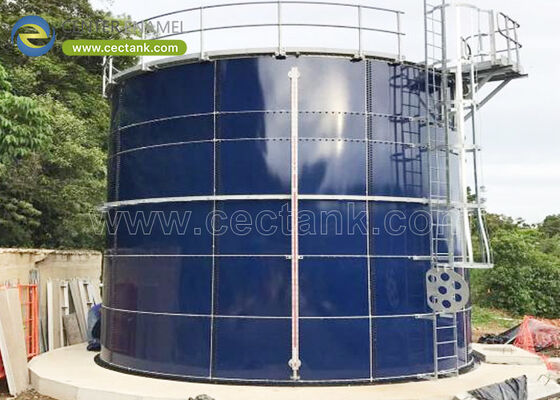
A liquid storage tank is selected by what it holds: Glass-Fused-to-Steel (GFS) and Fusion-Bonded Epoxy (FBE) bolted tanks cover most water, wastewater and mild-chemical duty with a corrosion-resistant, bolted shell; stainless (304/316L) is for hygienic or aggressive service; welded steel and concrete suit very large or fixed sites. Capacity runs from a few m3 to 60,000+ m3, and the liquid's corrosivity, temperature, hygiene class and volume set the choice.
The Main Types, Side by Side
GFS fuses a vitreous enamel to steel for an inert, corrosion-resistant, hygienic interior and bolts together fast. FBE is an organic powder coat fused on, thicker and a strong alternative. Stainless (304/316L) is the pick for food, pharma and chloride/acid duty. Welded steel is used where site and size allow, and concrete for very large fixed reservoirs. Each trades cost, speed and chemical fit differently.
| Type | Best for | Notes |
|---|---|---|
| GFS | Water, wastewater, mild chemical | Inert enamel, bolted, fast. |
| FBE epoxy | Water, wastewater, some chemical | Thick organic coat, bolted. |
| Stainless 304/316L | Food, pharma, chloride/acid | Hygienic; passivation needed. |
| Welded steel | Large/fixed sites | On-site welding. |
| Concrete | Very large reservoirs | Slow, joint sealing. |
Selecting by the Liquid
Four properties decide the tank. Corrosivity (pH, chlorides, solvents) points to GFS/FBE or stainless. Temperature sets insulation and material limits. Hygiene class (potable, food, pharma) calls for NSF/ANSI 61, FDA or EU 1935/2004 compliance and a cleanable surface. Volume and footprint then decide bolted versus welded versus concrete, and whether to parallel multiple tanks.
- Corrosivity -> GFS/FBE or stainless.
- Temperature -> insulation & material limits.
- Hygiene -> NSF/ANSI 61 / FDA / EU 1935/2004.
- Volume/footprint -> bolted vs welded vs concrete.
Scale and Parallelization
Bolted GFS and FBE tanks scale from a few m3 to the 20,000-60,000 m3 class by paralleling standard panels; large single tanks reach tens of metres in diameter (the Indonesia Cilincing tank is 42.04 m x 15.2 m, 21,088 m3; the Maldives project totals 43,067 m3 across many tanks). Very large or fixed reservoirs may favor concrete, while most industrial and municipal stores use bolted steel for speed and leak tightness.
- Bolted scales via standard panels + paralleling.
- Indonesia Cilincing: 21,088 m3 single GFS.
- Maldives: 43,067 m3 across a tank farm.
Project Reference
Delivered liquid storage spans the map: Indonesia Cilincing drinking water (2024, 21,088 m3), Maldives drinking water (2023, 43,067 m3 total), Namibia freshwater (2022, 6 x 11,230 m3) and the UAE Dubai Fire Water (2025, 652 m3) - showing the same tank family from fire reserve to city supply.
- Indonesia Cilincing 2024: 21,088 m3 potable GFS.
- Maldives 2023: 43,067 m3 drinking water.
- Namibia 2022: 6 x 11,230 m3 freshwater.
- UAE Dubai Fire 2025: 652 m3 fire reserve.
Company Expertise
Center Enamel supplies the full liquid-storage spectrum - GFS, FBE, stainless, galvanized and bolted - engineered to ISO 28765 / AWWA D103-09 with NSF/ANSI 61-capable linings, from small buffers to 20,000+ m3 farms.
Frequently Asked Questions
What are the main types of liquid storage tanks?
GFS, FBE epoxy, stainless (304/316L), welded steel and concrete - chosen by the liquid more than by habit.
Which tank is best for potable water?
GFS or FBE bolted tanks with an NSF/ANSI 61 lining are common; stainless where the water is treated.
How big can a liquid storage tank be?
Bolted GFS/FBE reach the 20,000-60,000 m3 class by paralleling panels; very large fixed reservoirs may use concrete.
When is stainless better than GFS?
For food/pharma hygiene or chloride/acid duty where the inert enamel is not the right fit.
What standards apply to bolted tanks?
ISO 28765 (GFS design) and AWWA D103-09 (bolted structure); potable contact adds NSF/ANSI 61 (or WRAS/EU 1935/2004).
Are bolted tanks as tight as welded?
A properly sealed bolted GFS/FBE tank with 8.8-grade bolts and compatible sealant is leak-tight; the joints are the detail to specify and test.
Conclusion
A liquid storage tank is a match between the liquid and the material: GFS and FBE for most water and mild-chemical duty, stainless for hygienic or aggressive service, welded or concrete for the largest fixed sites. Lead with corrosivity, temperature, hygiene and volume, and the type chooses itself.
Suggested CTA: Describe what you store, its chemistry and the volume you need and we will narrow the tank type and size - GFS, FBE, stainless or concrete - for your site.