-
Glass Fused To Steel Tanks (807)
-
Stainless Steel Tanks (434)
-
Fusion Bonded Epoxy Tanks (607)
-
Galvanized Steel Tanks (321)
-
Aluminum Dome Roofs (1336)
-
Wastewater Storage Tanks (280)
-
Welded Steel Tanks (457)
-
Pressure Vessels (295)
-
Anaerobic Digester (202)
-
Industrial Water Tanks (349)
-
Glass Lined Steel Tanks (180)
-
Bolted Steel Tanks (389)
-
Sludge Storage Tank (115)
-
Biogas Storage Tank (173)
-
Leachate Storage Tanks (133)
-
Agricultural Water Storage Tanks (179)
-
Fire Water Tank (166)
-
Grain Storage Silos (146)
-
Biogas Projects (424)
-
Wastewater Treatment Projects (1570)
-
Double Membrane Roof (223)
|
Fire Protection Water Tanks: Sizing, Standards, and Bolted-Steel Options
| Place of Origin: | China |
| Brand Name: | CEC TANKS |
| Certification: | ISO 9001:2008, AWWA D103 , OSHA , BSCI |
| Model Number: | W20160126004 |
| Minimum Order Quantity: | 1set |
| Price: | $5000~$20000 one set |
| Packaging Details: | PE poly-foam between each two steel plates ; wooden pallet and wooden box |
| Delivery Time: | 0-60 days after deposit received |
| Payment Terms: | L/C,T/T |
| Supply Ability: | 60 sets per month |
|
Detail Information |
|||
Product Description
Fire Protection Water Tanks: Sizing, Standards, and Bolted-Steel Options
A fire protection water tank is the permanently piped reserve that lets a sprinkler or hydrant system ride out the minutes between ignition and fire-department connection. Specifying one is less about picking a shape and more about matching a calculated demand to a code-compliant, always-available volume. This guide works through the sizing logic, the standard that governs the tank, and where bolted steel construction fits.
A fire protection water tank is a dedicated reserve sized to NFPA 22 demand x duration (2 h for light hazard, 3 h for ordinary hazard) and built to AWWA D103-09 as a bolted-steel shell. Its effective volume is always lower than the nominal nameplate because suction height, overflow and anti-vortex allowances are subtracted - so size the tank to the volume you can actually draw, not the number on the drawing.
How NFPA 22 Drives the Volume
NFPA 22 (Standard for Water Tanks for Private Fire Protection) is the reference most specifying engineers use. The starting point is the system demand - the peak flow in gallons (or litres) per minute multiplied by the required duration. Light-hazard occupancies typically need about 2 hours of on-site reserve; ordinary-hazard and foam/extra-hazard occupancies need longer. The tank must hold the full demand plus any make-up or alternate-source allowance, and it must do so at the pressure the system needs.
- Demand x duration gives the raw volume, not the tank size.
- A dedicated reserve means a permanent, separate suction - an administrative promise to 'share' the tank does not count.
- Effective (usable) volume is the nameplate volume minus suction, overflow and anti-vortex losses.
Why Bolted Steel (GFS, FBE, Stainless, Galvanized)
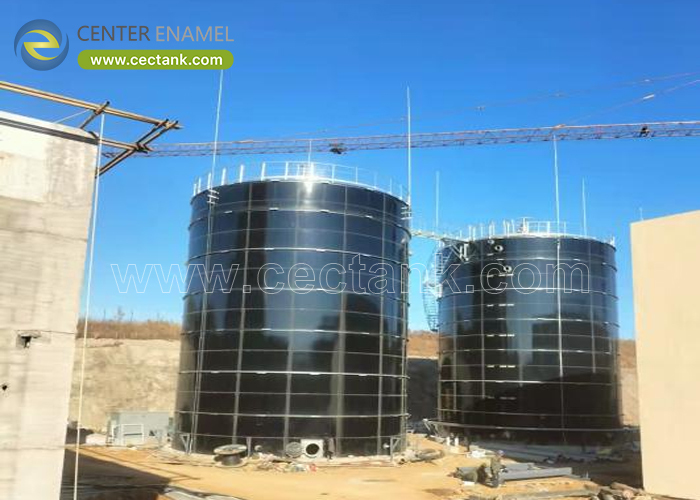
Bolted steel tanks are the pragmatic choice for fire reserve because the shell arrives as flat panels and is erected on site without heavy welding, which shortens schedule and lowers freight. The liner decides the chemistry: Glass-Fused-to-Steel (GFS) and Fusion-Bonded Epoxy (FBE) give a sealed, corrosion-resistant interior suited to potable or raw water; stainless (SS304/316L) is specified where the water is treated or the climate is aggressive; hot-dip galvanized is a cost-effective option for many raw-water reserves. All are engineered to AWWA D103-09 for the structure.
- GFS / FBE: sealed, corrosion-resistant, good for potable and raw water.
- SS304 / 316L: treated water and aggressive-service sites.
- Hot-dip galvanized: economical raw-water reserve.
- Structure to AWWA D103-09; 8.8-grade bolts and proper sealing details matter.
Siting, Freeze Protection, and Interface
A fire tank that freezes or whose suction is blocked is no reserve at all. The tank should sit on a ring foundation with a starter ring, the suction should enter below the low-water mark with an anti-vortex plate, and all exposed pipe, the downcomer and the roof must be freeze-protected in cold climates. The interface to the fire pump matters more than the tank metal: a clean, dedicated branch with a listed detector and a check valve is what the authority having jurisdiction will look at.
| Parameter | Typical rule / range | Why it matters |
|---|---|---|
| Required duration | 2 h light / 3 h ordinary hazard | Sets the raw volume from NFPA 22. |
| Effective volume | Nameplate - suction - overflow - vortex | The only volume you can actually draw. |
| Suction entry | Below low-water mark + anti-vortex | Prevents air ingestion and loss of prime. |
| Liner | GFS / FBE / SS / galvanized | Matches water chemistry and climate. |
| Structure | AWWA D103-09 bolted | Code acceptance and long service life. |
Project Reference
Real delivered fire-water tanks show the range of liners and sizes in active service:
- UAE, Dubai Fire Water Project 2025 - 652 m3, aluminum deck roof.
- Saudi Arabia Fire Water Project (FBE) 2024 - 2 x 246 m3, Fusion-Bonded Epoxy tank.
- China, Shanghai Fire Water Tank (SS304) 2026 - 317 m3, 304 cone roof + 304 bottom plate.
- USA, Porsche Speedway fire water 2016 - Southern California, GFS tanks.
- Guyana Fire Water 2025 and Guatemala Fire Water 2024 - small bolted reserves in the 160-600 m3 class.
Company Expertise
Center Enamel supplies fire-protection reserves as GFS, FBE, stainless and galvanized bolted tanks engineered to AWWA D103-09, with liner selection matched to whether the water is potable, raw or treated. The manufacturing base controls enameling and epoxy coating in house, and the export record covers fire-water, potable and industrial reserves across multiple continents.
Frequently Asked Questions
What size fire protection water tank do I need?
Start from NFPA 22: peak system demand (flow x duration). Light hazard is about 2 hours, ordinary hazard about 3 hours. Then subtract suction, overflow and anti-vortex losses to get the effective volume the tank must actually deliver.
Can a fire water tank share a suction with process water?
NFPA 22 expects a dedicated, permanently piped reserve. An administrative 'we will share it' does not satisfy the standard; the fire branch needs its own suction and isolation.
Is a GFS tank suitable for fire protection water?
Yes for potable or raw water. GFS (Glass-Fused-to-Steel) gives a sealed, corrosion-resistant interior and the bolted shell is built to AWWA D103-09. FBE, stainless or galvanized are alternatives by chemistry and climate.
How do I keep a fire tank from freezing?
Protect the tank shell, downcomer, exposed pipe and roof in cold climates - typically heat tracing, insulation, or locating the suction below grade. Frozen pipe negates the reserve regardless of tank size.
Does the tank need a roof?
A roof limits algae, debris and evaporation and is standard on most installations. Aluminum dome, enamel, or open configurations are chosen by climate and code.
What standard governs the tank structure?
AWWA D103-09 for bolted steel tanks is the common reference, paired with NFPA 22 for the fire-protection function and NFPA 25 for ongoing inspection.
Conclusion
A fire protection water tank is a calculated reserve, not a generic storage tank. Size it to NFPA 22 demand x duration, design to the volume you can actually draw, and choose the liner (GFS, FBE, stainless or galvanized) to the water and climate. Built to AWWA D103-09 as a bolted shell, it is fast to erect and straightforward to inspect.
Suggested CTA: Discuss your fire-protection demand, duration and water chemistry with our engineers so we can propose a correctly sized, code-compliant bolted-steel reserve.