-
Glass Fused To Steel Tanks (807)
-
Stainless Steel Tanks (434)
-
Fusion Bonded Epoxy Tanks (607)
-
Galvanized Steel Tanks (321)
-
Aluminum Dome Roofs (1336)
-
Wastewater Storage Tanks (280)
-
Welded Steel Tanks (457)
-
Pressure Vessels (295)
-
Anaerobic Digester (202)
-
Industrial Water Tanks (349)
-
Glass Lined Steel Tanks (180)
-
Bolted Steel Tanks (389)
-
Sludge Storage Tank (115)
-
Biogas Storage Tank (173)
-
Leachate Storage Tanks (133)
-
Agricultural Water Storage Tanks (179)
-
Fire Water Tank (166)
-
Grain Storage Silos (146)
-
Biogas Projects (424)
-
Wastewater Treatment Projects (1570)
-
Double Membrane Roof (223)

|
Chicken Manure Storage Tanks: Corrosion, Biogas, and Tank Selection
| Place of Origin: | China |
| Brand Name: | CEC TANKS |
| Certification: | ISO 9001:2008, AWWA D103 , OSHA , BSCI |
| Model Number: | W |
| Minimum Order Quantity: | 1set |
| Price: | $5000~$20000 one set |
| Packaging Details: | PE poly-foam between each two steel plates ; wooden pallet and wooden |
| Delivery Time: | 10-30 days after deposit received |
| Payment Terms: | L/C,T/T |
| Supply Ability: | 60 sets per month |
|
Detail Information |
|||
| Place of Origin | China | Brand Name | CEC TANKS |
|---|---|---|---|
| Certification | ISO 9001:2008, AWWA D103 , OSHA , BSCI | Model Number | W |
| Tank Material: | Glass Fused To Steel | Foundation: | Concrete Or Glass Fused Steel |
| Steel Grade: | ART 310 | Roof Available: | Glass Fused Steel Roof , Membrane Roof, Aluminum Roof , GRP Roof |
| Corrosion Integrity: | Excellent | Chemical Resistance: | Excellent |
| Elastic: | Same As Steel Sheet ,around 500KN /mm | Highlight: | corrosion-resistant chicken manure tanks,biogas-compatible wastewater storage tanks,durable chicken manure storage solutions |
Product Description
Chicken Manure Storage Tanks: Corrosion, Biogas, and Tank Selection
Chicken manure is stored in corrosion-resistant, gas-tight tanks because its ammonia and high moisture attack ordinary steel, and the gas space above the slurry is the most corrosive zone. Glass-Fused-to-Steel (GFS) is widely used because the fired glass face is inert to ammonia; many operations pair storage with anaerobic digestion, where the same tank family becomes a digester and the manure becomes biogas. Cattle, swine and poultry share the same manure-engineering logic.
Why Ordinary Steel Fails on Manure
Manure is not a neutral liquid. The ammonia it releases, plus the acidic and sulfide conditions that develop, corrode carbon steel from the gas space down. A tank that is fine for water can be perforated by manure in a few seasons. The defense is an inert barrier - a glass or epoxy lining - or a genuinely corrosion-proof material, plus a sealed roof so the gas is managed rather than vented into the structure.
- Ammonia + moisture attack carbon steel, worst in the gas space.
- An inert lining (glass or epoxy) is the practical barrier.
- A sealed roof manages gas instead of corroding the shell.
GFS and the Inert Glass Face
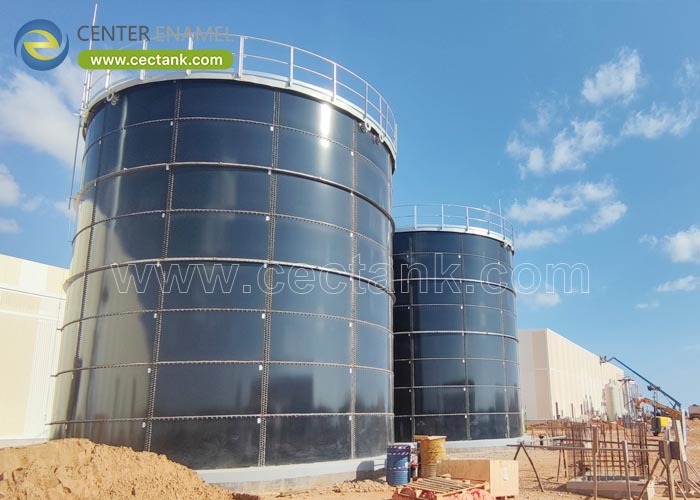
GFS fuses a vitreous enamel to steel at 820-930C, creating a surface that manure chemistry cannot readily attack. Because the lining is inorganic, it does not soften, leach or rot, and it withstands the abrasion of loaded slurry. For a bolted GFS manure tank, the joints are sealed with a compatible gasket and the roof is chosen for gas tightness - often a double-membrane or aluminum dome depending on whether the tank also digests.
- Inert glass face resists ammonia and sulfide.
- Bolted panels for fast site erection.
- Roof choice (double membrane / dome) follows digestion vs storage.
Storage Plus Anaerobic Digestion
Manure is also feedstock. Anaerobic digestion converts the volatile solids into biogas (roughly 55-65% methane) while stabilizing the residue. The same GFS tank family serves as the digester at a typical mesophilic temperature of 35-38C, with a hydraulic retention time of 20-40 days. Pairing storage and digestion turns a disposal cost into energy and a better fertilizer.
- Digestion: 35-38C mesophilic, 20-40 day HRT.
- Biogas ~55-65% methane.
- Same GFS family = storage or digester.
Manure Tank Selection at a Glance
The material choice follows the corrosivity of the manure and whether the tank also digests:
| Option | Fit for manure | Note |
|---|---|---|
| GFS (enamel) | Best for ammonia-rich slurry | Inert glass face resists corrosion. |
| FBE epoxy | Alternative coating | Thick organic coat. |
| Concrete | Large fixed sites | Slow, hard to seal joints. |
| Plain carbon steel | Not recommended | Ammonia + moisture attack it. |
Project Reference
The delivered base for manure and livestock-wastewater handling is substantial. At the Japan Cow Manure Waste Water Project (Hokkaido, 2024), two GFS tanks at 49.68 m diameter x 4.8 m hold 18,610 m3 of cow-manure wastewater; the Inner Mongolia Biogas Project (2016) used three 25.22 m x 8.4 m digesters with double-membrane roofs. Poultry, cattle and swine share this engineering.
- Japan Cow Manure WW 2024: 2 x Ø49.68 x 4.8 m, 18,610 m3 total.
- Inner Mongolia Biogas 2016: 3 x Ø25.22 x 8.4 m, double-membrane roof.
Company Expertise
Center Enamel supplies GFS manure storage and biogas tanks with an inert enamel face proven against ammonia-rich livestock streams, plus digester engineering (mixing, gas handling, roof) for the 35-38C mesophilic range. The export record spans livestock, municipal and industrial anaerobic projects.
Frequently Asked Questions
What tank is best for chicken manure?
A corrosion-resistant, gas-tight tank - usually Glass-Fused-to-Steel, whose inert enamel face resists the ammonia and moisture that eat ordinary steel.
Can manure tanks also produce biogas?
Yes. The same GFS tank family serves as an anaerobic digester at 35-38C, converting manure volatile solids into biogas (about 55-65% methane) over a 20-40 day retention time.
Why seal the roof on a manure tank?
Because the gas space above the slurry is the most corrosive zone and the source of odor; a sealed roof (double membrane or dome) manages the gas instead of letting it attack the shell.
Do poultry, cattle and swine use the same tank?
The engineering is the same - corrosive, gas-bearing manure. Sizing and mixing follow the solids and volume of each operation.
How long do GFS manure tanks last?
Commonly specified for a 30-50 year service life, with the lining the limiting factor more than the steel.
What mixing does a manure digester need?
Mixing is specified per unit volume (not just motor kW) to keep solids in suspension; the exact duty follows the manure total solids.
Chicken manure belongs in a tank the manure cannot corrode. GFS provides that inert barrier, and the same tank family doubles as an anaerobic digester so the manure becomes biogas instead of a liability. Sizing and roof follow whether you store, digest, or both.
Tell us your flock size, manure volume and whether you plan to digest, and we will propose a corrosion-resistant GFS storage or digester configuration.