-
Glass Fused To Steel Tanks (792)
-
Stainless Steel Tanks (434)
-
Fusion Bonded Epoxy Tanks (592)
-
Galvanized Steel Tanks (321)
-
Aluminum Dome Roofs (1336)
-
Wastewater Storage Tanks (237)
-
Welded Steel Tanks (457)
-
Pressure Vessels (295)
-
Anaerobic Digester (202)
-
Industrial Water Tanks (349)
-
Glass Lined Steel Tanks (180)
-
Bolted Steel Tanks (389)
-
Sludge Storage Tank (115)
-
Biogas Storage Tank (173)
-
Leachate Storage Tanks (133)
-
Agricultural Water Storage Tanks (179)
-
Fire Water Tank (166)
-
Grain Storage Silos (146)
-
Biogas Projects (424)
-
Wastewater Treatment Projects (1500)
-
Double Membrane Roof (223)

|
UASB Tank Design: Building an Upflow Anaerobic Sludge Blanket Reactor
| Place of Origin: | China |
| Brand Name: | CEC TANKS |
| Certification: | ISO 9001:2008, AWWA D103 , OSHA , BSCI |
| Model Number: | W20160705006 |
| Minimum Order Quantity: | 1set |
| Price: | $5000~$20000 one set |
| Packaging Details: | PE poly-foam between each two steel plates ; wooden pallet and wooden box |
| Delivery Time: | 0-60 days after deposit received |
| Payment Terms: | L/C,T/T |
| Supply Ability: | 60 sets per month |
|
Detail Information |
|||
| Place of Origin | China | Brand Name | CEC TANKS |
|---|---|---|---|
| Certification | ISO 9001:2008, AWWA D103 , OSHA , BSCI | Model Number | W20160705006 |
| Coating Thickness: | 0.25mm~0.40mm , Two Layer Of Coating Internal And External | Tank Material: | Glass Fused To Steel |
| Steel Grade: | ART 310 | Roof Available: | Glass Fused Steel Roof , Membrane Roof, Aluminum Roof , GRP Roof |
| Highlight: | UASB tank anaerobic sludge reactor,glass fused steel UASB tank,upflow anaerobic sludge blanket design |
||
Product Description
UASB Tank Design: Building an Upflow Anaerobic Sludge Blanket Reactor
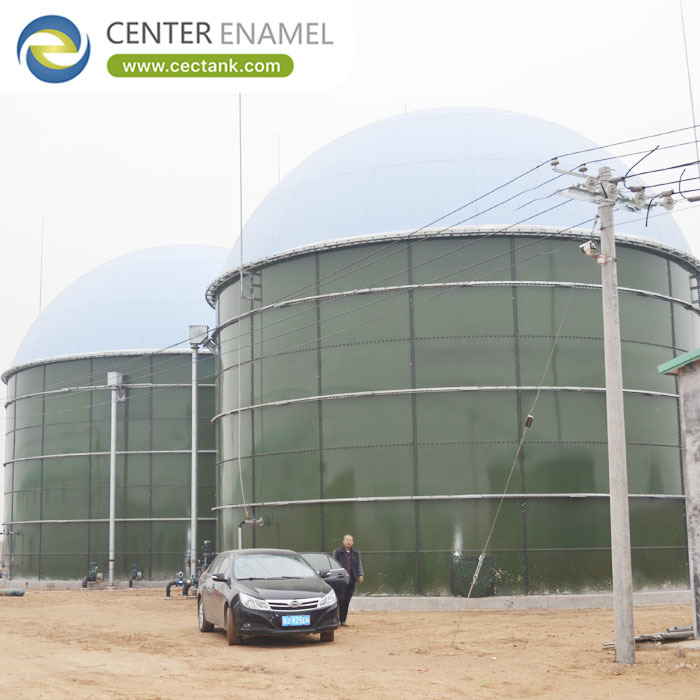
A UASB tank is an upflow anaerobic sludge blanket reactor that cleans high-strength wastewater by passing it upward through a dense granular sludge blanket at 20-35°C. The blanket converts organics to biogas of 55-65% methane with no mechanical mixing. Engineered by Shijiazhuang Zhengzhong Technology Co., Ltd. (Center Enamel), a Glass-Fused-to-Steel (GFS) UASB tank adds a corrosion-resistant, holiday-tested shell designed to ISO 28765 and AWWA D103-09.
What a UASB Tank Is
A UASB tank is a reactor where wastewater enters at the bottom, rises through a granular sludge blanket at 0.5-1.5 m/h, and exits clarified at the top under a gas-solid separator. Microbes in the blanket (20-40 g/L) digest organics anaerobically, producing biogas of 55-65% methane. The tank itself is a sealed vessel, commonly Glass-Fused-to-Steel (GFS), sized for 6-24 hours of hydraulic retention and an organic load of 5-15 kg COD/m3/d.
- Flow: upflow at 0.5-1.5 m/h.
- Blanket: 20-40 g/L granules.
- Gas: 55-65% methane.
- Load: 5-15 kg COD/m3/d.
Key Characteristics, Components, and Types
UASB tanks share three zones: a feed and distribution header, the sludge blanket, and a three-phase separator that splits gas, sludge, and water. Sizes range from 20 to 60,000 m3 as single bolted GFS shells. Variants include the external EGSB for higher upflow rates and the internal circulation reactor for very high loads, but all rely on a stable granule blanket rather than mixers.
- Zones: feed, blanket, separator.
- Shells: 20-60,000 m3 GFS.
- Variants: EGSB, IC reactor.
- Key: stable granule blanket.
Applications and Operating Conditions
They treat brewery, dairy, food, pulp, and municipal wastewaters where COD is high and alkalinity is adequate. Plants choose UASB when they want low energy use and biogas recovery without powered mixing. Because the GFS shell resists the acidic, H2S-rich environment (pH 6.5-7.5), it outperforms painted steel in continuous duty and needs no field welding.
- Feeds: brewery, dairy, food, pulp.
- Energy: low, no powered mix.
- pH: 6.5-7.5 window.
- Shell: H2S-resistant GFS.
Technical Considerations
Design fixes upflow velocity at 0.5-1.5 m/h, hydraulic retention at 6-24 hours, and organic load at 5-15 kg COD/m3/d, with temperature held at 20-35°C. The GFS shell is calculated to ISO 28765 and AWWA D103-09, plates blasted to Sa 2.5 and holiday-tested at 1500 V. The three-phase separator and feed header must be sized to avoid blanket washout during peak flow.
- Velocity: 0.5-1.5 m/h.
- Retention: 6-24 hours.
- Load: 5-15 kg COD/m3/d.
- Shell: Sa 2.5, 1500 V test.
Advantages and Limitations
UASB tanks recover energy with almost no mixing power and give a small footprint for high COD. The limitation is sensitivity: sulfate, toxins, and flow or temperature shocks can wash out the granule blanket, so pre-treatment and equalization are mandatory. This boundary must be engineered in, because a UASB without stable granules simply becomes an expensive clarifier.
- Advantage: energy recovery, small footprint.
- Advantage: no powered mixing.
- Limitation: sensitive to shocks.
- Boundary: pre-treat and equalize.
Design Parameters
The figures below are the load-bearing values a supplier should quote per UASB tank. They let an engineer confirm the reactor hydraulics, the GFS shell, and the separator before steel is ordered for an anaerobic wastewater duty.
| Design parameter | Typical value or range | Why it matters |
| Upflow velocity | 0.5-1.5 m/h | Sludge blanket hold |
| Hydraulic retention | 6-24 hours | COD removal window |
| Organic load | 5-15 kg COD/m3/d | Reactor productivity |
| Operating temperature | 20-35 °C | Mesophilic range |
| pH range | 6.5-7.5 | Methanogen window |
| Sludge concentration | 20-40 g/L | Granule blanket |
| Methane content | 55-65 % | Biogas value |
| Coating DFT | 0.25-0.40 mm | H2S resistance |
| Code basis | ISO 28765 / AWWA D103-09 | Design authority |
| Limitation to check | Sulfate and shocks | Confirm pre-treatment |
Comparison and Selection Guide
Against welded steel, concrete, and fiberglass, a Glass-Fused-to-Steel (GFS) UASB tank wins on corrosion resistance and build speed for the 20-60,000 m3 range. Use the table to match the material to feed corrosivity, site logistics, and required life.
| Criterion | GFS bolted tank | Welded steel tank | Concrete tank | FRP tank |
| Corrosion defense | Vitreous enamel, inert | Coating-dependent | Good but porous | Liner-dependent |
| Construction | Bolted, fast on site | Welded, slower | Cast in place | Molded / shop |
| Capacity ceiling | Up to 60,000 m3 | Up to 150,000 m3 | Very large | Limited (<5,000 m3) |
| Design life | 30-50 years | 30-50 years | 40-60 years | 20-30 years |
| Best fit | Corrosive, modular | Very large, generic | Heavy civil works | Small, neat chemical |
Best Practices: How to Choose a Provider
Confirm feed COD, alkalinity, and sulfate before sizing; provide equalization to absorb shocks. Require the ISO 28765 calculation, the 1500 V holiday test, and a coating log. Shijiazhuang Zhengzhong Technology Co., Ltd. (Center Enamel) supplies drawings, NDE records, and inspection packages so the reactor passes audit and keeps its coating warranty through 30-50 years of service.
- Confirm: COD, alkalinity, sulfate.
- Provide: equalization buffer.
- Require: ISO 28765 and 1500 V test.
- Package: drawings plus NDE records.
A UASB tank turns high-strength wastewater into biogas with almost no mixing power, but only if the granule blanket is protected. Specify the hydraulics, the ISO 28765-qualified GFS shell, and the 1500 V inspection proof together, and the reactor will perform for 30-50 years.
Frequently Asked Questions (FAQ)
What does UASB stand for?
Upflow Anaerobic Sludge Blanket. Wastewater rises through a granular sludge blanket where microbes convert organics to biogas of 55-65% methane, with no mechanical mixing.
What capacity can a UASB tank reach?
Single GFS shells span 20-60,000 m3; larger plants manifold multiple tanks. The reactor volume is set by hydraulic retention of 6-24 hours.
Which standard governs the tank?
The GFS shell is designed to ISO 28765 and AWWA D103-09; process design follows local wastewater codes and the anaerobic reactor hydraulics.
Why choose GFS for UASB?
The enamel resists the acidic, H2S-rich liquor at pH 6.5-7.5, is holiday-tested at 1500 V, and needs no field welding, shortening the build.
What are the main limitations?
Sulfate, toxins, and flow or temperature shocks can wash out the granule blanket, so pre-treatment and equalization are mandatory design steps.
Can it be customized?
Yes. The three-phase separator, feed header, roof, and instrumentation are engineered per feed and site, with drawings issued per tank.