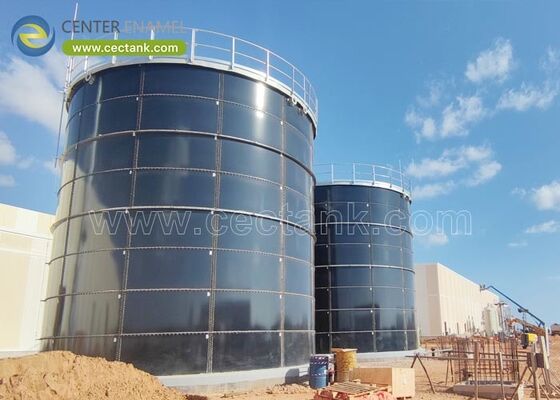
-
Glass Fused To Steel Tanks (792)
-
Stainless Steel Tanks (434)
-
Fusion Bonded Epoxy Tanks (592)
-
Galvanized Steel Tanks (321)
-
Aluminum Dome Roofs (1336)
-
Wastewater Storage Tanks (237)
-
Welded Steel Tanks (457)
-
Pressure Vessels (295)
-
Anaerobic Digester (202)
-
Industrial Water Tanks (349)
-
Glass Lined Steel Tanks (180)
-
Bolted Steel Tanks (389)
-
Sludge Storage Tank (115)
-
Biogas Storage Tank (173)
-
Leachate Storage Tanks (133)
-
Agricultural Water Storage Tanks (179)
-
Fire Water Tank (166)
-
Grain Storage Silos (146)
-
Biogas Projects (424)
-
Wastewater Treatment Projects (1500)
-
Double Membrane Roof (223)


|
Liquid Storage Tanks: Types, Materials, and Selection Basics
| Place of Origin: | China |
| Brand Name: | CEC TANKS |
| Certification: | ISO 9001:2008, AWWA D103 , OSHA , BSCI |
| Model Number: | W |
| Minimum Order Quantity: | 1set |
| Price: | $5000~$20000 one set |
| Packaging Details: | PE poly-foam between each two steel plates ; wooden pallet and wooden |
| Delivery Time: | 10-30 days after deposit received |
| Payment Terms: | L/C,T/T |
| Supply Ability: | 60 sets per month |
|
Detail Information |
|||
| Place of Origin | China | Brand Name | CEC TANKS |
|---|---|---|---|
| Certification | ISO 9001:2008, AWWA D103 , OSHA , BSCI | Model Number | W |
| Tank Body Color: | Dark Green / Can Be Customized | Corrosion Integrity: | Excellent |
| Steel Plates Thickness: | 3mm To 12mm , Depends On The Tank Structure | Chemical Resistance: | Excellent |
| Size Of Panel: | 2.4M * 1.2M | Easy To Clean: | Smooth, Glossy, Inert, Anti-adhesion |
| Highlight: | glass fused steel liquid tanks,liquid storage tank materials,steel tank selection basics |
||
Product Description
Liquid Storage Tanks: Types, Materials, and Selection Basics
A liquid storage tank holds water, chemical, or process liquid above or below ground, with material chosen by chemistry and volume. Capacities span 20 to 150,000 m3. Engineered by Shijiazhuang Zhengzhong Technology Co., Ltd. (Center Enamel), Glass-Fused-to-Steel (GFS) liquid tanks fuse enamel at 820-930°C for an inert 30-50 year shell designed to AWWA D103-09 and ISO 28765.
What a Liquid Storage Tank Is
A liquid storage tank is a vessel built to hold a fluid inventory - potable water, process water, chemicals, or effluent - above or below grade. Its defining choice is the lining, because the liquid, not the steel, sets the service life. Built from 20 to 150,000 m3, the tank's selection starts from the liquid's pH, temperature, and abrasives.
- Holds: water, chemical, effluent.
- Choice: the lining.
- Life: set by lining.
- Range: 20-150,000 m3.
Key Characteristics, Components, and Types
Four families: GFS bolted tanks fuse a 0.25-0.40 mm enamel at 820-930°C; welded steel tanks coat in the field and reach 150,000 m3; concrete tanks cast in place; FRP tanks mold small neat chemical duties below 5,000 m3. Roofs, nozzles, and 8.8-grade bolts are specified per duty, and the build method sets both schedule and lifecycle cost.
- GFS: 0.25-0.40 mm enamel.
- Welded: to 150,000 m3.
- Concrete: cast in place.
- FRP: small chemical.
Applications and Operating Conditions
Liquid tanks serve utilities, industry, agriculture, and mining storing water, reagents, slurries, and treated effluent. A municipality needs NSF/ANSI 61 contact surfaces; a mine needs abrasion resistance; a plant needs chemical compatibility. Matching the lining to the fluid is what keeps the tank in service for 30-50 years rather than failing at the coating.
- Utility: NSF/ANSI 61.
- Mine: abrasion resistant.
- Plant: chemical match.
- Key: lining to fluid.
Technical Considerations
Specify the liquid's pH (3-11 typical, 1-14 special), temperature (4-60°C), and abrasives; set coating DFT at 0.25-0.45 mm and shell plate at 6-40 mm. The shell is calculated to AWWA D103-09 and ISO 28765, plates blasted to Sa 2.5 and holiday-tested at 1500 V. Seismic and wind loads are confirmed for the installed location before steel is ordered.
- pH: 3-11, 1-14 special.
- Coat: 0.25-0.45 mm DFT.
- Test: 1500 V per m2.
- Site: seismic and wind.
Advantages and Limitations
GFS gives an inert, near-impervious lining and fast bolted build for 30-50 years. The limitation is that no single lining fits all fluids: GFS is not suitable for certain solvents or extreme pH without a special grade, so buyers confirm the lining grade against the real stream. This boundary is set in specification, not discovered at the first fill.
- Advantage: inert, fast, 30-50 yr.
- Advantage: near-impervious.
- Limitation: not all fluids.
- Boundary: confirm grade in spec.
Design Parameters
The figures below are the load-bearing values a supplier should quote per liquid tank. They let an engineer confirm the shell, coating, and joint system before steel is ordered for a fluid-storage duty.
| Design parameter | Typical value or range | Why it matters |
|---|---|---|
| Capacity range | 20-60,000 m3 | Single-tank throughput |
| Shell plate | 6-40 mm | Hydrostatic head |
| Coating DFT | 0.25-0.45 mm | Verified before shipment |
| pH tolerance | 3-11 (1-14 special) | Confirm lining grade |
| Holiday test | 1500 V | Every square meter |
| Bolt grade | 8.8 | Joint integrity |
| Design life | 30-50 years | With inspection |
| Operating temperature | 4-60 °C | Product and climate |
| Code basis | AWWA D103-09 / ISO 28765 | Design authority |
| Limitation to check | Solvent and extreme pH | Confirm special grade |
Comparison and Selection Guide
Against welded steel, concrete, and fiberglass, a Glass-Fused-to-Steel (GFS) liquid tank wins on corrosion resistance and build speed for the 20-60,000 m3 range. Use the table to match the material to fluid chemistry, volume, and required life.
| Criterion | GFS bolted tank | Welded steel tank | Concrete tank | FRP tank |
|---|---|---|---|---|
| Corrosion defense | Vitreous enamel, inert | Coating-dependent | Good but porous | Liner-dependent |
| Construction | Bolted, fast on site | Welded, slower | Cast in place | Molded / shop |
| Capacity ceiling | Up to 60,000 m3 | Up to 150,000 m3 | Very large | Limited (<5,000 m3) |
| Design life | 30-50 years | 30-50 years | 40-60 years | 20-30 years |
| Best fit | Corrosive, modular | Very large, generic | Heavy civil works | Small, neat chemical |
Best Practices: How to Choose
Send the liquid datasheet to the supplier and require the ISO 28765 calculation, a 1500 V holiday test, and a coating log. Shijiazhuang Zhengzhong Technology Co., Ltd. (Center Enamel) issues drawings, NDE records, and inspection packages so the liquid tank is auditable and warranty-backed across its life.
- Send: liquid datasheet.
- Require: ISO 28765 and 1500 V.
- Log: coating thickness.
- Package: drawings plus NDE.
Liquid storage tanks are a lining-and-chemistry problem first, a container second. Match the material to the fluid, demand the AWWA D103-09 code math and the 1500 V test proof, and the tank serves 30-50 years instead of failing at the coating.
Frequently Asked Questions (FAQ)
What are the main liquid tank types?
GFS bolted, welded steel, concrete, and FRP - chosen by chemistry and volume, from 20 to 150,000 m3.
Which is best for chemicals?
GFS enamel resists pH 3-11 (1-14 special); FRP suits small acidic baths; concrete fits heavy civil duty.
What standards apply?
The bolted shell is designed to AWWA D103-09 and ISO 28765; potable duty adds NSF/ANSI 61.
How is the lining verified?
Steel is blasted to Sa 2.5, the coating is applied to 0.25-0.45 mm DFT, and holiday-tested at 1500 V per square meter.
What capacity can one tank reach?
A single GFS tank reaches 60,000 m3; welded steel reaches 150,000 m3; larger duty splits into multiple tanks.
Can it be customized?
Yes. Material, roof, coating grade, nozzles, and instrumentation are engineered per fluid and site.