-
Glass Fused To Steel Tanks (896)
-
Stainless Steel Tanks (434)
-
Fusion Bonded Epoxy Tanks (660)
-
Galvanized Steel Tanks (321)
-
Aluminum Dome Roofs (1336)
-
Wastewater Storage Tanks (280)
-
Welded Steel Tanks (457)
-
Pressure Vessels (524)
-
Anaerobic Digester (217)
-
Industrial Water Tanks (424)
-
Glass Lined Steel Tanks (180)
-
Bolted Steel Tanks (389)
-
Sludge Storage Tank (115)
-
Biogas Storage Tank (173)
-
Leachate Storage Tanks (133)
-
Agricultural Water Storage Tanks (179)
-
Fire Water Tank (166)
-
Grain Storage Silos (146)
-
Biogas Projects (424)
-
Wastewater Treatment Projects (1872)
-
Double Membrane Roof (223)
|
Data Center Water Tank Norway: NVE Rules And Potable-Contact Compliance
| Place of Origin: | CHINA |
| Brand Name: | CEC TANKS |
| Certification: | ISO 9001:2008, AWWA D103 , OSHA , BSCI |
| Model Number: | W20180508003 |
| Minimum Order Quantity: | 1 SET |
| Price: | $5000~$20000 one set |
| Packaging Details: | PE poly-foam between each two steel plates;wooden pallets and wooden box |
| Delivery Time: | 10-30 days after deposit received |
| Payment Terms: | L/C,T/T |
| Supply Ability: | 60 sets per month |
|
Detail Information |
|||
Product Description
Data Center Water Tank Norway: NVE Rules And Potable-Contact Compliance
A data center water tank in Norway is a storage vessel that holds evaporated-cooling makeup, process top-up or an isolated fire reserve for a Norwegian colocation or hyperscale site, and the specification is shaped less by the tank catalogue than by the water and planning rules that apply to the site. Norway's water regulation and cold climate make abstraction, discharge and freeze protection early design questions. Center Enamel supplies Glass-Fused-to-Steel, Fusion-Bonded Epoxy and stainless bolted tanks engineered for water duty, with more than 30,000 installed tank projects across 100-plus countries. This article sets out the compliance-first specification baseline a Norwegian data-center project should work from.
What A Norwegian Data-Center Water Tank Stores
A single water tank on a data-center site may serve three distinct duties: evaporated-cooling makeup, closed-loop or process top-up, and a fire reserve held under separate control. Treating them as one undifferentiated volume is the most common specification error, because the potable-contact and backflow requirements differ between a makeup line and a fire line. The correct approach assigns a defined volume and a documented isolation point to each duty, then sizes the shell for the sum while keeping the quality boundaries explicit.
· Makeup water replaces evaporation and blowdown losses.
· Process or closed-loop top-up needs low-mineral, controlled water.
· Fire reserve is isolated and sized to the fire hydraulic demand.
· Each duty needs its own volume accounting and backflow protection.
Norwegian Compliance A Specifier Must Confirm
For a data-center water tank in Norway the first questions are the municipal permit under the Planning and Building Act and TEK17, and whether abstraction or discharge triggers the Norwegian Water Resources and Energy Directorate (NVE) and the water regulations. Materials in contact with water intended for human consumption are commonly specified to EU 1935/2004 and a recognised scheme such as NSF/ANSI 61 where a potable claim is made, with backflow protection at the public-supply connection. The local fire service (brannvesen) sets the reserve and access conditions. Confirm each with the authority having jurisdiction at concept stage.
· Confirm municipal permit under Plan- og bygningsloven and TEK17.
· Check NVE and water-regulation triggers for abstraction or discharge.
· Confirm EU 1935/2004 and any potable-contact approval required.
· Agree reserve, access and separation with the local brannvesen.
Tank Materials And Construction
A thermal store, chilled-water buffer, data-center water reservoir or fire reserve sits idle or cycles slowly for most of its life, so the internal finish and shell discipline matter more than the nameplate rating. Glass-Fused-to-Steel panels are fired at 820-930 degrees C to give a smooth inert skin at 0.25-0.45 mm thickness, adhesion above 3,450 N/cm2 and 100 percent 1,500 V DC spark testing per panel. Fusion-Bonded Epoxy bolted tanks (Resicoat R4-ES interior 180-280 micrometres, Interpon D2015 exterior 150-250 micrometres, adhesion above 16 MPa) and hot-dip galvanized bolted tanks cover specified or cost-sensitive duties. Stainless 304 or 316 is chosen where the fluid is low-mineral or a factory-fabricated vessel is preferred. The caveat is that lining choice follows fluid chemistry and code duty, so the specifier should confirm pH, chloride load and pressure class rather than assume one construction fits every duty.
· GFS bolted: inert enamel, low roughness, no field recoating.
· FBE bolted: documented epoxy lining for a specified duty.
· Hot-dip galvanized: lower cost, zinc shell protection.
· Stainless 304/316 for low-mineral or pressure-vessel duty.
Design Parameters And Specification Baseline
Sizing starts from the real duty calculation - thermal charge/discharge profile, chilled-water temperature swing, makeup and process balance, or fire hydraulic demand - not from a catalogue number. The coating thickness of 0.25-0.45 mm for GFS or 180-280 micrometres for FBE, a 30-50 year tank lifecycle, the NSF/ANSI 61 or WRAS potable-contact option where relevant, and the local freeze or frost margin then set the shell, roof and appurtenances. Every figure below is checked against the applicable standard and the authority having jurisdiction in the destination country.
|
Design parameter |
Typical value or range |
Why it matters |
|
Peak duty / flow |
Site-specific m3/h or kW |
Sets drawdown, refill and diffuser design |
|
Separated duty volumes |
Makeup + process + reserve |
Prevents quality cross-contamination |
|
Potable-contact option |
NSF/ANSI 61 / EU 1935/2004 |
Required where water feeds a human-use system |
|
Backflow protection |
Isolated, verified connections |
Protects the public supply |
|
Coating thickness |
0.25-0.45 mm enamel / 180-280 um FBE |
Idle-water surface integrity |
|
Adhesion |
above 3,450 N/cm2 (GFS) |
Lining integrity on drawdown |
|
Spark test |
1,500 V DC per panel |
Holiday verification |
|
Design lifecycle |
30-50 years |
Standby-plus-cyclic water duty |
|
Freeze / frost margin |
Site-specific cold climate |
Protects shell, roof and appurtenances |
Project Case Study: Verified Capability Reference
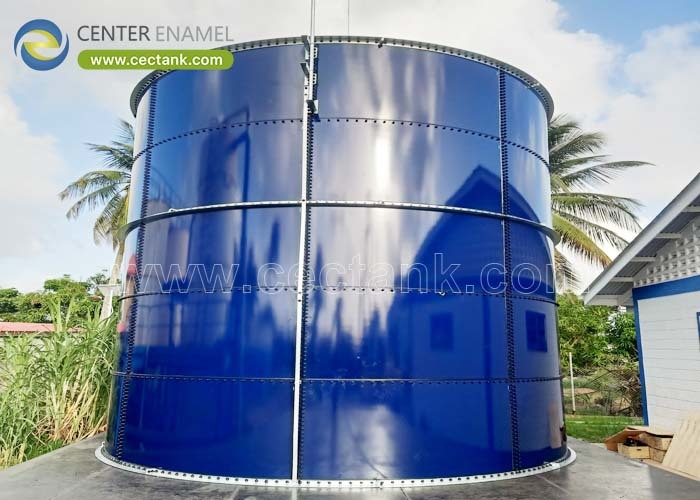
The figure below is a REAL Center Enamel delivery cited here as manufacturing-capability evidence for the tank type discussed, NOT as a claimed thermal-energy-storage, chilled-water, data-center water or fire-water delivery in the named country or Nordic region. Center Enamel's verified project record (case_library.csv) holds no dedicated TES, chilled-water, data-center-water or Finland/Norway/Denmark/Nordic fire-water project for this specific duty, and no in-country delivery at all in Norway, Denmark or Finland. Where a real fire-protection tank exists it is cited as the closest analogue, never as the named geography's application. This reference demonstrates the ability to engineer large coated and bolted water tanks for demanding duty, not a claim about this specific application or location. Where the source did not record a diameter or height, the field reads Not Provided and is never estimated.
|
Project |
Country |
Tank type |
Volume |
Year |
Relevance |
|
Saint Kitts potable-water tank |
Saint Kitts and Nevis |
GFS bolted tank |
1 tank, 2,436 m3 |
2026 |
Real potable-water tank (capability, not a Norway data-center project) |
How To Specify The Tank Before You Order
Issue a duty schedule that names each stored volume, its water quality, its refill and drawdown rates and its isolation point, then require the supplier to demonstrate the lining system, coating thickness, adhesion and spark-test record. Reject a proposal that quotes only a geometric volume with no link to the makeup balance or the fire demand. In Norway add the cold-climate siting and freeze-protection basis, and keep the documentation sufficient for the municipal and any NVE review.
· Issue a per-duty volume and water-quality schedule.
· Require coating thickness, adhesion and spark-test records.
· Tie tank size to the makeup balance and fire demand, not a catalogue figure.
· Keep the documentation permit-ready for the Norwegian authority.
Frequently Asked Questions
What does a data-center water tank in Norway store?
It can hold evaporated-cooling makeup, process or closed-loop top-up water, and an isolated fire reserve - each a separate volume with its own quality and isolation requirements.
Who permits water use at a Norwegian data center?
The municipality under the Planning and Building Act and TEK17, with NVE and the water regulations where abstraction or discharge is involved.
Does a Norway data-center water tank need potable-contact approval?
Where stored water feeds a human-use system, materials are commonly specified to EU 1935/2004 and a scheme such as NSF/ANSI 61 or an approved equivalent.
Can makeup water and fire reserve share one tank?
Only with separately assigned volumes and documented isolation and backflow protection; the control and water-quality requirements differ.
Which tank construction suits Norwegian water duty?
GFS enamel for inert standby water, FBE or galvanized for specified or cost-sensitive duty, and stainless where the fluid is low-mineral.
How is the tank volume set?
From the makeup peak flow and drawdown/refill balance plus the separately calculated fire reserve - not from a generic rule of thumb.
What coating evidence should the supplier provide?
Thickness (0.25-0.45 mm for GFS or 180-280 micrometres for FBE), adhesion above 3,450 N/cm2 for GFS, and 100 percent 1,500 V DC spark testing per panel.
Does the tank need freeze protection in Norway?
Yes - a cold climate drives insulation, freeze margin, siting and appurtenance detail for an outdoor or unheated tank.
What is the ex-works lead time for a bolted water tank?
About 30 days ex-works for a 1,000-10,000 m3 vessel, with on-site bolted erection in weeks.
How long does a water tank last in this duty?
A 30-50 year shell lifecycle is expected; the lining, not the steel, drives the maintenance interval under cyclic water duty.
Should the warranty cover the lining?
Yes - the lining should be warranted separately because water chemistry and drawdown cycles stress the coating more than the shell.
What single tank has Center Enamel built largest?
A verified single shell of 20,000 m3 was delivered in 2016, setting the upper bound for one bolted tank.
Is the cited project a Norwegian data-center delivery?
No - it is a real potable-water tank cited as capability evidence, not a claimed Norway data-center water project.
Does Center Enamel build water tanks for Norway projects?
Yes - GFS, FBE and stainless bolted tanks with the coating documentation and permit-ready records a Norwegian review requires.
Why not treat all stored water as one volume?
Because makeup, process and fire water have different quality and backflow requirements, and merging them makes compliance to the authority and fire service hard to demonstrate.
Conclusion
A data-center water tank in Norway is specified around the municipal and NVE water rules, EU and Norwegian potable-contact requirements and a clean separation of makeup, process and fire volumes. Size it from the real water balance, demand lining evidence and design for the cold.
Suggested CTA: Issue a per-duty water schedule and check NVE and potable-contact requirements before ordering a Norway data-center water tank.