-
Glass Fused To Steel Tanks (896)
-
Stainless Steel Tanks (434)
-
Fusion Bonded Epoxy Tanks (660)
-
Galvanized Steel Tanks (321)
-
Aluminum Dome Roofs (1336)
-
Wastewater Storage Tanks (280)
-
Welded Steel Tanks (457)
-
Pressure Vessels (485)
-
Anaerobic Digester (217)
-
Industrial Water Tanks (384)
-
Glass Lined Steel Tanks (180)
-
Bolted Steel Tanks (389)
-
Sludge Storage Tank (115)
-
Biogas Storage Tank (173)
-
Leachate Storage Tanks (133)
-
Agricultural Water Storage Tanks (179)
-
Fire Water Tank (166)
-
Grain Storage Silos (146)
-
Biogas Projects (424)
-
Wastewater Treatment Projects (1832)
-
Double Membrane Roof (223)

|
Expansion Tank For Data Center Cooling: Pressure Control And ASME Classification
| Place of Origin: | China |
| Brand Name: | CEC TANKS |
| Certification: | ISO 9001:2008, AWWA D103 , OSHA , BSCI |
| Model Number: | J2016012330 |
| Minimum Order Quantity: | 1set |
| Price: | $5000~$20000 one set |
| Packaging Details: | PE poly-foam between each two steel plates ; wooden pallet and wooden box |
| Delivery Time: | 0-60 days after deposit received |
| Payment Terms: | L/C,T/T |
| Supply Ability: | 60 sets per month |
|
Detail Information |
|||
| Place of Origin | China | Brand Name | CEC TANKS |
|---|---|---|---|
| Certification | ISO 9001:2008, AWWA D103 , OSHA , BSCI | Model Number | J2016012330 |
| Material: | Glass Fused To Steel | Acid And Alkalinity Proof :: | Standard Sheet PH:3~11; Special Sheet PH: 1~14 |
| Coating Color: | Ark Green, White, Blue, Color Can Be Customized Upon Your Request | Holiday Test: | > 1500 V |
| Corrosion Resistance: | Excellent. Suitable For Waste Water Treatment, Sewage Treatment, Effluent Treatment.、salt Water、sea Water、high-sulfur Crude Oil、salt Fox、organic And Inorganic Compounds | Service Life: | More Than 30 Years |
| Capacity: | 20 M3 - 18,000 M3 | Coating Thickness: | 0.25mm ~0.40mm ,double Coating |
| Hardness: | 6.0 ( Mohs ). We Use Special Steel To Make The Hardness Twice Then Other Steel. | Highlight: | ASME expansion tank data center,pressure control expansion tank,industrial water expansion tank |
Product Description
An expansion tank for data center cooling is a pressure vessel that absorbs the thermal expansion of the closed chilled-water and heating loops and holds the loop's reference pressure, preventing relief events and low-pressure cavitation. It is a distinct product class from a buffer tank: where a buffer adds thermal and hydraulic inertia, an expansion vessel manages volume change and pressure. Center Enamel already publishes a dedicated page on this exact subject at cectank.com/expansion-tank-data-center-hvac, so this article is written for the batch but should be consolidated with or canonicalized to that existing page rather than published as a competing standalone URL. The engineering below still stands as the specification baseline.
A closed HVAC loop must hold a reference pressure above the static and vapour-pressure minima yet below the relief setpoint, and the expansion tank fixes that datum. As water heats it expands; as it cools it contracts. The tank's pre-charge sets the neutral pressure, it accepts the volume the water gains on warmup, and it returns volume on cooldown so the loop never relieves to drain or collapses into cavitation.
- Reference pressure set by tank pre-charge.
- Expansion acceptance keeps pressure in band.
- Contraction cover prevents air or vapour ingress.
- Wrong sizing trips relief or causes cavitation.
A tank that supports a data-center cooling loop, thermal store or fire reserve sits idle for most of its life, so the internal finish and the shell discipline decide reliability more than the nameplate rating. Glass-Fused-to-Steel panels are fired at 820-930 °C to give a smooth inert skin at 0.25-0.45 mm thickness, adhesion above 3,450 N/cm2 and 100 percent 1,500 V DC spark testing per panel. Fusion-Bonded Epoxy bolted tanks (Resicoat R4-ES interior 180-280 micrometres, Interpon D2015 exterior 150-250 micrometres, adhesion above 16 MPa) and hot-dip galvanized bolted tanks cover specified or cost-sensitive duties. Stainless 304 or 316 is chosen where the fluid is low-mineral or a factory-fabricated pressure vessel is preferred, and ASME BPVC Section VIII governs a vessel that exceeds the local pressure-equipment threshold. A caveat applies: the right lining depends on the fluid chemistry and the code duty, so the engineer should confirm pH, halide load and pressure class rather than assume one construction fits every duty.
- GFS bolted: inert enamel, Ra below 0.8 micrometres, no field recoating.
- FBE bolted: documented epoxy lining for specified duty.
- Hot-dip galvanized: lower cost, zinc shell protection.
- Stainless 304 or 316 for low-mineral or pressure-vessel duty.
Sizing starts from the actual duty calculation - loop volume and temperature swing, thermal charge/discharge profile, cooling-makeup balance or fire hydraulic demand - not a catalogue number. The coating thickness of 0.25-0.45 mm for GFS or 180-280 micrometres for FBE, the tank lifecycle of 30-50 years, the NSF/ANSI 61 or WRAS potable-contact option and the freeze or tropical duty margin then set the shell, roof and appurtenances. Every figure below is confirmed against the applicable standard and the local authority having jurisdiction.
Design parameter |
Typical value or range |
Why it matters |
System water volume |
Pipe + coil + unit inventory |
Primary sizing input |
Temperature range |
Cold-fill to max operating |
Sets volume-change fraction |
Pre-charge pressure |
Equals cold static head |
Tank begins accepting at need |
Max allowable pressure |
Relief setpoint |
Upper band of the tank |
Expansion factor |
Fluid-dependent (water/glycol) |
Drives acceptance volume |
Pressure class |
Above PED/ASME threshold? |
Code or non-code decision |
Adhesion |
above 3,450 N/cm2 |
Lining integrity under pressure |
Spark test |
1,500 V DC per panel |
Holiday verification |
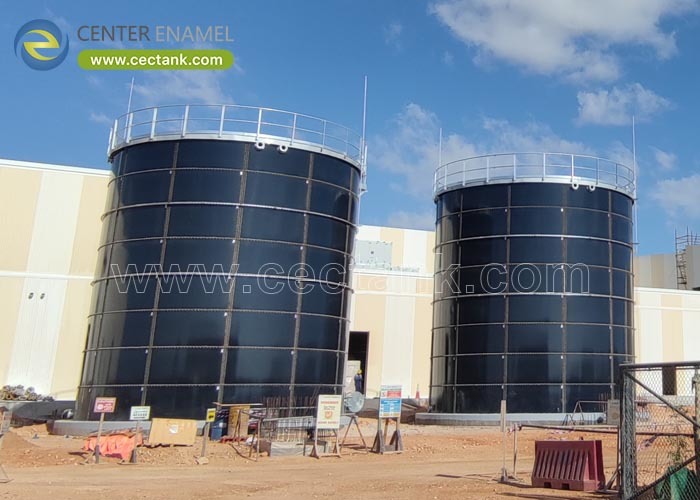
The figure below is a REAL Center Enamel delivery used here as manufacturing-capability evidence for the tank type discussed, NOT as a claimed data-center cooling, thermal-energy-storage, chilled-water, immersion, expansion or Germany/Ireland/Netherlands project. Center Enamel's verified project record (case_library.csv) holds no data-center cooling-loop, TES, chilled-water, immersion, expansion-vessel or DE/IE/NL tank delivery, so this reference demonstrates the ability to engineer large coated, stainless and bolted water tanks for demanding duty, not a claim about this specific application or geography. Where the source did not record a diameter or height, the field reads Not Provided and is never estimated.
Project |
Country |
Tank type |
Volume |
Year |
Relevance |
Liaoning oil-industry water |
China |
Epoxy-coated bolted tank |
1,159 x2 + 433 m3 |
2026 |
Real industrial process tank (capability, not DC expansion) |
Whether the expansion vessel must be built to ASME BPVC Section VIII depends on its operating pressure and volume against the applicable pressure-equipment threshold, decided up front. A pressure vessel and a non-code tank are different products: the code vessel carries documented design, inspection and stamping; the non-code vessel is still engineered for duty but not stamped. Specifying non-code where code is required creates a compliance gap.
- ASME Section VIII where threshold is exceeded.
- Non-code permitted below the trigger.
- Code vessel carries nameplate and stamp.
- Classify before ordering.
A pressure vessel that absorbs the thermal expansion of closed chilled-water and heating loops and holds the loop's reference pressure.
No - an expansion vessel manages volume change and pressure, while a buffer tank adds thermal and hydraulic inertia.
From the system water volume, the temperature range and the permitted pressure band, using the fluid expansion factor.
The pre-charge is set to the loop's cold-fill static head so the tank begins accepting expansion exactly when needed.
When its pressure and volume exceed the local pressure-equipment threshold; smaller units may be non-code where local rules permit.
The loop relieves fluid to drain on warmup or cavitates on cooldown - both are reliability and water-loss events.
Stainless 304 or 316 for factory-fabricated pressure vessels, or an epoxy-lined shell where the fluid and code allow.
Yes - cectank.com/expansion-tank-data-center-hvac covers it; this article should be canonicalized to that page.
The engineering baseline (sizing, code classification, materials) is valid and reusable for the consolidated page.
Thickness, adhesion above 3,450 N/cm2 and 100 percent 1,500 V DC spark testing per panel for coated vessels.
Only with a documented hydraulic design that keeps the pressure bands compatible; separate vessels are common.
About 30 days ex-works for a 1,000-10,000 m3 equivalent scope, with on-site erection in weeks.
A 30-50 year shell lifecycle, with the diaphragm or bladder as the serviceable item.
Yes - the bladder or diaphragm, not only the shell, should be warranted because it degrades under cyclic pressure.
Yes - stainless and epoxy-lined bolted vessels engineered to ASME where required, with the documentation plan review expects.
An expansion tank for data center cooling absorbs loop volume change and fixes the reference pressure; it is a pressure vessel classified to ASME only above the local threshold. This article duplicates the existing company page cectank.com/expansion-tank-data-center-hvac and is flagged for consolidation or canonicalization rather than standalone publication.
Suggested CTA: Consolidate this expansion-tank content with the existing cectank.com page and specify on system volume, temperature range and pressure band.