-
Glass Fused To Steel Tanks (896)
-
Stainless Steel Tanks (434)
-
Fusion Bonded Epoxy Tanks (660)
-
Galvanized Steel Tanks (321)
-
Aluminum Dome Roofs (1336)
-
Wastewater Storage Tanks (280)
-
Welded Steel Tanks (457)
-
Pressure Vessels (485)
-
Anaerobic Digester (217)
-
Industrial Water Tanks (384)
-
Glass Lined Steel Tanks (180)
-
Bolted Steel Tanks (389)
-
Sludge Storage Tank (115)
-
Biogas Storage Tank (173)
-
Leachate Storage Tanks (133)
-
Agricultural Water Storage Tanks (179)
-
Fire Water Tank (166)
-
Grain Storage Silos (146)
-
Biogas Projects (424)
-
Wastewater Treatment Projects (1832)
-
Double Membrane Roof (223)
|
Data Center Process Water Tank: Operations Buffer And Supply Resilience
| Place of Origin: | China |
| Brand Name: | CEC TANKS |
| Certification: | ISO 9001:2008, AWWA D103 , OSHA , BSCI |
| Model Number: | W20170706009 |
| Minimum Order Quantity: | 1set |
| Price: | $5000~$20000 one set |
| Packaging Details: | PE poly-foam between each two steel plates ; wooden pallet and wooden box |
| Delivery Time: | 10-30 days after deposit received |
| Supply Ability: | 60 sets per month |
|
Detail Information |
|||
Product Description
A data center process water tank is the operations buffer that facilities teams rely on to keep cooling resilient when the municipal supply falters, a recovery batch is delayed or demand spikes. It holds the water the facility consumes - cooling-tower makeup and humidification - and decouples the cooling loop from supply variability. Center Enamel supplies Glass-Fused-to-Steel, Fusion-Bonded Epoxy and stainless bolted tanks with the inert finish and sealed roof that data-center process-water duty requires, delivered to 100-plus countries. The right tank is sized from the facility's resilience target - hours or days of cooling water - rather than the minimum to keep the loop running.
Facilities teams size the process water tank against a resilience target: how many hours or days of cooling water the site must hold if the municipal main is interrupted or a reuse delivery is delayed. The tank becomes the buffer that lets the cooling loop ride through supply gaps without shedding load. Because the buffer is potable-adjacent or reuse-fed, the internal finish and the isolation from the IT loop and the fire reserve matter as much as the volume.
- Sized against a resilience target in hours or days.
- Rides through supply interruptions.
- Protects the cooling loop from load shedding.
- Inert finish and isolation matter as much as volume.
Water stored for reuse, process or fire duty spends most of its life idle, so the internal finish decides reliability more than the shell rating. Glass-Fused-to-Steel panels are fired at 820-930 °C to give a smooth inert skin at 0.25-0.45 mm thickness, adhesion above 3,450 N/cm2 and 100 percent 1,500 V DC spark testing per panel. Fusion-Bonded Epoxy bolted tanks (Resicoat R4-ES interior 180-280 micrometres, Interpon D2015 exterior 150-250 micrometres, adhesion above 16 MPa) and hot-dip galvanized bolted tanks cover specified or cost-sensitive duties. Stainless 304 or 316 is chosen where the recovered water is low-mineral and a factory vessel is preferred. A caveat applies: the right lining depends on the recovered-water chemistry, so the engineer should confirm pH and halide load rather than assume one coating fits every reuse stream.
- GFS bolted: inert enamel, Ra below 0.8 micrometres, no field recoating.
- FBE bolted: documented epoxy lining for specified duty.
- Hot-dip galvanized: lower cost, zinc shell protection.
- Stainless 304 or 316 for low-mineral recovered water.
Sizing starts from the actual duty calculation - rainfall capture volume, cooling-makeup balance, greywater generation rate or fire hydraulic demand - not a catalogue number. The coating thickness of 0.25-0.45 mm for GFS or 180-280 micrometres for FBE, the tank lifecycle of 30-50 years, the NSF/ANSI 61 or WRAS potable-contact option and the freeze or tropical duty margin then set the shell, roof and appurtenances. Every figure below is confirmed against the applicable standard and the local authority having jurisdiction.
Design parameter |
Typical value or range |
Why it matters |
Resilience target |
hours or days of cooling water |
Sets buffer volume |
Demand |
cooling makeup and humidification |
Sets base draw rate |
Supply gap |
municipal or delivery delay |
Drives buffer need |
Coating thickness |
0.25-0.45 mm GFS |
Inert process-water surface |
FBE interior |
180-280 micrometres |
Alternative documented lining |
NSF/WRAS |
available for potable-adjacent |
Where contact risk exists |
Isolation |
from IT loop and fire reserve |
Prevents cross-contamination |
Tank lifecycle |
30-50 years |
Total-cost-of-ownership basis |
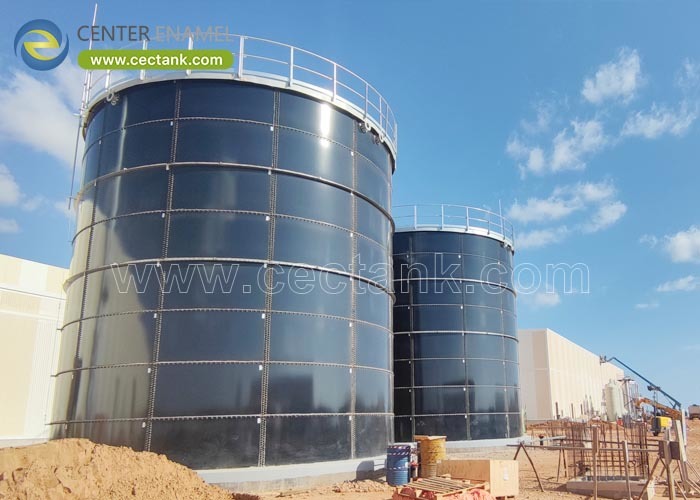
The figure below is a REAL Center Enamel delivery used here as manufacturing-capability evidence for the tank type discussed, NOT as a claimed data-center, rainwater, greywater, reclaimed, condensate or ice-storage project. Center Enamel's verified project record (case_library.csv) holds no data-center water-reuse, greywater, reclaimed-water, condensate-recovery or ice-storage delivery, so this reference demonstrates the ability to engineer large coated and stainless water tanks for demanding duty, not a claim about this specific application. Where the source did not record a diameter or height, the field reads Not Provided and is never estimated.
Project |
Country |
Tank type |
Volume |
Year |
Relevance |
Indonesia water tank |
Indonesia |
GFS bolted |
3,348 m3 |
2023 |
Large coated water tank; capability, not DC process water |
Define the resilience target first - the hours or days of cooling water to hold - then size the tank from that and the makeup demand, and select a lining and sealed roof that protect the stored water. Keep the buffer isolated from the IT loop and the code-referenced fire reserve, and document the coating so the authority having jurisdiction can verify the water is fit for the process.
- Define resilience target in hours or days.
- Size from target and makeup demand.
- Select lining and sealed roof for quality.
- Isolate from IT loop and fire reserve.
The operations buffer that holds the facility's cooling and humidification water so the cooling loop can ride through supply gaps without shedding load.
The reuse tank is a recovered source buffer, while the process tank is the operational buffer against supply variability; both may feed the same makeup loop but are sized and isolated separately.
The hours or days of cooling water the site must hold if the municipal main is interrupted or a reuse delivery is delayed.
GFS enamel gives an inert skin; FBE and stainless are alternatives where the stored water chemistry directs.
Yes - the fire reserve is a separate code-referenced volume and must stay isolated from the process-water loop.
Where the water is potable-adjacent, NSF/ANSI 61 or WRAS approval is selected on the lining.
From the resilience target and the makeup demand, so the site holds the required hours or days of cooling water.
Yes - GFS, FBE and stainless bolted tanks with the inert finish and sealed roof that process-water duty requires, delivered to 100-plus countries.
AWWA D103-09 and ISO 28765 for the bolted structure, with NSF/ANSI 61 or WRAS available where the lining contacts potable-adjacent water.
About 30 days ex-works for a 1,000-10,000 m3 tank, with on-site bolted erection in weeks versus months for concrete.
A verified single shell of 20,000 m3 was delivered in 2016, establishing the upper bound for one bolted tank.
Process-water quality is unforgiving; documented 0.25-0.45 mm enamel or 180-280 micrometre FBE predicts it will not contaminate the stream.
Yes - the lining, not only the steel, should be warranted, because process-water duty stresses the coating over a 30-50 year life.
Periodic internal inspection of the lining and verification of appurtenances support a 30-50 year service life.
No - the fire reserve is a separate code-referenced volume and must stay isolated from the process-water loop.
A data-center process water tank is the operations buffer that lets the cooling loop ride through supply gaps, sized against a resilience target in hours or days rather than the minimum to keep running. The target-based volume, inert finish and isolation from the IT loop and fire reserve decide resilience more than the headline size, and those figures must come from the facility's cooling-water requirement rather than a generic estimate.
Suggested CTA: Specify a data-center process tank from a resilience target, isolate it from the IT loop and fire reserve, and select a protective lining for the stored water.