-
Glass Fused To Steel Tanks (896)
-
Stainless Steel Tanks (434)
-
Fusion Bonded Epoxy Tanks (660)
-
Galvanized Steel Tanks (321)
-
Aluminum Dome Roofs (1336)
-
Wastewater Storage Tanks (280)
-
Welded Steel Tanks (457)
-
Pressure Vessels (485)
-
Anaerobic Digester (217)
-
Industrial Water Tanks (384)
-
Glass Lined Steel Tanks (180)
-
Bolted Steel Tanks (389)
-
Sludge Storage Tank (115)
-
Biogas Storage Tank (173)
-
Leachate Storage Tanks (133)
-
Agricultural Water Storage Tanks (179)
-
Fire Water Tank (166)
-
Grain Storage Silos (146)
-
Biogas Projects (424)
-
Wastewater Treatment Projects (1832)
-
Double Membrane Roof (223)

|
Buffer Tank For Data Center HVAC: Hydraulic Decoupling And Chiller Protection
| Place of Origin: | CHINA |
| Brand Name: | CEC TANKS |
| Certification: | ISO 9001:2008, AWWA D103 , OSHA , BSCI |
| Model Number: | W20180508003 |
| Minimum Order Quantity: | 1 SET |
| Price: | $5000~$20000 one set |
| Packaging Details: | PE poly-foam between each two steel plates;wooden pallets and wooden box |
| Delivery Time: | 10-30 days after deposit received |
| Payment Terms: | L/C,T/T |
| Supply Ability: | 60 sets per month |
|
Detail Information |
|||
| Place of Origin | CHINA | Brand Name | CEC TANKS |
|---|---|---|---|
| Certification | ISO 9001:2008, AWWA D103 , OSHA , BSCI | Model Number | W20180508003 |
| Coating Color: | Dark Green, Or Customizing Colors | Coating Thickness: | 0.25~0.40mm, Double Coating |
| Acid And Alkalinity Proof: | Standard Coating Suits For PH3 - PH11, Special Coating Suits For PH1 - PH14 | Adhesion: | 3,450N/cm |
| Hardness: | 6.0 Mohs | Holiday Test: | >1500V |
| Installation: | By Jacking Machine Or Steel Pole, Fast In Installation | Permeability: | Gas / Liquid Impermeable |
| Foundation: | Concrete Or Glass Fused Steel | Steel Grade: | ART 310 |
| Applications: | Water , Waste Water, Digester , Reactor , Grain , Sludge , Chemicals | Highlight: | data center buffer tank,HVAC hydraulic decoupling tank,chiller protection buffer tank |
Product Description
A buffer tank for data center HVAC is a stratified or mixed-volume vessel placed between the chilled-water plant and the distribution system so the chillers see a stable load while the server halls draw water at a varying rate. Without it, short cycling, compressor Hunting and control instability appear the moment rack density or ambient conditions swing. Center Enamel supplies Glass-Fused-to-Steel, Fusion-Bonded Epoxy and stainless bolted tanks engineered for chilled-water duty, with more than 30,000 installed tank projects across 100-plus countries and ex-works lead times near 30 days for a 1,000-10,000 m3 vessel. The right buffer is sized from the chiller minimum-run time and the loop volume, not from a generic rule, and built so the thermal and hydraulic interface stays clean for decades.
Why A Data Center HVAC Loop Needs A BufferA central chiller wants to run in long, steady blocks; a data-center load wants to vary by hour, by hall and by weather. The buffer tank absorbs that mismatch. It gives the chillers a thermal flywheel so they do not start and stop on every load step, it lets a failed chiller hand off without freezing the loop, and it smooths the primary-secondary interface where the plant meets the distribution. In a hyperscale or colocation site the buffer is the component that turns a fragile instantaneous balance into a forgiving one.
- Decouples chiller run-time from variable IT load.
- Prevents short cycling and compressor hunting.
- Stabilizes primary-secondary pump interface.
- Buys time during chiller failover.
A tank that supports a data-center cooling loop, thermal store or fire reserve sits idle for most of its life, so the internal finish and the shell discipline decide reliability more than the nameplate rating. Glass-Fused-to-Steel panels are fired at 820-930 °C to give a smooth inert skin at 0.25-0.45 mm thickness, adhesion above 3,450 N/cm2 and 100 percent 1,500 V DC spark testing per panel. Fusion-Bonded Epoxy bolted tanks (Resicoat R4-ES interior 180-280 micrometres, Interpon D2015 exterior 150-250 micrometres, adhesion above 16 MPa) and hot-dip galvanized bolted tanks cover specified or cost-sensitive duties. Stainless 304 or 316 is chosen where the fluid is low-mineral or a factory-fabricated pressure vessel is preferred, and ASME BPVC Section VIII governs a vessel that exceeds the local pressure-equipment threshold. A caveat applies: the right lining depends on the fluid chemistry and the code duty, so the engineer should confirm pH, halide load and pressure class rather than assume one construction fits every duty.
- GFS bolted: inert enamel, Ra below 0.8 micrometres, no field recoating.
- FBE bolted: documented epoxy lining for specified duty.
- Hot-dip galvanized: lower cost, zinc shell protection.
- Stainless 304 or 316 for low-mineral or pressure-vessel duty.
Sizing starts from the actual duty calculation - loop volume and temperature swing, thermal charge/discharge profile, cooling-makeup balance or fire hydraulic demand - not a catalogue number. The coating thickness of 0.25-0.45 mm for GFS or 180-280 micrometres for FBE, the tank lifecycle of 30-50 years, the NSF/ANSI 61 or WRAS potable-contact option and the freeze or tropical duty margin then set the shell, roof and appurtenances. Every figure below is confirmed against the applicable standard and the local authority having jurisdiction.
Design parameter |
Typical value or range |
Why it matters |
Chiller min run-time |
5-15 minutes |
Sets minimum buffer volume |
Primary loop volume |
System pipe + coil inventory |
Drives thermal flywheel size |
Temperature glide |
4-8 K chilled water |
Stratification band for the tank |
Flow stability |
+/- 10 percent of design |
Avoids pump cavitation |
Coating thickness |
0.25-0.45 mm enamel |
Idle-surface integrity |
Adhesion |
above 3,450 N/cm2 |
Prevents lining failure on drawdown |
Spark test |
1,500 V DC per panel |
100 percent holiday verification |
Tank lifecycle |
30-50 years |
Standby-plus-cyclic duty |
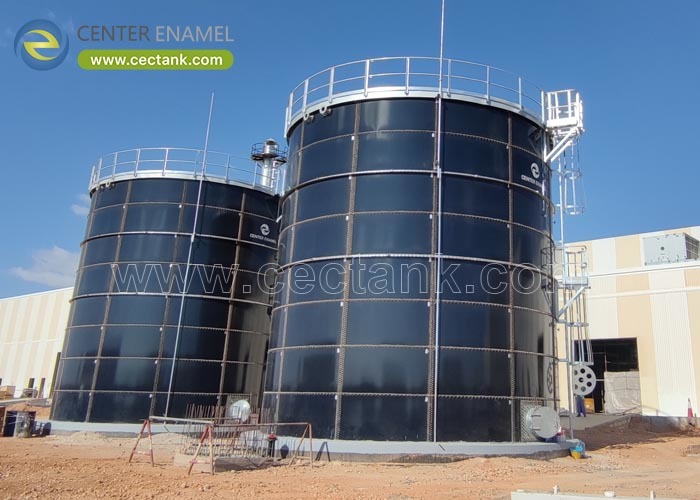
The figure below is a REAL Center Enamel delivery used here as manufacturing-capability evidence for the tank type discussed, NOT as a claimed data-center cooling, thermal-energy-storage, chilled-water, immersion, expansion or Germany/Ireland/Netherlands project. Center Enamel's verified project record (case_library.csv) holds no data-center cooling-loop, TES, chilled-water, immersion, expansion-vessel or DE/IE/NL tank delivery, so this reference demonstrates the ability to engineer large coated, stainless and bolted water tanks for demanding duty, not a claim about this specific application or geography. Where the source did not record a diameter or height, the field reads Not Provided and is never estimated.
Project |
Country |
Tank type |
Volume |
Year |
Relevance |
Hebei pharmaceutical water |
China |
Epoxy-coated bolted tank |
25,860 + 6,492 m3 |
2024 |
Real large process-water tank (capability, not DC cooling) |
Require the buffer volume tied to the chiller minimum run-time and the measured loop inventory, the stratification or mixed design, and the coating documentation (thickness, adhesion, spark test). Reject any proposal that quotes only a geometric volume with no link to the plant control sequence, because the useful buffer is the volume that actually decouples the machines. Confirm the tank integrates with makeup and expansion only through isolated, documented connections.
- Require buffer volume from chiller run-time and loop inventory.
- Confirm stratified versus mixed design and sensor layout.
- Demand coating thickness, adhesion and spark-test records.
- Isolate buffer from makeup and expansion draws.
It decouples the chillers from the variable server-hall load by providing a thermal flywheel, so the machines run in steady blocks while the distribution draws water at a changing rate.
Is a buffer tank the same as an expansion tank?No - a buffer adds thermal and hydraulic inertia to stabilize temperature and flow, while an expansion vessel accepts volume change and sets the pressure datum; confusing them is a common specification error.
How is a data center HVAC buffer tank sized?From the chiller minimum run-time (typically 5-15 minutes) and the primary loop inventory, not from a catalogue number; the useful volume is what actually decouples the plant.
Should the buffer be stratified or mixed?Stratified buffers preserve a temperature glide for better chiller efficiency; mixed buffers are simpler and suit smaller loops - the choice follows the control sequence and the glide.
What material suits a chilled-water buffer tank?GFS enamel for inert idle standby, FBE or galvanized for specified or cost-sensitive duty, and stainless where the fluid is low-mineral.
Does a buffer tank need ASME certification?Only if it exceeds the local pressure-equipment threshold and becomes a pressure vessel; most atmospheric chilled-water buffers fall outside ASME but the loop and pump side should be assessed.
How does the buffer help during chiller failover?It holds temperature and flow long enough for a standby chiller to start and load, preventing a freeze or a control upset in the distribution loop.
What coating evidence should the supplier provide?Thickness (0.25-0.45 mm for GFS or 180-280 micrometres for FBE), adhesion above 3,450 N/cm2, and 100 percent 1,500 V DC spark testing per panel.
Can the buffer share water with cooling makeup?Only through isolated, backflow-protected connections that keep the buffer volume verifiable and the potable or makeup side separated.
What is the ex-works lead time for a bolted buffer tank?About 30 days ex-works for a 1,000-10,000 m3 vessel, with on-site bolted erection in weeks rather than months.
How long does a chilled-water buffer tank last?A 30-50 year lifecycle is expected for the shell; the lining, not the steel, drives the maintenance interval under cyclic duty.
Should the warranty cover the lining?Yes - the lining should be warranted separately because cyclic chilled-water duty stresses the coating more than the shell over the life.
What single tank has Center Enamel built largest?A verified single shell of 20,000 m3 was delivered in 2016, setting the upper bound for one bolted tank.
Does Center Enamel build data-center HVAC buffer tanks?Yes - GFS, FBE and stainless bolted tanks engineered for chilled-water duty with the coating documentation and execution discipline data-center plan review requires.
Why not just oversize the chiller instead of adding a buffer?Oversizing wastes capital and still leaves the loop exposed to instantaneous load steps; a buffer is the cheaper, more stable fix for variability.
ConclusionA data center HVAC buffer tank decouples chillers from a variable load, protects compressors and stabilizes the primary-secondary interface, and its useful volume comes from the chiller minimum run-time and the loop inventory rather than a generic size. The coating evidence, stratified design and isolated integration decide whether the buffer earns its place in the plant.
Suggested CTA: Specify a data-center HVAC buffer tank on chiller run-time, loop inventory and documented coating evidence before purchase.