-
Glass Fused To Steel Tanks (896)
-
Stainless Steel Tanks (434)
-
Fusion Bonded Epoxy Tanks (660)
-
Galvanized Steel Tanks (321)
-
Aluminum Dome Roofs (1336)
-
Wastewater Storage Tanks (280)
-
Welded Steel Tanks (457)
-
Pressure Vessels (451)
-
Anaerobic Digester (202)
-
Industrial Water Tanks (364)
-
Glass Lined Steel Tanks (180)
-
Bolted Steel Tanks (389)
-
Sludge Storage Tank (115)
-
Biogas Storage Tank (173)
-
Leachate Storage Tanks (133)
-
Agricultural Water Storage Tanks (179)
-
Fire Water Tank (166)
-
Grain Storage Silos (146)
-
Biogas Projects (424)
-
Wastewater Treatment Projects (1752)
-
Double Membrane Roof (223)

|
What Is a TES Tank: Definition Components and How It Stores Cooling
| Place of Origin: | China |
| Brand Name: | CEC TANKS |
| Certification: | ISO 9001:2008, AWWA D103 , OSHA , BSCI |
| Model Number: | W |
| Minimum Order Quantity: | 1set |
| Price: | $5000~$20000 one set |
| Packaging Details: | PE poly-foam between each two steel plates ; wooden pallet and wooden |
| Delivery Time: | 10-30 days after deposit received |
| Payment Terms: | L/C,T/T |
| Supply Ability: | 60 sets per month |
|
Detail Information |
|||
| Place of Origin | China | Brand Name | CEC TANKS |
|---|---|---|---|
| Certification | ISO 9001:2008, AWWA D103 , OSHA , BSCI | Model Number | W |
| Tank Material: | Glass Fused To Steel | Foundation: | Concrete Or Glass Fused Steel |
| Steel Plates Thickness: | 3mm To 12mm , Depends On The Tank Structure | Size Of Panel: | 2.4M * 1.2M |
| Easy To Clean: | Smooth, Glossy, Inert, Anti-adhesion | Permeability: | Gas / Liquid Impermeable |
| Highlight: | TES tank cooling storage,industrial water tank components,thermal energy storage tank |
||
Product Description
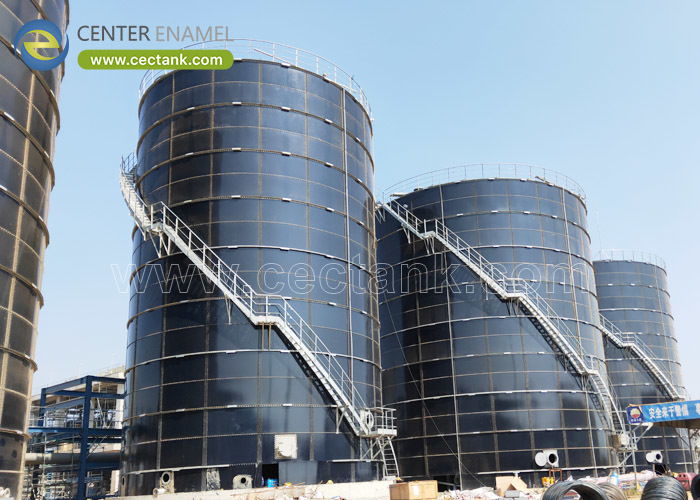
A TES tank is an engineered thermal battery: a large stratified water volume (or an ice/phase-change store) plus diffusers, insulation and controls that let a chilled-water plant charge off-peak and discharge on demand. The shell is typically a bolted Glass-Fused-to-Steel, FBE-coated, stainless or welded vessel built to AWWA D103 or ASME VIII. Center Enamel has no published TES delivery; its 44,900 m3 Namibia GFS build (2022) shows the large-vessel capability that a TES shell draws on, but that was a drinking-water project.
A thermal energy storage tank is an engineered thermal battery that banks cooling or heat as a temperature difference in a large insulated water volume, or as a phase-change medium, so a plant can make cooling when it is cheap or available and use it hours later. The defining parts are the shell, the low-velocity diffuser that protects stratification, the insulation and vapour barrier, and the controls that tie charge and discharge to the chiller and load. Sensible water storage dominates data-center and district-cooling duty because it is cheap per kWh; latent ice storage is denser per volume but costlier. The shell is a bolted Glass-Fused-to-Steel, epoxy-coated, stainless or welded vessel built to AWWA D103 or ASME Section VIII. Center Enamel supplies the bolted GFS, FBE, stainless and ASME vessel families a TES shell draws on, but has no published TES delivery; its large-water builds are cited as manufacturing-capability evidence only.
A thermal energy storage tank is a vessel that stores thermal energy - usually as sensible heat in thousands of cubic metres of chilled water, or as latent heat in a phase-change medium - so cooling produced at one time can be used hours later. It is not a battery in the electrical sense; it is a thermal one. In a data-center or district-cooling loop the tank decouples when cooling is made from when it is needed.
- Sensible storage: a temperature difference across a large water mass.
- Latent storage: ice or phase-change material at near-constant temperature.
- Stratified tank: cold dense water below, warm water above, split by a thermocline.
- Atmospheric or pressurized: duty decides the shell class.
A useful definition lists the parts that make a TES tank work: the shell, the diffuser manifold, the insulation and vapour barrier, the nozzles and manways, and the control interface to the building management system. The diffuser is the component that most decides whether the tank actually stores usable cold or quietly mixes it away.
- Shell: bolted GFS/FBE/stainless or welded steel, 20-60,000 m3 class.
- Diffuser: low-velocity manifold that protects the thermocline.
- Insulation: PU or mineral wool with a vapour barrier for chilled duty.
- BMS interface: charge/discharge logic tied to chiller and load.
The two storage forms answer the same job differently. Sensible storage holds cooling as a temperature spread in cheap water and is the dominant data-center form. Latent storage holds it as ice and is denser per volume but costs more and lifts the chiller. Specifiers pick by footprint, budget and the temperature the loop needs.
- Sensible: low cost per kWh stored, modest efficiency loss.
- Latent (ice): higher density, higher lift and capital cost.
- Hybrid: rare, used where footprint is the binding constraint.
A TES tank is piped in parallel with, or ahead of, the cooling plant. During charging the plant over-produces and fills the tank; during discharge the tank supplies the load while the plant ramps down or shuts off. The valve and sensor layout is what makes the bank useful rather than decorative.
- Parallel connection to the chilled-water loop.
- Charge at off-peak tariff or favourable ambient.
- Discharge on peak, on a chiller trip, or on generator transfer.
- Controls decide priority: stored cooling before active chillers.
Honest boundary: Center Enamel has no published thermal-energy-storage or data-center TES delivery in its verified project record. The references above (Namibia 44,900 m3 GFS drinking water, 2022; Cilincing 21,088 m3; Sardinia 30,549 m3) are cited strictly as large-diameter bolted-vessel manufacturing-capability evidence, not as TES or data-center projects. No TES project result, dimension or client is claimed.
| Parameter | Value | Note |
| Company | Shijiazhuang Zhengzhong Technology (Center Enamel) | GFS tank manufacturer since 2008 |
| Manufacturing system | Bolted GFS / FBE / stainless / galvanized + ASME Sec VIII vessels | Same plant builds all families |
| Capability reference | Namibia drinking-water 44,900 m3 (2022); diameter/height Not Provided | GFS bolted; cited as large-vessel capability, NOT a TES project |
| Other verified large builds | Cilincing Indonesia 21,088 m3 (2024); Sardinia 30,549 m3 (2025) | Water / process duty; not TES |
| Standards | AWWA D103, ISO 28765, EN 1090, ASME VIII, NSF/ANSI 61, WRAS | Where potable or indirect-potable contact applies |
| Scale | >30,000 installed projects; 100+ countries; up to 60,000 m3 single tank | Public company facts |
A definition is incomplete without the build rules. Atmospheric bolted tanks are built to AWWA D103 and ISO 28765 with GFS or FBE liners; pressurized shells follow ASME Section VIII. Coatings for potable or indirect-potable contact are certified to NSF/ANSI 61 and WRAS where the application requires. These are the standards a specifier should see on any TES vessel quotation.
- AWWA D103-19: bolted tank standard.
- ISO 28765: design of GFS tanks.
- ASME Section VIII: pressurized vessel class.
- NSF/ANSI 61 and WRAS: contact-water approvals.
TES stands for Thermal Energy Storage. In a TES tank it means storing cooling (or heat) as a temperature difference in water or a phase-change medium, so a plant can shift when energy is used.
Not an electrical battery. It is a thermal battery: it banks cold water at a lower temperature and releases it later. The stored energy is simply a temperature difference, which is cheap to hold in a large insulated volume.
A shell (bolted or welded), a diffuser manifold that protects stratification, insulation with a vapour barrier, nozzles and manways, and a control interface to the building management system.
Sensible storage holds cooling as a temperature spread in water; latent storage holds it as ice or phase-change material at near-constant temperature. Latent is denser per volume but more expensive and lifts the chiller.
Bolted Glass-Fused-to-Steel, fusion-bonded epoxy-coated steel, stainless steel, or welded carbon steel. The choice follows duty, water chemistry, pressure class and lifecycle cost.
Atmospheric bolted tanks follow AWWA D103 and ISO 28765; pressurized shells follow ASME Section VIII. Contact-water liners are certified to NSF/ANSI 61 and WRAS where required.
Honest boundary: Center Enamel has no published thermal-energy-storage or data-center TES delivery in its verified project record. The references above (Namibia 44,900 m3 GFS drinking water, 2022; Cilincing 21,088 m3; Sardinia 30,549 m3) are cited strictly as large-diameter bolted-vessel manufacturing-capability evidence, not as TES or data-center projects. No TES project result, dimension or client is claimed.
Bolted GFS/fabricated vessels for water and thermal duty are documented from small volumes up to about 60,000 m3 per single tank, with diameter and height governed by transport and site erection.
The diffuser sets the inlet velocity and protects the thermocline. A poorly matched diffuser degrades stratification and can shrink usable storage volume by 20 to 40 percent, so it decides realized efficiency more than tank size.
A TES tank is an engineered thermal bank - a large stratified water volume or phase-change store with diffusers, insulation and controls that let a cooling plant charge off-peak and discharge on demand. The shell is a bolted or welded vessel built to AWWA D103 or ASME VIII, and the diffuser is the component that decides whether the stored cooling is actually usable. Center Enamel supplies the bolted GFS, FBE, stainless and ASME vessel families that a TES shell draws on, but has no published TES delivery; its large-water builds are cited here as manufacturing-capability evidence only.