-
Glass Fused To Steel Tanks (896)
-
Stainless Steel Tanks (434)
-
Fusion Bonded Epoxy Tanks (660)
-
Galvanized Steel Tanks (321)
-
Aluminum Dome Roofs (1336)
-
Wastewater Storage Tanks (280)
-
Welded Steel Tanks (457)
-
Pressure Vessels (451)
-
Anaerobic Digester (202)
-
Industrial Water Tanks (364)
-
Glass Lined Steel Tanks (180)
-
Bolted Steel Tanks (389)
-
Sludge Storage Tank (115)
-
Biogas Storage Tank (173)
-
Leachate Storage Tanks (133)
-
Agricultural Water Storage Tanks (179)
-
Fire Water Tank (166)
-
Grain Storage Silos (146)
-
Biogas Projects (424)
-
Wastewater Treatment Projects (1752)
-
Double Membrane Roof (223)

|
How to Size a TES Tank: From Peak Deficit to Storage Volume
| Place of Origin: | China |
| Brand Name: | CEC TANKS |
| Certification: | ISO 9001:2008, NSF - 61 , AWWA D103 , OSHA , BSCI |
| Model Number: | W20160831001 |
| Minimum Order Quantity: | 1set |
| Price: | $5000~$20000 one set |
| Packaging Details: | PE poly-foam between each two steel plates ; wooden pallet and wooden box |
| Delivery Time: | 30 days after deposit received |
| Supply Ability: | 60 sets per month |
|
Detail Information |
|||
Product Description
To size a TES tank, take the peak cooling deficit (the load the tank must cover) and multiply by the reserve hours to get stored cooling in ton-hours, then divide by the temperature difference and density to get water volume. A 1,000-ton load with 4 hours of reserve at a 5.6 deg C delta T needs roughly 11,700 m3. Center Enamel has no published TES delivery; its large-bolted-vessel builds show shell capability, cited as evidence only. Works with the companion capacity-calculation article.
Sizing a TES tank starts from the peak cooling deficit and the hours of storage required, then converts that thermal energy into a volume. Compute the load that must be shifted, multiply by the desired hours of autonomy or peak-shaving, divide by the usable temperature swing and the water energy density of about 1.16 kWh per m3 per deg C, and add freeboard and a thermocline allowance. The result is the tank volume; diameter and height follow site and transport limits, with bolted panels suiting large diameters. A worked example ties the numbers to a real plant and shows how swing and hours trade against footprint. Center Enamel has no published TES delivery; its large-bolted-vessel builds show shell manufacturing capability cited as evidence only.
Step 1 - Define the Cooling DeficitThe deficit is the peak load the tank must serve during ride-through or load shift, in refrigeration tons (or kW of cooling). Use the instantaneous peak the chillers would otherwise have to meet, not the daily average. This single number sets everything else.
- Peak load the tank must cover, in tons or kW.
- Use instantaneous peak, not daily average.
- Split ride-through from load-shift volume if both apply.
- Confirm against the chiller restart time.
Reserve hours are the ride-through time (often 15 to 30 minutes for a trip) plus any load-shift hours (commonly 4 to 6 hours for peak shaving). Keep the two distinct so the tank is not sized to the whole day, which is the classic oversizing error.
- Ride-through: 15-30 minutes typical.
- Load shift: 4-6 hours typical.
- Keep the two volumes distinct.
- Do not size to full daily load.
Multiply the deficit by the reserve hours to get stored cooling in ton-hours (1 ton = 3.517 kW). This is the energy the tank must bank. It is a clean intermediate because it is independent of the tank fluid.
- Stored cooling = deficit x hours (ton-hours).
- 1 refrigeration ton = 3.517 kW.
- Independent of the tank fluid.
- Basis for the volume conversion.
Divide stored cooling by the temperature difference and the water density to get volume. Sensible storage holds roughly 1.16 kWh per cubic metre per deg C, so volume = stored kWh / (1.16 x delta T). A 1,000-ton (3,517 kW) load, 4 hours, 5.6 deg C delta T gives about 11,700 m3. (Full unit-tracked arithmetic is in the companion article.)
- Water sensible heat ~1.16 kWh/m3/deg C.
- Volume = stored kWh / (1.16 x delta T).
- Example: ~11,700 m3 for 1,000 ton x 4 h x 5.6 deg C.
- Companion article carries the full worked calc.
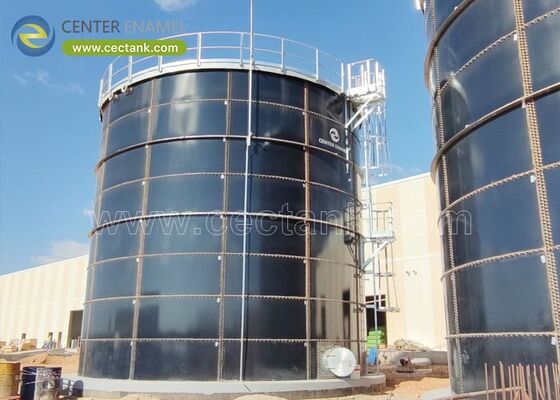
A bolted GFS or FBE shell can be a single large tank or several cells; aspect ratio is optimized for stratification and footprint. Confirm diameter and height against transport and site, and add freeboard and usable-volume factor (thermocline thickness) so the nominal volume matches the usable volume.
- Single tank or multiple cells.
- Aspect ratio optimized for stratification.
- Confirm diameter/height vs transport and site.
- Apply usable-volume factor for thermocline.
Honest boundary: Center Enamel has no published thermal-energy-storage or data-center TES delivery in its verified project record. The references above (Namibia 44,900 m3 GFS drinking water, 2022; Cilincing 21,088 m3; Sardinia 30,549 m3) are cited strictly as large-diameter bolted-vessel manufacturing-capability evidence, not as TES or data-center projects. No TES project result, dimension or client is claimed.
| Parameter | Value | Note |
|---|---|---|
| Company | Shijiazhuang Zhengzhong Technology (Center Enamel) | GFS tank manufacturer since 2008 |
| Manufacturing system | Bolted GFS / FBE / stainless / galvanized + ASME Sec VIII vessels | Same plant builds all families |
| Capability reference | Namibia drinking-water 44,900 m3 (2022); diameter/height Not Provided | GFS bolted; cited as large-vessel capability, NOT a TES project |
| Other verified large builds | Cilincing Indonesia 21,088 m3 (2024); Sardinia 30,549 m3 (2025) | Water / process duty; not TES |
| Standards | AWWA D103, ISO 28765, EN 1090, ASME VIII, NSF/ANSI 61, WRAS | Where potable or indirect-potable contact applies |
| Scale | >30,000 installed projects; 100+ countries; up to 60,000 m3 single tank | Public company facts |
Define the peak cooling deficit - the instantaneous load the tank must cover - in tons or kW of cooling, separate from the daily average.
How many hours of storage do I need?Ride-through is typically 15 to 30 minutes for a chiller trip, plus 4 to 6 hours of load shift for peak shaving; keep the two volumes distinct.
How do I convert stored cooling to volume?Divide stored cooling (kWh) by the temperature difference and water density; water sensible heat is about 1.16 kWh per cubic metre per deg C.
Can you give a sizing example?A 1,000-ton (3,517 kW) load, 4 hours of reserve, 5.6 deg C delta T needs roughly 11,700 m3 of water storage. The companion article shows the full arithmetic.
Should I size to the daily load?No. Size to the peak deficit and reserve hours; sizing to total daily load oversizes the tank and adds cost and footprint without proportional benefit.
Does Center Enamel size TES tanks?Honest boundary: Center Enamel has no published thermal-energy-storage or data-center TES delivery in its verified project record. The references above (Namibia 44,900 m3 GFS drinking water, 2022; Cilincing 21,088 m3; Sardinia 30,549 m3) are cited strictly as large-diameter bolted-vessel manufacturing-capability evidence, not as TES or data-center projects. No TES project result, dimension or client is claimed.
What shell does the volume become?A bolted GFS/FBE/stainless tank or an ASME vessel, as one large cell or several, with aspect ratio set for stratification and footprint.
What usable-volume factor should I apply?Account for the thermocline thickness so the nominal volume matches the usable cold volume; ask the vendor for the guaranteed usable fraction.
What standard governs the sized tank?Atmospheric bolted tanks follow AWWA D103 and ISO 28765; pressurized shells follow ASME Section VIII, with NSF/ANSI 61 and WRAS where contact applies.
Sizing a TES tank means converting the peak cooling deficit and reserve hours into stored cooling, then into a water volume via the temperature difference - roughly 1.16 kWh per cubic metre per deg C. A 1,000-ton load with 4 hours of reserve at 5.6 deg C needs about 11,700 m3. Center Enamel supplies the bolted GFS, FBE, stainless and ASME vessel families behind the shell and has no published TES delivery; its large-water builds are cited as capability evidence only. The companion 'How to Calculate TES Tank Capacity' carries the full worked arithmetic.
Suggested CTA: Share your cooling deficit, reserve hours and delta T with Center Enamel to get a sized shell and capability datasheet.